Childcare Medical Certificates: A Practical Guide
Need tips on getting a medical certificate for childcare? Learn centre requirements, absence vs clearance rules, and how telehealth doctor reviews work today.

A medical certificate for an absence isn’t always the same as clearance to return to childcare. When your child is unwell, getting a medical certificate for childcare can feel like one more task, especially if the centre’s requirements aren’t clear.
First, ask the service what it needs the document to cover. It may want evidence of an illness-related absence, or information relevant to your child returning after being unwell. These are different requests, so clarify the purpose, dates and any specific details the centre needs before arranging a clinical assessment.
This guide explains what to ask your childcare service, what a doctor considers when assessing a certificate request, and what information to prepare. Aussie Scripts connects patients with Australian-registered doctors for medical certificate assessments by telehealth, seven days a week. Telehealth may be suitable for some requests, but a certificate isn’t guaranteed. The doctor assesses the information provided and decides whether a certificate is clinically appropriate. An in-person examination may be needed in some circumstances, and the centre decides whether the document meets its requirements.
Key Takeaways
- Find out whether the centre needs documentation of an absence or information relevant to returning to care. These serve different purposes.
- For getting a medical certificate for childcare, prepare the requested dates, purpose and relevant details about your child’s illness for the clinical review.
- A doctor decides whether a certificate is clinically appropriate after assessing the information provided. Making a request doesn’t guarantee one will be issued.
- Choose an assessment pathway based on your child’s circumstances. Telehealth can support an assessment when appropriate, but some situations require an in-person examination.
- If a certificate is issued, check its details and provide it as the centre requests. If not, follow the clinician’s advice and clarify the documentation requirement with the centre.
Getting a medical certificate for childcare: when might families need one?
Has your childcare centre requested a certificate, or are you seeking medical advice about your child’s symptoms? Separate these two needs first. A centre may ask for documentation of an illness-related absence, or for information before your child returns after being unwell. The request depends on the service’s policy and the circumstances, so there isn’t one requirement for every family.
A certificate records a clinician’s assessment. It doesn’t automatically clear a child to return to care or replace the service’s health and attendance procedures. Before getting a medical certificate for childcare, establish what the centre needs the document to address.
What might a childcare service ask a medical certificate to confirm?
The requested information may relate to the dates of an absence, a medical assessment, or a question about returning after illness. A Medical certificate records information assessed by a clinician, but its purpose and relevance depend on the situation. Ask the centre to specify the dates, purpose and information it requires. You can then explain the request clearly to the doctor.
A certificate doesn’t replace the centre’s procedures for managing illness, attendance or return to care. The service applies its own policy and considers the circumstances separately from what a clinician can assess.
Is a medical certificate always needed after a child’s illness?
Don’t assume the same rule applies to every childcare service or illness. Check your service’s current requirements, especially if it has asked for documentation or your child’s symptoms are affecting attendance. For general Australian guidance on infectious diseases in early childhood education and care, the NHMRC’s Staying Healthy resource is a relevant reference. Specific requirements may also depend on current state or territory guidance and the centre’s policy.
Keep the administrative question separate from the health question. A centre may need a document for its records, while a doctor assesses your child’s health and provides advice based on the consultation. A certificate doesn’t establish that symptoms have resolved or that returning to care is appropriate. If you’re unsure whether your child needs medical advice, focus on their symptoms and seek clinical guidance rather than treating paperwork as a substitute for care.
What a doctor assesses before providing a childcare medical certificate
A medical certificate is based on a clinician’s professional assessment. A parent or carer can request one, but the request alone doesn’t determine whether a certificate is appropriate or what it can say.
Clinical suitability, not the request alone, determines whether a medical certificate is appropriate. The doctor considers the information available, your child’s circumstances and the purpose of the documentation. The certificate, if issued, should reflect the assessment rather than act as an automatic form for childcare.
What information should a parent or carer explain?
Before the consultation, organise a clear account of what’s happening. Include:
- Your child’s symptoms, when they began and how they have changed.
- The dates the certificate may need to cover and the reason the centre requested it.
- Relevant medical history, medicines or care already received, where appropriate.
Be specific about the centre’s request. Explain whether it concerns an illness-related absence or asks for information relevant to a possible return. If symptoms have changed, describe when and how. These details give the doctor useful context, but they don’t guarantee a particular outcome.
Can a certificate confirm a child is ready to return?
A certificate documents a clinician’s assessment. It doesn’t automatically confirm that a child is fit to attend childcare, or that the service will treat the document as return clearance. The doctor considers the symptoms reported and the clinical circumstances, and may recommend further assessment if the information available isn’t sufficient.
Advice about keeping a child home can depend on symptoms and the setting. The American Academy of Pediatrics guidance offers general parent information about school attendance and illness, but it isn’t a substitute for Australian childcare service procedures or individual clinical advice.
Follow the centre’s current attendance requirements as well as the clinician’s advice. A certificate and a service’s decision about attendance serve different purposes. If you’re getting a medical certificate for childcare, Aussie Scripts provides medical certificate assessments by telehealth with Australian-registered doctors when appropriate. You can request a medical certificate assessment and provide the relevant details for clinical review.
Online or in-person assessment: choosing a suitable route for childcare documentation
Choose an assessment pathway based on your child’s health concern, not on which option seems more likely to produce a certificate. Telehealth can be a convenient way to discuss symptoms and the childcare service’s documentation request with an Australian-registered doctor. An in-person assessment may be more suitable if the doctor needs to examine your child or gather information that can’t be assessed remotely.
The right consultation format depends on the clinical circumstances. An online request provides a route to clinical review, but the doctor still needs to assess whether documentation is appropriate.
When might telehealth be a practical option?
A remote consultation may suit a situation where the doctor can assess the concern using the details you provide. Be ready to explain your child’s symptoms, when they started, how they have changed and what the childcare service wants the certificate to cover. The doctor will decide whether telehealth is suitable and whether further assessment is needed.
Telehealth offers a route to clinical review, not a promise of a certificate or a particular response time. The outcome depends on the information available and the clinician’s judgement.
When might an in-person assessment be more appropriate?
If your child’s symptoms are worsening, severe or urgent, prioritise appropriate medical attention rather than focusing on documentation. A doctor may also recommend an in-person examination if a remote review isn’t enough to assess the concern. Telehealth doesn’t replace emergency care or every examination. If you believe your child needs urgent help, seek appropriate urgent or emergency care.
Childcare services follow their own attendance procedures and relevant Australian health guidance. Check the centre’s current requirements, as a certificate doesn’t replace those processes or determine whether your child can return.
When getting a medical certificate for childcare, address your child’s health concern first and explain the documentation request clearly. Aussie Scripts provides online medical certificate assessments with Australian-registered doctors when telehealth is appropriate. The clinician reviews the information and advises on suitable next steps.
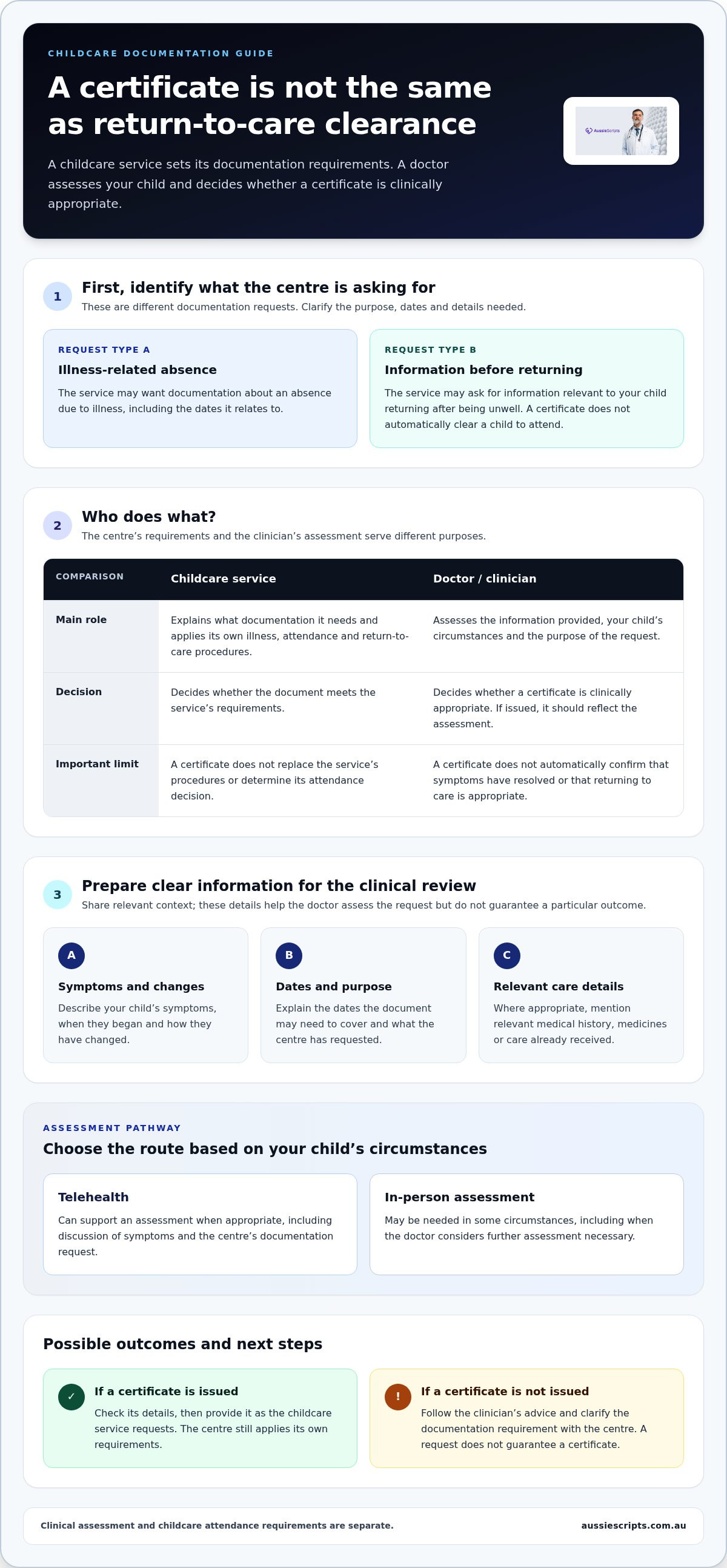
How to request a medical certificate for childcare: prepare in four steps
A clear request helps the doctor understand both the health concern and the childcare service’s documentation needs. Before starting a consultation, note the dates the document may need to address and the centre’s stated purpose. Then follow these four steps.
- Clarify the request. Find out what the centre needs the document to cover, such as an illness-related absence or information relevant to returning to care. Note the requested dates and any specific details or format the service has asked for.
- Gather relevant details. Prepare a timeline of your child’s symptoms, including when they began and any changes. Have relevant health information available, along with details of care already received, such as advice or treatment. Share what’s relevant to the assessment.
- Request a clinical review. Explain the centre’s request and provide the information you’ve gathered. During an online assessment, an Australian-registered doctor may ask follow-up questions to understand your child’s circumstances. The doctor may decide that a different form of care or further assessment is needed.
- Follow the outcome. The clinician determines whether a certificate is appropriate based on the assessment. If one is issued, check its details and give it to the childcare service as instructed. If it isn’t appropriate to issue, follow the doctor’s advice and clarify any remaining documentation questions with the centre.
Before requesting an assessment
Keep the centre’s instructions together with your notes on dates, symptoms and relevant care. This makes it easier to describe the request accurately and distinguish the period the centre is asking about from the dates of the illness. If you’re unsure what the service means, clarify the request before the consultation.
After the doctor reviews the request
A medical certificate isn’t automatic. The doctor assesses the information and decides whether documentation is clinically appropriate. An issued certificate records the clinician’s assessment, but it doesn’t replace the childcare service’s attendance procedures or guarantee acceptance for every purpose. Follow the doctor’s advice and the centre’s instructions.
If you’re getting a medical certificate for childcare, Aussie Scripts provides online medical certificate assessments with Australian-registered doctors. Request an online medical certificate assessment and provide the relevant details for clinical review.
Post-Assessment: Understand Outcomes and Next Steps
Once the doctor has reviewed the request, use the outcome as clinical documentation, not as an automatic decision about childcare attendance. If a certificate is issued, check that its details are accurate and relate to the dates and purpose discussed during the assessment. Then provide it to the service in the way it requested.
A certificate doesn’t override the centre’s current attendance procedures or relevant public-health advice. The service may still need to apply its own requirements before your child returns. Keep the clinical advice and the centre’s instructions in view together.
If the childcare service needs different information
If the centre says the document doesn’t address its request, ask the service to explain what information it needs and which dates matter. Don’t alter the certificate or describe the doctor’s assessment more broadly than the document supports. If the centre’s request raises a new health question, or your child’s concern remains unresolved, seek further clinical advice.
If no certificate is issued
A doctor may decide that a certificate isn’t clinically appropriate based on the information available, or may recommend another form of care. Follow that advice. If the service still needs documentation, clarify its requirement separately. A certificate request doesn’t guarantee a document, and the centre’s procedures remain separate from the clinician’s assessment.
Prioritise your child’s health
If symptoms are urgent, severe or worsening, focus on appropriate medical attention rather than paperwork. Aussie Scripts provides medical certificate assessments, not emergency medical care. For urgent concerns, use an appropriate urgent or emergency care service.
For families who need a doctor to review a childcare-related certificate request, Aussie Scripts offers online medical certificate assessments with Australian-registered doctors. Request a clinical assessment through Aussie Scripts when it’s suitable for your child’s circumstances. The clinician will assess the information provided and advise on appropriate next steps.
Take the next step with clear information
Before getting a medical certificate for childcare, clarify what your centre needs and note the dates and purpose of its request. A certificate records a clinician’s assessment; it doesn’t automatically clear a child to return or replace the service’s attendance procedures. The doctor reviews the information provided and determines whether a certificate is clinically appropriate.
If an online consultation suits your circumstances, Aussie Scripts connects patients with Australian-registered doctors for medical certificate assessments. Telehealth consultations are available seven days a week, providing a convenient pathway to clinical review. A certificate isn’t guaranteed, and an in-person assessment may be needed when the clinical circumstances call for it. If your child’s symptoms are urgent, severe or worsening, prioritise appropriate medical care.
Prepare the centre’s instructions and relevant health details before requesting a review. Request an online medical certificate assessment through Aussie Scripts to have your request clinically assessed.
Frequently Asked Questions
Does my child need a medical certificate to return to childcare?
Not necessarily. Requirements depend on the childcare service’s current policy and your child’s circumstances. Ask the centre what documentation it needs and which dates it relates to. A doctor can assess your child and decide whether a certificate is clinically appropriate, but the document doesn’t automatically grant permission to return or replace the service’s attendance procedures. Follow the centre’s instructions and any relevant health advice.
Can I get a medical certificate for childcare online in Australia?
Yes. Telehealth can be a convenient way to request a clinical assessment. Aussie Scripts connects patients with Australian-registered doctors and provides telehealth services seven days a week. The doctor reviews the information you provide and decides whether a certificate is appropriate. Getting a medical certificate for childcare online doesn’t guarantee one will be issued. Depending on your child’s circumstances, the doctor may recommend another form of assessment or care.
What information should I provide when requesting a childcare medical certificate?
Explain why you’re requesting the certificate, the dates it may need to cover and what the childcare service has asked you to provide. Be ready to describe your child’s symptoms, when they began and how they have changed. Share relevant health information and any care already received. Accurate details help the doctor assess the request and advise on appropriate next steps.
Can a doctor issue a certificate without examining my child in person?
It depends on whether the doctor considers the information available during the consultation sufficient to assess the request. A clinician may be able to review the circumstances through telehealth, or may recommend an in-person examination or further information. An online request doesn’t guarantee a certificate. If your child needs immediate medical attention, prioritise urgent care rather than focusing on documentation.
Can a childcare centre refuse a medical certificate?
A certificate records a clinician’s assessment, but it doesn’t automatically determine a childcare service’s attendance decision. Requirements may differ between services and situations. Ask the centre to explain its current policy and the information it needs, then provide appropriate documentation as directed. A certificate doesn’t override the service’s procedures or relevant health guidance. If the request is unclear, clarify the dates and purpose with the centre.
What happens if the doctor does not issue a childcare medical certificate?
The doctor may decide that a certificate isn’t appropriate based on the assessment, or may recommend further information or another form of care. Follow the clinician’s advice, then ask the childcare service to clarify any documentation it still requires. A certificate request doesn’t guarantee that a document will be issued. If your child’s symptoms are severe or worsening, prioritise appropriate medical care instead of focusing on paperwork.
Disclaimer
The information provided by AussieScripts is for general informational purposes only and does not constitute medical advice, diagnosis, or treatment. For advice tailored to your specific symptoms or health concerns, please consult one of our doctors or your regular GP.