Doctor-Led Weight Loss for Emotional Eaters: What to Expect
Explore doctor-led weight loss for emotional eaters. Understand your eating habits, clinical care options, and what to expect from a telehealth consultation.

What if eating in response to stress isn’t a willpower problem, but a pattern worth discussing with a clinician? Doctor-led weight loss for emotional eaters can help explore how eating habits, health and difficult emotions may be connected, without treating one behaviour as a diagnosis.
If self-directed attempts haven’t addressed what prompts you to eat, it’s reasonable to want support that looks beyond the scales. A consultation is an assessment, not a judgement or a promise of a particular prescription or result. It can help you understand your options and decide on practical next steps.
This article explains what emotional eating can mean, how clinical support differs from managing weight alone, and what you may discuss during a weight-management consultation. Through Aussie Scripts’ telehealth pathway, an Australian-registered doctor can assess your health history, eating patterns and goals, then discuss appropriate care options. If medication is considered, the doctor can explain its role and suitability. Your plan can also account for continuity with your regular GP or specialist.
Key Takeaways
- Occasional eating in response to emotions doesn’t, by itself, indicate a diagnosis or personal failure.
- Doctor-led weight loss for emotional eaters can help assess health history, goals and relevant concerns without guaranteeing a diagnosis or treatment.
- Before a consultation, clarify your goals and note eating patterns or health information that may help inform the discussion. Calorie counting and self-diagnosis aren’t required.
- Aussie Scripts’ weight-management consultation follows a clear sequence: select the consultation, complete a clinical assessment with an Australian-registered doctor, then discuss appropriate next steps.
What emotional eating means for weight management
Emotional eating is eating in response to feelings or situations, rather than mainly to physical hunger. It can happen when someone feels stressed, bored, lonely or unsettled. It describes a possible eating pattern, not a diagnosis, and an occasional episode doesn’t mean someone has failed or needs treatment.
People may eat for both physical and emotional reasons at the same time. A meal can be satisfying and comforting, for example, or a difficult day may influence what, when or how much someone eats. The emotional eating overview provides background on the term, but reading about it can’t determine what is happening for an individual.
How emotional eating can differ from physical hunger
Physical hunger may build gradually and be satisfied by a range of foods. Eating linked to emotions may feel more sudden or connected to a particular situation, such as reaching for a snack during a stressful workday or eating while bored in the evening. These are possible differences, not a reliable test. Hunger and emotions vary between people, and one cue alone can’t establish a pattern or explain its cause.
Noticing context can be more useful than judging a food choice. For instance, someone might observe that they often want to eat after an argument, or that they snack while feeling tired. The aim isn’t to label the behaviour or monitor every bite. It’s to notice whether a recurring situation seems relevant, and whether the pattern concerns them or affects their goals.
Why weight-loss advice may feel incomplete
Eating patterns can be shaped by several influences, including appetite, routines, food access, health and emotions. Their relative importance differs from person to person. Advice focused only on reducing portions or avoiding certain foods may not address a recurring emotional trigger. At the same time, not everyone with weight-management concerns experiences emotional eating, and emotional eating doesn’t explain every difficulty with weight goals.
If eating in response to feelings happens repeatedly, a plan based only on food rules may be harder to follow. Someone might manage meals during a calm week, then find their usual routine changes when stress increases. That doesn’t prove a single cause or mean a particular approach is right for everyone. It may be useful to discuss the context around eating alongside health and weight-management goals.
For doctor-led weight loss for emotional eaters, the useful starting point isn’t self-diagnosis. It’s a clear account of what you’ve noticed and what you want help with. A clinician can consider that information alongside broader health factors. This keeps the discussion practical and individual, rather than reducing weight management to willpower or assuming one explanation fits everyone.
How a doctor-led assessment can explore emotional eating
A weight-management consultation assesses your health, goals and concerns to help identify appropriate next steps; it doesn’t guarantee a diagnosis, prescription or particular outcome. For doctor-led weight loss for emotional eaters, the assessment can include discussion of eating patterns and whether they’re affecting your goals. The doctor considers this alongside your wider health, rather than treating one behaviour as a complete explanation.
What a clinician may ask about
A doctor may ask what you’d like help with, what eating patterns you’ve noticed, and whether particular situations seem relevant. They may also discuss your medical history and current medicines, which can help inform an individual assessment. You can explain your concerns at a pace that feels manageable. You don’t need to arrive with a diagnosis or a perfect record of what you eat.
A questionnaire can help organise information, but it can’t determine by itself whether emotional eating is present or what care is suitable. The clinical conversation gives you a chance to clarify your answers, ask questions and discuss relevant context. If you’re unsure how to describe a pattern, simply explain what you’ve observed and what you want to understand.
What telehealth can and cannot do
Telehealth offers remote access to an Australian-registered doctor for a clinical weight-management assessment. It can make it easier to discuss goals and relevant health information without travelling to a clinic. The format doesn’t change the need for an individual assessment: suitability, recommendations and next steps depend on the information available and the doctor’s clinical judgement.
An online consultation isn’t a guarantee of treatment, and it may not be enough for every health concern. The doctor may determine that further assessment or another form of care is needed. Telehealth isn’t emergency care. If you’re experiencing an emergency, call 000.
Where relevant, the doctor may discuss how next steps can fit with care from your regular GP or specialist. Keeping your existing care team informed can support continuity and help ensure relevant health information is considered. The consultation is a place to explore options, not a promise that a particular medicine or referral will follow.
If you’d like a clinician to assess your weight-management goals and concerns, consider an Aussie Scripts weight-management consultation with an Australian-registered doctor.
Comparing support options when emotional eating affects weight goals
Different kinds of support serve different purposes. Self-directed changes can help you notice routines and make practical adjustments. A clinician-led assessment adds a review of health history and treatment questions. Ongoing care may help you revisit goals and adapt a plan over time. These approaches can complement one another, and none guarantees a particular result.
Self-directed changes and clinician-led support
A self-directed starting point might be to notice which situations disrupt your usual eating routine, or to plan regular meals that suit your day. This can be useful when changes feel manageable. However, it may not answer questions about how health conditions, current medicines or previous treatment relate to your goals.
A doctor-led weight-loss consultation can assess those questions and discuss appropriate options without promising a prescription. It doesn’t need to replace your relationship with your regular GP or specialist. If you already receive care, relevant coordination can help keep next steps connected to your broader health needs.
How to discuss weight-loss medicines responsibly
Medicine may be one option a doctor considers after an individual clinical assessment. It isn’t automatic, and medication alone doesn’t necessarily address the situations or feelings linked to eating patterns. If emotional triggers remain a concern, raise them as part of the conversation rather than assuming a medicine will resolve them.
In Australia, Wegovy is TGA-approved for chronic weight management in eligible adults, including adults with a BMI of 30 kg/m² or higher, or 27 kg/m² or higher with a weight-related comorbidity. TGA approval is not the same as PBS subsidy. The PBAC has recommended a proposed PBS listing for a limited population of people with obesity and established cardiovascular disease, subject to pricing and risk-sharing arrangements. Wegovy is currently available in Australia on private prescription and is not yet PBS-subsidised. The listing process has not yet been completed. Patients should therefore expect to pay the private prescription price unless and until a PBS listing takes effect.
Ozempic is PBS-listed for specific type 2 diabetes indications, not weight loss. Its PBS status doesn’t mean Wegovy is subsidised for weight management. Any discussion of these medicines should distinguish TGA approval, a PBAC recommendation for a possible subsidy and an actual PBS listing.
Use these questions to compare what each option can offer:
- Self-directed changes: Can support practical routine adjustments, but won’t assess clinical questions.
- Clinical assessment: Can review health factors and discuss suitable options, but doesn’t guarantee a particular treatment.
- Ongoing care: Can support review and continuity with your regular GP or specialist, while recognising that needs and next steps may change.
The right starting point depends on your circumstances and what you want help with. A consultation can clarify options without requiring you to choose medication in advance.
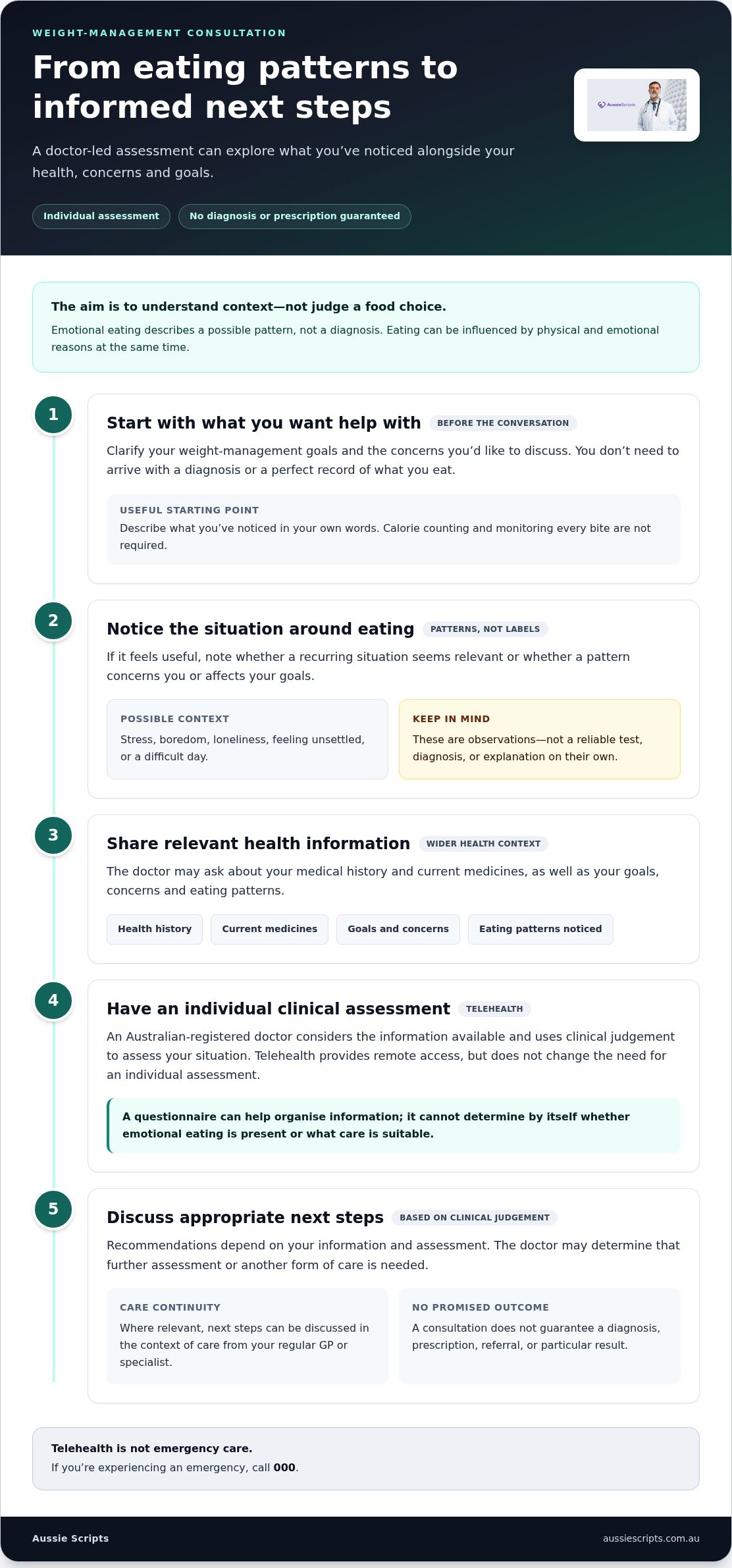
Preparing for a weight-management consultation about emotional eating
A little preparation can help you use the consultation time well. You don’t need to diagnose yourself, count calories or arrive with a complete record. Focus on what you want help with, what you’ve noticed and which health details may matter. For doctor-led weight loss for emotional eaters, honest observations are more useful than trying to find the “right” answer.
Use this short sequence to get ready:
- Clarify your goal. Write down what you’d like to discuss, such as managing weight, understanding eating patterns or reviewing treatment options.
- Note relevant patterns. If eating sometimes feels connected to emotions, record the situation or feeling and what you noticed. A few brief notes are enough; calorie counting isn’t required.
- Gather health information. Have a concise medical history and current medicines in mind, along with details of any regular GP or specialist care that relates to your question.
Information to have ready
Keep notes simple and relevant. You might mention that eating feels harder to manage during certain routines or periods, without needing to label the experience. Include health conditions, previous weight-management care and medicines that may be relevant to the discussion. If you’re unsure whether something matters, raise it with the doctor. Share information at a pace you’re comfortable with.
- Your main health or weight-management concern
- Current medicines and relevant medical history
- Any existing care with a regular GP or specialist
- Situations or feelings you’ve noticed around eating
Questions to ask during the appointment
Questions can help clarify how the assessment works and what may happen afterwards. You could ask how the doctor will consider your goals, health history and concerns; whether follow-up or coordination with your regular GP may be appropriate; and what the clinical assessment fee covers. Ask which medicines, tests, specialist appointments or follow-ups may involve additional costs.
- How will you assess my weight-management concerns?
- What next steps might be appropriate, and how will we decide?
- Could follow-up or coordination with my regular GP be useful?
- Which costs relate to the assessment, and which services may cost extra?
A consultation is an opportunity to discuss your circumstances and consider options. Preparing questions doesn’t commit you to a particular treatment, and an assessment can’t guarantee a prescription or outcome. The doctor can explain next steps based on your individual clinical needs.
Book a weight-management consultation to discuss your goals and concerns with an Australian-registered doctor.
Aussie Scripts weight-management consultations: what happens next
Aussie Scripts provides a dedicated weight-management consultation with an Australian-registered doctor. The telehealth process gives you a way to discuss weight-related concerns remotely, with the clinical assessment guiding what may be appropriate next. It’s an opportunity to review your circumstances, not a promise of a diagnosis, prescription, specific medicine or weight-loss outcome.
From service selection to clinical assessment
Selecting the weight-management consultation begins the process. You provide relevant information for the doctor to consider, then the doctor assesses your individual case. This can include your goals, health history, current medicines and concerns about eating patterns. Your information helps inform the discussion, but a form or questionnaire alone doesn’t determine a diagnosis or treatment.
The consultation can help you understand possible next steps based on the clinical assessment. Depending on your circumstances, the discussion may include whether further care or follow-up is appropriate. If a prescription is issued, it depends on the doctor’s assessment and must be filled at a pharmacy. The consultation itself doesn’t guarantee that a medicine will be prescribed.
The journey can be understood in three stages:
- Select the consultation. Choose the dedicated weight-management pathway and provide relevant details about your concerns and goals.
- Complete the clinical assessment. An Australian-registered doctor reviews the information and discusses your individual circumstances with you.
- Discuss next steps. The doctor explains options that may be suitable, which could include further assessment, a follow-up discussion or coordination with your existing care team.
Planning next steps with your existing care team
Weight management may sit alongside other health care. If you have a regular GP or specialist, discuss how any plan could fit with that existing care. Continuity matters: relevant information from your care team may help inform decisions, and you can raise coordination as part of the consultation.
Keep costs in mind as you consider next steps. The consultation fee covers Aussie Scripts’ clinical assessment only. Medicines, tests, specialist appointments and follow-up consultations may incur separate charges. If an electronic prescription is issued, it needs to be filled at a pharmacy. The consultation doesn’t include medicine supply.
For doctor-led weight loss for emotional eaters, the key outcome of the appointment is a considered clinical assessment and a clearer discussion of possible next steps, not a guaranteed treatment. Explore the weight-management consultation to begin the process with an Australian-registered doctor.
Take a considered next step
You don’t need to have every detail worked out before seeking clinical guidance. A useful next step can be deciding what you want help understanding, then discussing it in a setting where your health and goals can be considered together. Doctor-led weight loss for emotional eaters is about a considered assessment, not a test of willpower or a promise of a particular treatment.
Aussie Scripts is an Australian-owned service. Its weight-management consultation offers a way to discuss your concerns with an Australian-registered doctor and consider next steps in the context of your existing care. You remain part of the decision-making process, and the assessment can help clarify what may be suitable for you.
If you’re ready to discuss your goals, explore an Aussie Scripts weight-management consultation. A clear conversation can be a practical first step towards care that fits your circumstances.
Frequently Asked Questions
Can a doctor help with emotional eating and weight management?
Yes. A doctor can review your health history, goals and eating-related concerns, then discuss possible next steps. Doctor-led weight loss for emotional eaters starts with an individual assessment, not an assumption about what is causing a concern. Telehealth may be a convenient first step for discussing your situation, though the doctor may recommend additional or in-person care if needed. An assessment doesn’t guarantee a diagnosis, prescription or particular outcome.
Is emotional eating a medical diagnosis?
No. Emotional eating describes eating in response to emotions, but the phrase alone doesn’t establish a medical diagnosis. If a pattern feels recurring or distressing, you can raise it with a clinician, who can consider it alongside your broader health and circumstances. You don’t need to decide what label applies before asking for help. An assessment can provide a practical opportunity to discuss your concerns and understand possible next steps.
What happens during a telehealth weight-management consultation?
A telehealth weight-management consultation involves a clinical discussion of your health history, goals and relevant concerns. The doctor considers the information in your individual case and explains possible next steps. You can use the appointment to clarify what an assessment can address and what may need further care. The consultation fee covers the clinical assessment only. Medicines, tests, specialist appointments and follow-up consultations may involve separate charges.
Can a doctor prescribe weight-loss medication for emotional eating?
A doctor may discuss whether medication is appropriate, but prescribing isn’t automatic. The decision depends on your clinical assessment, suitability and applicable requirements. Your appointment can also consider other factors relevant to your goals, so a prescription shouldn’t be assumed to be the only next step. The clinician will explain their assessment and options for your circumstances. No consultation can promise a particular medicine or prescription outcome.
Is Wegovy covered by the PBS in Australia?
No. Wegovy is not yet listed on the PBS and is not PBS-subsidised for weight loss. It is currently available in Australia on private prescription. Patients should therefore expect to pay the private prescription price unless and until a PBS listing takes effect. A private prescription does not mean the medicine is available at a PBS co-payment price.
Can an online weight-management consultation replace my regular GP?
Not automatically. Telehealth can provide access to a clinical assessment, but it doesn’t necessarily replace ongoing care with your regular GP or specialist. Aussie Scripts emphasises continuity with existing clinicians, and the appropriate arrangement depends on your health needs and the doctor’s assessment. You can discuss how any next steps may fit with your current care. For emergency symptoms, don’t use a telehealth consultation. Call 000.
Disclaimer
The information provided by AussieScripts is for general informational purposes only and does not constitute medical advice, diagnosis, or treatment. For advice tailored to your specific symptoms or health concerns, please consult one of our doctors or your regular GP.