How Medical Indications Guide Your Online Consultations
Discover how medical indications determine your online prescription eligibility. Learn about TGA rules, off-label use, and the safety checks doctors perform.

A prescription is more than a digital transaction; it's a clinical decision anchored by strict safety guardrails. When you request a treatment, your doctor isn't just checking a box. They're evaluating specific medical indications to ensure the medication is both safe and appropriate for your diagnosed condition. This process can feel opaque when you're faced with complex jargon or an unexpected "not eligible" notification during an online consultation.
We understand that navigating TGA regulations and prescribing criteria can be confusing. You want to know exactly why certain drugs are approved for your needs while others are not. This article clarifies the clinical meaning of indications and how they determine your eligibility for prescriptions in Australia. We'll examine how Australian-registered doctors use these markers to make evidence-based decisions. You'll also learn the critical difference between TGA-approved uses and off-label prescribing, supported by the June 2026 CATAG guidance. By the end, you'll have a clear framework for understanding the professional standards that govern your digital healthcare experience and ensure your safety.
Key Takeaways
- Define the clinical role of indications as the primary evidence-based reason for a specific treatment or procedure.
- Explore the TGA framework and the Australian Register of Therapeutic Goods (ARTG) to understand how medications are regulated for specific uses.
- Distinguish between indications and contraindications to recognize the clinical safety checks used to prevent adverse reactions.
- Understand the legal and clinical context of off-label prescribing in Australia and how it allows for flexible, patient-centered care.
- See how digital consultations use symptom-based questionnaires to match your health profile with appropriate clinical treatments.
Understanding Medical Indications: The Clinical 'Why' Behind Treatment
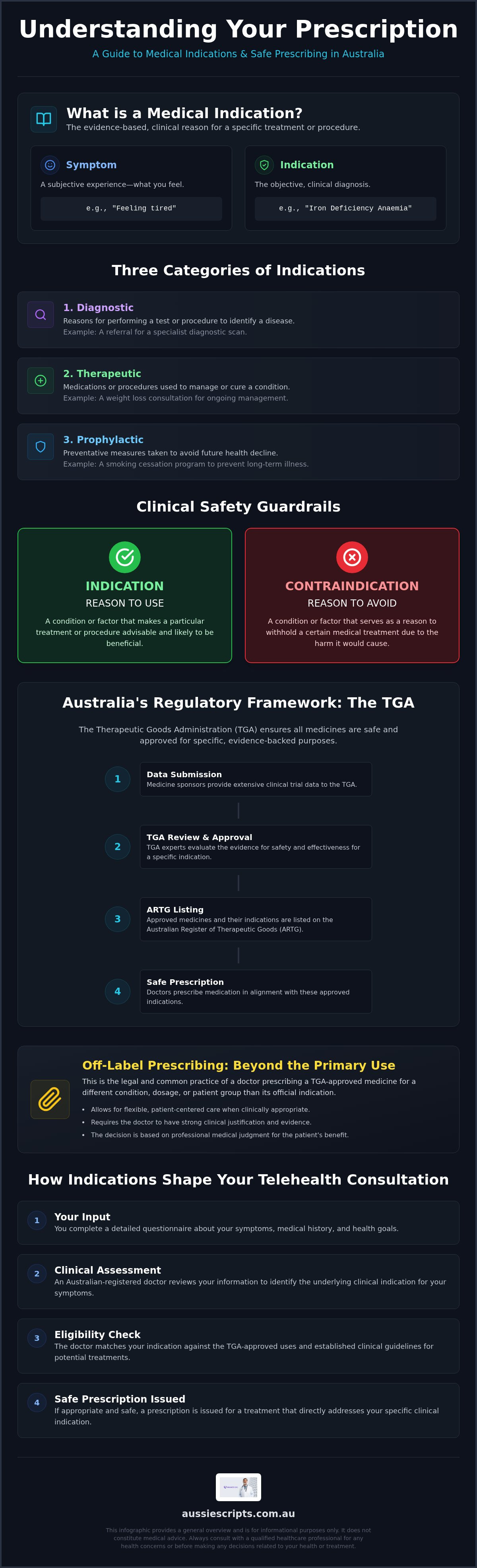
Every prescription issued by an Australian-registered doctor must be supported by a valid clinical justification. This justification is formally called a medical indication. While you might seek treatment to alleviate a specific discomfort, the medical practitioner must ensure your condition aligns with the approved uses of a drug. An indication is the evidence-based purpose for which a medication is authorised.
These indications are not arbitrary. They are the result of extensive clinical trial evidence that proves a drug is effective for a specific health issue. Before a medication is available for a Standard Script, the Therapeutic Goods Administration (TGA) reviews this data to confirm that the benefits of using the drug for that specific condition outweigh the potential risks. This regulatory oversight ensures that treatments aren't just available, but are safe for their intended use.
It's helpful to understand the difference between a symptom and an indication. A symptom is a subjective experience; it is what you feel, such as fatigue or pain. An Indication (medicine) is the objective, clinically recognised reason to initiate a treatment. For instance, while "feeling tired" is a symptom, "iron deficiency anaemia" is the indication that justifies a specific clinical intervention. Doctors use your reported symptoms during a consultation to identify the underlying indication.
The Purpose of Defining Indications
Defining clear indications is the foundation of evidence-based medicine. This system protects patient safety by preventing the inappropriate use of potent medications for conditions they weren't designed to treat. When a doctor follows established indications, they are choosing the therapy most likely to produce a positive outcome based on global research. This structured approach reduces clinical friction and ensures that your digital consultation remains a safe, professional alternative to traditional in-person visits.
Types of Medical Indications
Indications are generally grouped into three functional categories to guide clinical decision-making during your medical review:
- Diagnostic indications: These are the reasons for performing a test or procedure to identify a disease, such as a Specialist Referral for a specific diagnostic scan.
- Therapeutic indications: These involve medications or procedures used to manage or cure a condition. Most online consultations for chronic conditions, such as a Weight Loss Consultation, fall into this category.
- Prophylactic indications: These are preventative measures. Treatments like Smoking Cessation Consultation programs are often indicated to prevent long-term health decline before a critical illness occurs.
The TGA Framework: How Indications are Regulated in Australia
The Therapeutic Goods Administration (TGA) serves as the primary regulatory body for all medicines supplied in Australia. It maintains the Australian Register of Therapeutic Goods (ARTG), a comprehensive database that tracks every approved therapeutic good. For a medication to be legally supplied, its sponsor must provide data that justifies specific indications. These are the formal therapeutic claims that describe the medicine's intended purpose and the specific conditions it's designed to treat.
Regulatory approval isn't a blanket permission for all uses. Instead, the TGA limits what manufacturers can claim about their products through a system of "Permitted Indications." This framework ensures that any health claim made to the public or clinicians is backed by verified data. When a practitioner evaluates your eligibility for a treatment, they typically align their decision with these approved uses to maintain compliance with national safety standards. When you apply for an Express Script, our doctors verify your request against these established TGA standards to ensure clinical safety.
Permitted vs. Required Indications
In the Australian system, medicines are categorised as either "listed" or "registered." Listed medicines, such as vitamins or herbal supplements, must select their claims from a pre-approved list of "Permitted Indications." These are generally lower-risk claims that don't require the TGA to evaluate the evidence before the product enters the market. Registered medicines, which include most prescription drugs, face a much higher hurdle. They require "Required Indications" supported by extensive clinical data. Clinicians rely on the Product Information (PI) document, a TGA-approved technical file, to understand the exact parameters of these indications and any associated risks.
Evidence-Based Requirements
The level of evidence required by the TGA varies depending on the severity of the condition being treated. For high-risk prescription medications, sponsors must provide results from rigorous Phase III clinical trials. these trials determine which specific patient groups the indication applies to, including variables like age, weight, and existing health conditions. This evidence-based approach is dynamic. As new research emerges, the TGA may update a drug's listing to include new uses or restrict existing ones based on safety signals. While the TGA regulates what companies can market, doctors may use their professional judgement to prescribe a drug for a different purpose. This is often referred to as Understanding Unapproved Use of Approved Drugs, a practice that remains legal and common when supported by clinical literature.
Indications vs. Contraindications: Safety Guardrails
Every clinical decision involves a careful balance between potential benefits and inherent risks. While indications provide the evidence-based justification for a treatment, contraindications serve as the essential red lights that signal when a drug may cause harm. A contraindication is a specific situation or condition in which a medication, procedure, or surgery should not be used. Safety in modern medicine is defined as much by knowing when to withhold a drug as it is by knowing when to prescribe it.
Doctors perform a risk-benefit analysis for every patient. They categorise contraindications into two main types: absolute and relative. An absolute contraindication means that under no circumstances should the treatment be used, such as a known life-threatening allergy to a specific active ingredient. A relative contraindication suggests that the treatment may be used with extreme caution, but only if the clinical benefit significantly outweighs the potential for a complication. This screening process is a core component of every professional medical review.
Key Differences at a Glance
Understanding these "traffic lights" of medicine helps you navigate your treatment options with more clarity. During an online consultation, your responses to health questionnaires are used to identify these factors instantly. The following table illustrates how a single medication can be appropriate for one condition while being dangerous for another.
| Feature | Indication (The Green Light) | Contraindication (The Red Light) |
|---|---|---|
| Clinical Definition | The reason to initiate a specific treatment. | A reason to avoid a specific treatment entirely. |
| Primary Goal | To manage, cure, or prevent a disease. | To protect the patient from predictable harm. |
| Example (Beta-blockers) | Managing high blood pressure (hypertension). | History of severe asthma or certain heart blocks. |
Side Effects vs. Contraindications
It's important to distinguish between a side effect and a contraindication. A side effect is an unwanted but often expected result of a drug's mechanism of action, such as mild nausea or a dry mouth. Most side effects are manageable and don't necessarily require stopping the medication. In contrast, a contraindication is a pre-existing medical reason to avoid the drug from the outset. For example, while a headache might be a side effect of a new medication, having active liver disease could be a contraindication that makes the drug fundamentally unsafe for you.
The role of an Australian-registered doctor is to act as a safety filter. By reviewing your medical history, they screen for these risks before issuing a Standard Script or approving a Weight Loss Consultation. This professional oversight ensures that your digital healthcare experience remains as safe and compliant as a traditional in-person visit.
Off-Label Prescribing: Using Medicine Outside Primary Indications
Off-label prescribing occurs when a medical practitioner authorises a medication for a condition, age group, or dosage that is not formally listed on the Australian Register of Therapeutic Goods (ARTG). While the TGA regulates the claims a pharmaceutical company can make, it does not restrict how a registered doctor uses a drug in clinical practice. This is a legitimate and frequent part of Australian medicine. It allows clinicians to apply the latest scientific findings before official indications are formally updated, a process that can take years of regulatory review.
You might question if a treatment is safe if it is not "indicated" for your specific health concern. Safety in this context relies on professional clinical judgement and the weight of available peer-reviewed evidence. If a medication has a well-documented history of treating a condition successfully in high-quality trials, a doctor may determine that the benefit to the patient justifies the off-label use. This decision is never made lightly; it is a calculated choice based on the patient's immediate health needs and the established safety profile of the drug.
When Off-Label Use is Appropriate
In specialised fields such as oncology or the treatment of rare diseases, off-label use is often the clinical standard of care. Because these health conditions are complex, official indications may not cover every possible treatment combination or patient subtype. The June 2026 CATAG guidance, "Rethinking Medicines Decision-Making," provides a clear framework for this practice. It requires clinicians to ensure the use is safe and responsible, which includes obtaining informed consent. Your doctor must explain that the treatment is off-label and discuss the evidence that supports its use for your specific case.
Limitations and Responsibilities
Pharmaceutical companies are strictly prohibited from advertising or promoting their products for off-label purposes. This is why you will not see marketing for these uses, even if they are widely accepted by the medical community. When a doctor chooses an off-label path, they accept an increased level of clinical responsibility. They must be prepared to justify the treatment based on reputable medical literature and current best-practice guidelines.
Our Australian-registered doctors perform a rigorous medical review for every patient request. Whether you are seeking a Standard Script or a more specialised treatment plan, our practitioners evaluate your safety by cross-referencing your medical history with current clinical standards. This ensures that every prescription, whether for an approved or off-label use, is backed by professional oversight and a commitment to patient safety.
How Indications Shape Your Telehealth Consultation
The digital medical review process at Aussie Scripts is designed to be both efficient and clinically sound. When you start a consultation, you complete a structured health questionnaire. This tool is specifically engineered to identify your current symptoms and health history to determine if they align with the necessary clinical indications for a specific treatment. By providing precise information, you allow our Australian-registered doctors to perform a thorough safety check before any medication is authorised.
Once your assessment is submitted, a practitioner reviews your data. Their primary role is to verify that a Standard Script is appropriate for your specific condition. If the clinical indications are clearly met and no contraindications are identified, the prescription is issued. However, if the information provided does not meet the required clinical threshold, the consultation may be declined. This is a vital safety measure; it ensures that medications are only provided when they are evidence-based and safe for the user.
The Assessment Process
Providing an accurate and comprehensive medical history is the most important part of your consultation. It allows the doctor to confirm that your request is medically justified. The speed of telehealth at Aussie Scripts is always balanced with the rigour of professional clinical standards. We don't bypass safety for convenience. For those requiring formal documentation for work or study, our Medical Certificate Online guide explains the specific requirements for clinical evidence and practitioner documentation in Australia.
Getting Started with Aussie Scripts
Accessing professional healthcare through our platform is a streamlined, step-by-step process. You don't have to navigate bureaucratic delays or long wait times. Simply follow these steps to begin your review:
- Choose your service: Select from our offerings, including Weight Loss Consultation, Smoking Cessation Consultation, or a Standard Script renewal.
- Complete the assessment: Answer the clinical questions accurately to help our doctors identify relevant symptoms.
- Doctor review: An Australian-registered doctor evaluates your request against TGA standards and your specific health profile.
- Direct delivery: If approved, your medication can be delivered directly to your door, or your script sent to your phone.
Your health and safety remain our priority. Our system ensures that every clinical decision is grounded in the regulatory framework of the TGA and the professional standards of Australian medicine. Request your clinical review today to access efficient, safe, and reliable healthcare from anywhere in the country.
Securing Your Health Through Professional Clinical Standards
Medical safety depends on the precise alignment between your health profile and verified clinical indications. You've learned how the TGA framework and the distinction between approved and off-label uses create a secure environment for modern healthcare. This structured approach ensures that every treatment path is backed by clinical evidence rather than digital convenience alone. By understanding these safety guardrails, you can navigate your healthcare journey with greater clarity and confidence.
Aussie Scripts streamlines this professional oversight by connecting you with Australian-registered doctors who perform TGA compliant assessments. Our process prioritises your safety through secure digital prescriptions and rigorous medical reviews. We don't compromise on clinical standards; we ensure that every consultation remains as legitimate as a traditional in-person visit. It's a modern solution designed for those who value both their time and their health.
Take the next step in your health journey by choosing a service that values professional reliability and digital efficiency. Start your telehealth consultation with Aussie Scripts today. We're here to help you access the treatments you need through a safe, compliant, and supportive framework.
Frequently Asked Questions
What is a 'permitted indication' in Australia?
A permitted indication is a pre-approved therapeutic claim for lower-risk medicines, such as vitamins or herbal supplements, that are listed on the ARTG. These claims are selected from a specific list maintained by the TGA. Unlike registered prescription drugs, these indications don't require the TGA to evaluate clinical evidence before the product enters the market. They ensure that manufacturers only make health claims that are appropriate for the product's risk level.
Can I get a prescription if my condition isn't a standard indication?
Yes, you can, provided the doctor determines that the treatment is clinically appropriate for your specific health needs. This practice is known as off-label prescribing. It's legal and common in Australia when supported by peer-reviewed medical literature. The doctor takes on increased clinical responsibility and must ensure you understand that the use is outside the drug's primary approved purpose. Your safety remains the priority in these clinical decisions.
What is the difference between an indication and a symptom?
A symptom is a subjective experience reported by the patient, such as a headache or fatigue. An indication is the objective clinical reason a doctor authorises a treatment. For example, iron deficiency is the indication that justifies prescribing a specific supplement to treat the symptom of tiredness. Doctors use your reported symptoms during a consultation to identify the underlying medical indications that make a treatment appropriate for you.
Why do indications change for some medications over time?
Indications change as new clinical trial data and real-world evidence emerge. As researchers discover that an existing medication is effective for a new condition, the TGA may update its listing on the ARTG. Conversely, if safety signals suggest a drug is less effective or riskier for a specific group, the TGA may restrict or remove an indication. This dynamic process ensures that medical practice reflects the most current scientific knowledge.
Are all telehealth prescriptions based on indications?
Yes, every prescription issued through a telehealth platform must be grounded in clinical indications. Australian-registered doctors are bound by the same professional standards as in-person practitioners. They must verify that the requested treatment is medically justified for your condition. If the clinical evidence doesn't support the use of a drug for your specific health profile, the doctor won't issue the script to ensure your long-term safety.
What happens if a doctor finds a contraindication during my consult?
If a doctor identifies a contraindication, they'll decline your prescription request for that specific medication. This happens when your medical history or current health status suggests the drug would be fundamentally unsafe for you. In such cases, the doctor may suggest an alternative therapy or advise you to seek an in-person physical examination. This screening is a vital safety check to prevent adverse reactions and protect your health.
Is off-label use of a medication covered by Medicare?
Generally, Medicare and the Pharmaceutical Benefits Scheme (PBS) only provide subsidies for medications used according to their TGA-approved indications. If a drug is prescribed off-label, it's usually provided as a private prescription. This means the patient pays the full cost of the medication at the pharmacy. You should discuss the potential costs with your doctor or pharmacist if a treatment is recommended outside its primary approved use.
How do I find the approved indications for my current medication?
You can find the approved indications for any medication by searching the Australian Register of Therapeutic Goods (ARTG) on the TGA website. Alternatively, you can read the Consumer Medicine Information (CMI) leaflet provided with your prescription. This document outlines what the medicine is used for and any known risks. Your pharmacist or the prescribing doctor can also provide detailed information about why a specific drug was chosen for your condition.
Disclaimer
The information provided by AussieScripts is for general informational purposes only and does not constitute medical advice, diagnosis, or treatment. For advice tailored to your specific symptoms or health concerns, please consult one of our doctors or your regular GP.
