How to Get a Prescription for Weight Loss Medication in Australia
Wondering how to get a prescription for weight loss medication in Australia? Learn about eligibility, doctor consultations, private costs, and safety steps.

A weight-loss prescription follows a clinical assessment; booking a consultation does not guarantee one. If you’re wondering how to get a prescription for weight loss medication in Australia, start by discussing your health, medical history and goals with a doctor. This helps the doctor decide whether medication may be suitable for you.
You may have questions about eligibility, online consultations and what happens after a prescription is issued. This guide explains the steps from assessment to pharmacy supply, what information to prepare and how a telehealth consultation with an Australian-registered doctor can support the process. A consultation provides a medical assessment, not a promise of a prescription. If a doctor issues an electronic prescription, a pharmacy supplies the medicine separately.
You’ll also find the distinctions between Wegovy and Ozempic, and between TGA approval, a PBAC recommendation and PBS listing. Wegovy is approved for chronic weight management in eligible adults and is available on private prescription, but it is not yet PBS-subsidised. The proposed PBS listing process is incomplete. Understanding these points can help you plan your next steps and discuss treatment options with your doctor and regular care team.
Key Takeaways
- Getting a prescription for weight loss medication starts with a clinician’s assessment, followed by a plan based on your individual health needs.
- A consultation doesn’t guarantee a prescription. The doctor considers your medical history, overall health, eligibility and potential risks.
- Prepare for an online consultation by noting your goals, relevant health history, current medicines and questions. Share information accurately.
- Wegovy is TGA-approved for chronic weight management in eligible adults, but it is not yet PBS-subsidised. A PBAC recommendation is not the same as an active PBS listing.
- If a doctor issues an electronic prescription, you fill it at a pharmacy, which supplies the medicine. Keep your regular GP involved where appropriate.
How to get a prescription for weight loss medication in Australia: start with an assessment
If you’re working out how to get a prescription for weight loss medication, begin with a clinician’s assessment, not an assumption that you’ll receive a script. The doctor considers your health and weight-management goals before deciding whether medication is appropriate. A prescription is one possible outcome, not the guaranteed result of a consultation.
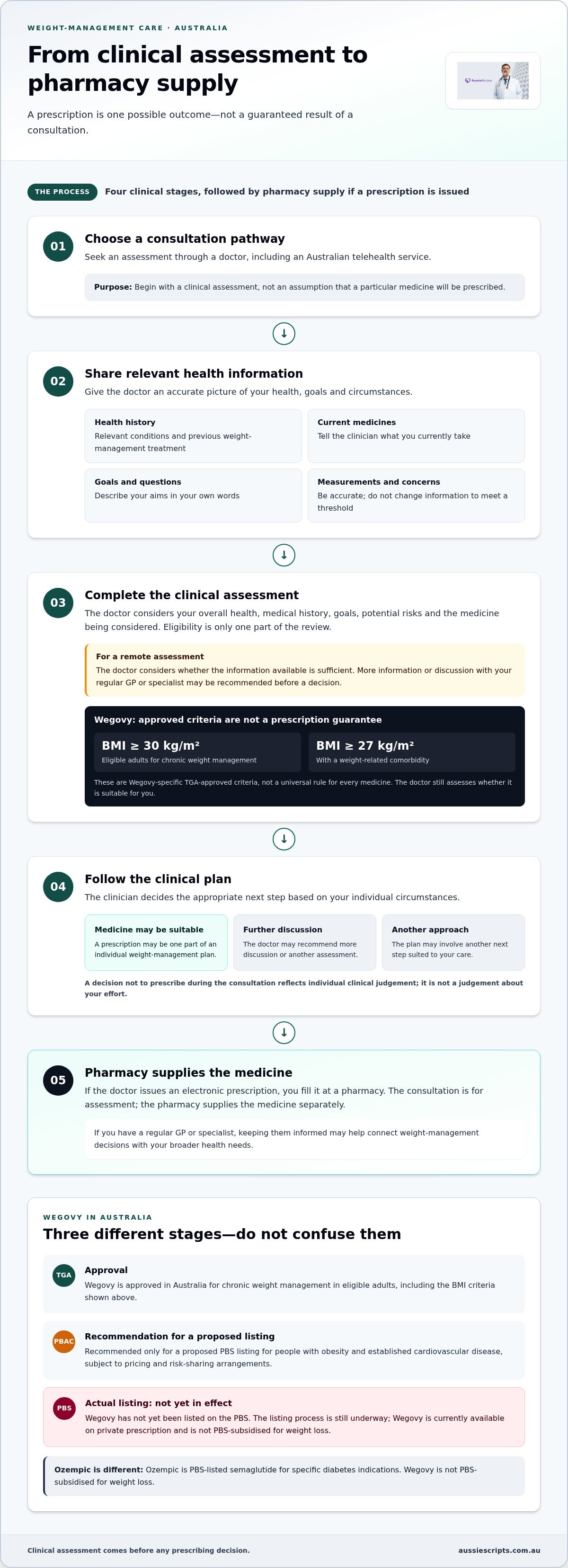
The steps are straightforward, although the clinical decision is individual:
- Choose a consultation pathway. You can seek an assessment through a doctor, including an Australian telehealth service.
- Provide relevant health information. Share an accurate account of your health, goals and circumstances so the clinician can assess your situation.
- Complete the assessment. The doctor reviews the information and discusses whether a medicine or another approach may be suitable.
- Follow the clinical plan. If appropriate, this may include a prescription. The doctor may instead recommend further discussion or another next step.
Medication may be considered as one part of an individual weight-management plan, alongside other care suited to the person. Medicines can work in different ways, so the treatment option and its suitability depend on the clinical assessment. For general background on the types and mechanisms of weight loss medication, see this overview.
What a weight-loss prescription assessment is for
A prescription assessment is a clinical review of your health and weight-management goals, not a guaranteed prescription. The doctor uses the information you provide to understand your circumstances and consider whether a medicine could be appropriate. This review is separate from obtaining medicine. The consultation is for assessment, while a pharmacy supplies the medicine if an electronic prescription is issued and filled.
Why the process starts with a doctor
Different medicines have different suitability considerations. A doctor uses professional judgement to weigh your circumstances, potential risks and the medicine being considered. Being eligible for one option does not automatically mean another is suitable. An assessment may lead to advice, further discussion or another next step rather than a prescription. That is part of individualised care, not a failed consultation.
Be open about your situation and describe your goals in your own words. The aim is to give the clinician a sound basis for advice, not to meet a particular threshold or secure a specific medicine. If you already have a regular GP or specialist involved in your care, keeping them informed may help connect weight-management decisions with your broader health needs.
Does a weight-loss consultation guarantee medication? What doctors assess
No. Booking a weight-loss consultation does not guarantee that a doctor will prescribe medication. The consultation lets a clinician assess your circumstances and decide what next step is appropriate. A prescription may be considered, but the doctor may instead recommend further discussion, other care or another assessment.
Prescribing decisions are individual clinical decisions based on the person’s health, the medicine being considered and the clinician’s judgement. Getting a prescription for weight loss medication is not simply a matter of meeting a number or selecting a product. Eligibility is one part of the review, alongside overall health, medical history and potential risks.
Eligibility and the role of BMI
For Wegovy, TGA approval for chronic weight management applies to eligible adults with a BMI of 30 kg/m² or higher, or a BMI of 27 kg/m² or higher with a weight-related comorbidity. These are product-specific approved criteria, not a universal eligibility rule for every weight-management medicine. Meeting a threshold alone doesn’t mean a doctor will prescribe Wegovy. The clinician still needs to assess whether it is suitable for you.
BMI can inform an assessment, but it does not describe your full health picture. Be accurate about your measurements and any related health concerns. Don’t alter or present information to meet a threshold. The assessment is intended to support an appropriate clinical decision, not to secure a particular outcome.
Health history, risks and clinical judgement
Share a clear, complete account of your current medicines, relevant health conditions and previous weight-management treatment. Include details that may seem unrelated if you think they could affect the clinician’s understanding of your health. Accurate information helps the doctor consider the potential benefits and risks of the medicine under discussion without relying on assumptions.
For a telehealth assessment, the doctor also considers whether the information available is sufficient to assess your situation remotely. If it isn’t, the clinician may recommend another step before making a decision, such as obtaining further information or discussing your situation with your regular GP or specialist. A decision not to prescribe during the consultation is not a judgement about your effort. It reflects the clinician’s responsibility to consider suitability and safety.
If you’re ready to discuss your circumstances with a doctor, an Aussie Scripts weight management consultation provides access to an individual clinical assessment. Share your health information openly and use the consultation to understand options and next steps that may be appropriate for you.
Weight-loss medication in Australia: understand Wegovy approval and PBS status
Wegovy’s approval, a recommendation for possible subsidy and an active PBS listing are separate things. Knowing which status applies can help you understand the treatment pathway and plan for medicine costs. If you’re exploring how to get a prescription for weight loss medication, remember that TGA approval does not mean the medicine is subsidised by the PBS.
TGA approval
Wegovy is approved in Australia for chronic weight management in eligible adults with a BMI of 30 kg/m² or higher, or 27 kg/m² or higher with a weight-related comorbidity.
PBAC recommendation
The PBAC has recommended a proposed PBS listing for a limited population of people with obesity and established cardiovascular disease, subject to pricing and risk-sharing arrangements.
Actual PBS listing
Wegovy has not yet been listed on the PBS. The listing process is incomplete, so PBS subsidy is not currently available.
A PBAC recommendation is not an active PBS listing, and it does not mean patients can currently access the medicine at PBS co-payment prices.
Wegovy: TGA approval, PBAC recommendation and current PBS status
The TGA approval sets out the eligible-adult criteria for using Wegovy for chronic weight management. It is separate from the PBAC’s recommendation about a possible future subsidy. That recommendation is limited to a proposed population with obesity and established cardiovascular disease, and remains subject to pricing and risk-sharing arrangements. It is not a current PBS entitlement.
Wegovy is currently available in Australia on private prescription and is not yet PBS-subsidised. The listing process has not been completed, so patients should expect to pay the private prescription price unless and until a PBS listing takes effect. A doctor must still assess whether Wegovy is suitable for an individual, even if the person appears to meet the TGA-approved BMI criteria.
How Ozempic differs from Wegovy for PBS purposes
Ozempic and Wegovy both contain semaglutide, but their Australian approval and subsidy positions are not interchangeable. Ozempic is PBS-listed for specific diabetes indications. Wegovy is approved for chronic weight management, but it is not PBS-subsidised for weight loss.
The PBS listing for one brand and its specified indications does not make another brand available for a different purpose under the same subsidy. If you’re discussing treatment, be clear with your clinician about the brand and intended use. For current PBS status, rely on the actual listing, not a recommendation or reports about a proposed change.
How to prepare for an online weight-loss medication consultation
A little preparation can help you make good use of an online consultation. You don’t need to rehearse answers or build a case for a particular medicine. Bring clear, accurate information and a few questions. This gives the clinician a practical picture of your circumstances and helps you understand the discussion and any next steps.
Information to have ready before the consultation
Before your appointment, gather the information you may need to refer to. Include your current medicines, relevant diagnoses and previous weight-management approaches. Note your goals and any concerns, such as what you hope treatment could help with or what makes you unsure. You don’t need to frame your history to meet a threshold. Accuracy helps the clinician assess your situation.
- Your goals: Write down what you want to address and what a useful outcome would mean to you.
- Health history: Note relevant diagnoses, previous treatments and other details you think the doctor should know.
- Current medicines: Prepare an up-to-date list, including names and how you take them if known.
- Questions or concerns: Record anything you want clarified about treatment options or the consultation process.
Keep your notes accessible during the call. If you’re unsure whether a detail matters, share it and let the clinician decide what is relevant. The aim is not to secure a prescription, but to make the discussion informed and useful.
Questions to ask about a treatment plan
Use your questions to understand the plan, not to steer the clinician towards a particular outcome. Ask what the doctor recommends for your circumstances, what potential benefits and risks they have discussed, and how follow-up or progress review would work if treatment proceeds. You can also ask what to do if you have concerns after treatment begins.
- How will you assess whether this option is suitable for me?
- What benefits and risks should I understand before deciding on next steps?
- How will follow-up and progress review be handled?
- Who should I contact if a concern comes up after treatment starts?
- How can this plan fit with care from my regular GP or specialist?
These questions can clarify responsibilities and keep expectations realistic. If your GP or specialist is involved in your care, mention that during the consultation. Discussing how a plan can fit alongside their care may support continuity and help you understand who is involved in your treatment decisions.
Preparing this information is a practical first step in understanding how to get a prescription for weight loss medication, but the consultation is for clinical assessment, not a guaranteed script. For an online assessment with an Australian-registered doctor, book a weight management consultation through Aussie Scripts.
How Aussie Scripts supports a weight-management consultation
Aussie Scripts provides a dedicated weight-management consultation through a national telehealth service that connects patients with Australian-registered doctors. The pathway gives you a clear route to clinical assessment and next-step planning. The doctor makes the clinical decision about whether treatment, including a prescription, is appropriate for you.
The patient journey has three practical stages:
- Select the weight-management consultation. This begins the pathway to an assessment with a doctor.
- Complete the clinical assessment. The doctor reviews your health information and discusses your circumstances and goals.
- Follow the next-step plan. The doctor explains what may be appropriate, which could include an electronic prescription or another recommendation.
What to expect from an Aussie Scripts consultation
Think of the appointment as an opportunity to discuss your health and receive an individual assessment, not as a promise of medication. The clinician’s advice depends on the information available and their professional judgement. A prescription may be issued only if the doctor considers it appropriate. The outcome could instead be advice or a different next step based on your situation.
Clear planning matters whichever outcome follows. The consultation should help you understand the recommended next step and how it relates to your wider care. If you have a regular GP or specialist, continuity with them may be relevant to your weight-management plan. Raise this during the consultation so the clinician understands who is already involved in your care.
From an electronic prescription to pharmacy supply
Aussie Scripts does not dispense medicines. If the doctor considers a medicine appropriate and issues an electronic prescription, take it to a pharmacy to have it filled. The pharmacy supplies the medicine and may charge separately. The clinical consultation and the pharmacy’s medicine supply are distinct parts of the process, so a consultation does not itself provide medicine.
This distinction can help you plan: the doctor assesses and advises, while the pharmacy handles supply if there is a valid prescription to fill. If no prescription is issued, the clinician can still discuss an appropriate next step. Before proceeding, make sure you understand the clinical plan and that any pharmacy charge is separate from the consultation.
If you’re ready to discuss your circumstances with an Australian-registered doctor, an Aussie Scripts weight-management consultation provides access to an individual assessment. It’s a practical starting point for understanding how to get a prescription for weight loss medication, with the prescribing decision guided by clinical judgement rather than assumed in advance.
Take a considered next step
A useful consultation doesn’t require you to arrive with a fixed treatment choice. It gives you a chance to discuss what matters to your health, clarify what you still need to know and consider a suitable way forward with a clinician. Keep your expectations open: the right outcome may be a prescription, further discussion or another recommendation.
If you’re considering how to get a prescription for weight loss medication, focus on starting an honest conversation rather than trying to secure a particular result. Your questions and circumstances can guide the discussion, while the doctor’s assessment determines what may be appropriate. Take time to understand the plan and decide how it fits your ongoing care.
Aussie Scripts offers a dedicated weight-management pathway for clinical assessment and next-step planning, with continuity of care in mind. Start a weight management consultation with Aussie Scripts to discuss your circumstances with a doctor and understand your next steps.
Frequently Asked Questions
Can an online doctor prescribe weight-loss medication in Australia?
Yes. An Australian-registered doctor may assess you by telehealth and prescribe weight-loss medication if clinically appropriate. A completed consultation isn’t an automatic script: the doctor considers your health information, goals and whether remote assessment is suitable. To prepare, have your current medicine list and relevant health details available. If an electronic prescription is issued, you fill it at a pharmacy, where medicine supply and any charges are separate.
Is Wegovy available on the PBS in Australia in 2026?
No. Wegovy is currently available in Australia on private prescription and is not yet PBS-subsidised. The PBAC has recommended a proposed listing for a limited population with obesity and established cardiovascular disease, but the listing process has not been completed. A recommendation isn’t an active subsidy. Patients should expect to pay the private prescription price unless and until a PBS listing takes effect.
Can I get a Wegovy prescription if my BMI is below 30?
Possibly. The TGA-approved criteria for Wegovy include eligible adults with a BMI of at least 27 kg/m² when a weight-related comorbidity is present. This threshold doesn’t guarantee a prescription. The doctor considers your individual circumstances and current product information. Share relevant health details and ask how they relate to your assessment, rather than relying on BMI alone to determine whether treatment is suitable.
What happens if a telehealth doctor decides medication is not suitable?
The doctor may explain their assessment and discuss another appropriate next step. You can ask what information or review would help clarify your options, and share the outcome with your regular GP where appropriate. Don’t start, stop or change treatment based on an assumed future prescription. If you’re experiencing an emergency, seek emergency help separately by calling 000.
Can I have a weight-management consultation while taking other medicines?
Yes, but tell the doctor about all medicines you take, including non-prescription products, and provide accurate information about your health. For example, bring a written list or the packaging details if you’re unsure of a medicine’s name. This context helps the clinician assess your request. Don’t stop, start or change a medicine based on general online information. Ask a qualified clinician or pharmacist about your circumstances.
Should I tell my doctor if I am pregnant, breastfeeding or planning pregnancy?
Yes. Tell the doctor before discussing any prescription treatment, including if you’re pregnant, breastfeeding or planning a pregnancy. Whether a medicine is appropriate depends on your circumstances and current clinical guidance, so don’t start or continue weight-loss medication without advice from a qualified clinician who understands your situation. If you become pregnant during treatment, seek prompt medical advice.
Disclaimer
The information provided by AussieScripts is for general informational purposes only and does not constitute medical advice, diagnosis, or treatment. For advice tailored to your specific symptoms or health concerns, please consult one of our doctors or your regular GP.