Male Pattern Baldness: The Complete 2026 Guide to Causes and Treatments
Struggling with male pattern baldness? Our 2026 guide explains DHT, TGA-approved treatments, and how to get a script online from a registered Aussie doctor.

By the age of 50, approximately 50% of Australian men will experience significant hair thinning or a receding hairline caused by male pattern baldness. You've likely encountered various "miracle cures" that promise instant results but lack medical backing. It's common to feel concerned about the potential side effects or the high costs associated with traditional hair clinics. You want a solution that's grounded in science rather than marketing hype.
This 2026 guide provides the clinical clarity required to make informed decisions about your health. You'll understand the biological role of Dihydrotestosterone (DHT) and learn how to access TGA-approved pathways through a professional medical consultation. We'll help you identify your current stage of hair loss and outline the efficient process to request a script from an Aussie-registered doctor online. By focusing on proven clinical pathways, you can manage hair loss with the authority and convenience of modern telehealth.
Key Takeaways
- Understand the clinical role of Dihydrotestosterone (DHT) and how it drives the progression of male pattern baldness across the Australian population.
- Learn how to use the Norwood Scale to accurately identify your current stage of hair loss and plan a targeted medical response.
- Distinguish between TGA-approved medications and unproven cosmetic products to ensure your treatment plan is backed by scientific evidence.
- Debunk common myths regarding lifestyle factors and avoid the financial pitfalls of herbal supplements that lack clinical validation.
- Discover the efficient process to request a script through a secure telehealth consultation for discreet access to professional treatments.
What is Male Pattern Baldness? Understanding Androgenetic Alopecia
Male pattern baldness is the most frequent cause of hair loss among Australian men, affecting millions of individuals nationwide. Clinically referred to as androgenetic alopecia, this condition is characterised by a predictable thinning pattern. Research indicates that 50% of men over the age of 40 experience some degree of visible hair loss. It isn't just a sign of getting old. It is a specific medical condition driven by a combination of genetics and hormones. Pattern hair loss involves the progressive reduction of hair density, usually starting with a receding hairline or thinning at the vertex of the scalp.
The Role of DHT and Genetics
Dihydrotestosterone (DHT) is a potent hormone and byproduct of testosterone that binds to androgen receptors in the scalp. In men with a specific genetic predisposition, this binding causes hair follicles to weaken and shrink. Not all follicles react the same way to these hormones. Hair at the back and sides of the head is typically resistant to DHT, while follicles on the top and hairline are highly sensitive. You might have heard that baldness only comes from your mother's father. This is a myth. While the AR gene on the X chromosome is a major factor, researchers have identified over 200 genetic loci from both parents that influence your likelihood of losing hair.
How Hair Follicles Change Over Time
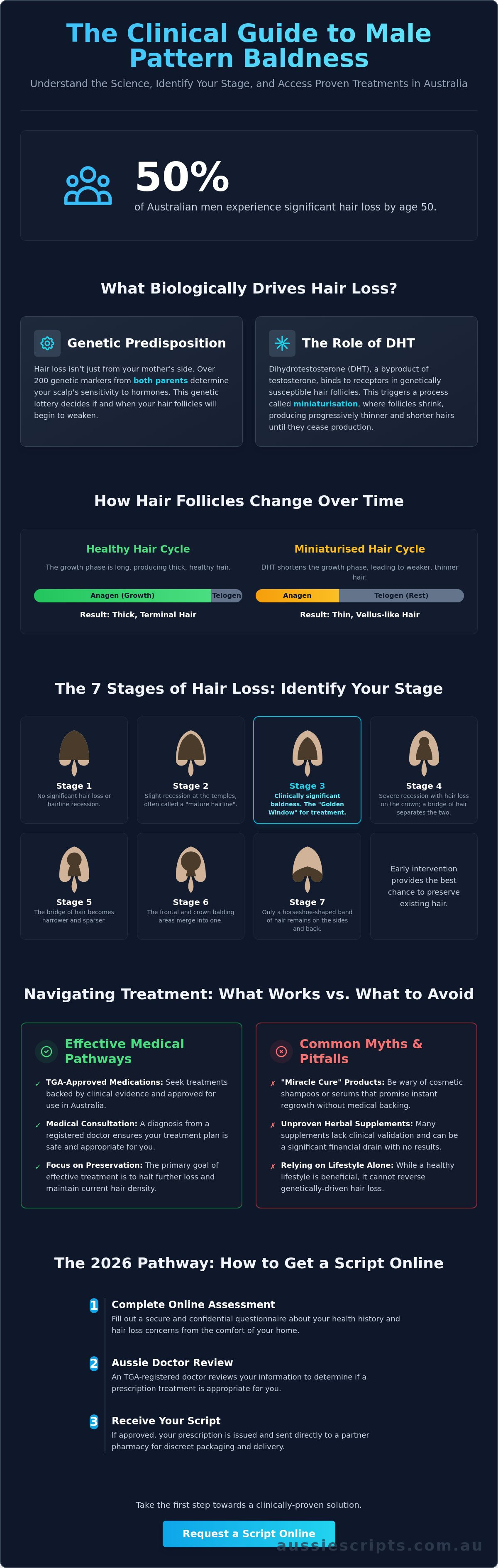
The physical change in the scalp is known as miniaturisation. This process describes a follicle that produces increasingly smaller, thinner hairs with every cycle. Hair growth occurs in stages, primarily the anagen (growth) and telogen (resting) phases. In healthy scalps, the anagen phase lasts several years. In those with male pattern baldness, the anagen phase shortens while the telogen phase remains the same or lengthens. This results in hair that never reaches its full length or thickness. Eventually, the follicle may stop producing visible hair entirely. Once a follicle remains dormant for an extended period, it loses the ability to be reactivated. Swift action is required to maintain the hair you still have.
- Anagen phase: The active growth period, which shortens as the condition progresses.
- Telogen phase: The resting phase, which becomes relatively longer over time.
- Miniaturisation: The process where thick terminal hairs are replaced by fine vellus hairs.
The 7 Stages of Hair Loss: The Norwood Scale
Clinicians use the Norwood Scale as the universal standard for categorising the progression of male pattern baldness. This seven-stage classification system provides a visual roadmap for men to identify their current level of hair loss and determine the most appropriate clinical response. Understanding where you sit on this scale is vital because hair follicles that have been dormant for several years are significantly harder to revive than those in the early stages of thinning.
It's important to distinguish between a maturing hairline and the onset of clinical balding. A maturing hairline is a natural shift where the hairline moves back evenly by approximately 1 to 2 centimetres above the upper brow crease. This usually occurs between the ages of 17 and 29. True recession is often asymmetrical and follows a specific pattern of follicular miniaturisation driven by androgenetic alopecia genetics and hormonal sensitivity.
Early Signs: Stages 1 to 3
Stage 1 is characterised by a full head of hair with no visible recession or thinning at the crown. Stage 2 shows a slight, often symmetrical recession at the temples, frequently referred to as a "mature" hairline. Stage 3 marks the first clinical stage of male pattern baldness. At this point, the recession at the temples becomes deep enough to form a distinct "M", "U", or "V" shape. This period is widely considered the "golden window" for intervention. Medical treatments are most effective when you start them during these initial stages, as the primary goal is to preserve existing hair density and prevent further recession.
Advanced Thinning: Stages 4 to 7
By Stage 4, the hairline recession is more severe, and a noticeable bald spot begins to develop at the back of the head, known as the vertex. A bridge of hair still separates the receding front from the thinning crown. In Stages 5 and 6, this bridge becomes increasingly sparse until it disappears entirely, merging the two balding areas. Stage 7 is the most advanced level, where only a horseshoe-shaped band of hair remains around the sides and back of the scalp.
In these later stages, the clinical focus typically shifts from aggressive regrowth to the maintenance of remaining hair or surgical restoration. While pharmaceutical options can still provide benefits, the likelihood of returning to a Stage 1 or 2 hairline diminishes as the follicles undergo permanent fibrosis. If you notice your hairline shifting beyond the temples, you can request a script through a digital consultation to explore TGA-approved preventative measures before further loss occurs.
- Stage 1-2: Monitoring phase; focus on scalp health.
- Stage 3-4: Active treatment phase; high success rate for preservation.
- Stage 5-7: Management phase; focus on slowing progression or surgical options.
TGA-Approved Treatments: What Actually Works in Australia?
Distinguishing between cosmetic marketing and medical science is the first step in addressing hair loss. Many retail products claim to "thicken" hair, but these are typically cosmetic solutions that coat the hair shaft rather than treating the underlying follicle. In Australia, the Therapeutic Goods Administration (TGA) regulates medications that can actually stop or reverse male pattern baldness. Effective treatment requires a personalised plan from a registered practitioner to ensure the approach suits your specific health profile.
Clinical success relies on the "Big Two" medications: Minoxidil and Finasteride. These are the gold standards for hair loss treatments and have been the foundation of hair preservation for decades. Success isn't instant. You'll need to maintain a consistent routine for 3 to 6 months before visible changes occur. Hair follicles operate on a slow growth cycle, so patience is a clinical necessity during this period. Consistency is the most important factor in seeing a result.
Topical vs. Oral Solutions
Minoxidil acts as a vasodilator, widening blood vessels to deliver more oxygen and nutrients to the follicle. Finasteride works differently by blocking Dihydrotestosterone (DHT), the hormone responsible for follicle miniaturisation in male pattern baldness. While each medication works alone, combination therapy is often more effective because it addresses the problem from two different biological angles. By 2026, delivery methods have evolved significantly. Many patients now prefer dual-action topical sprays that combine both ingredients into a single daily application, reducing the "pill fatigue" often associated with long-term treatment.
Managing Potential Side Effects
Concerns regarding sexual side effects often prevent men from seeking help. Data from clinical trials indicates these effects occur in a very small percentage of users. Specifically, most studies show an incidence rate between 2.1% and 3.8%, which is only marginally higher than the rates reported by placebo groups. Most men use these treatments without any adverse issues.
If side effects do occur, they are typically reversible once a doctor adjusts the dosage or delivery method. A telehealth consultation allows a practitioner to monitor your progress and manage your health safely. It's essential to avoid self-diagnosing or purchasing unregulated products online. Professional oversight ensures your safety and the efficacy of the treatment. Your doctor can help you decide if a topical or oral approach is better suited to your lifestyle and health history.
Common Myths and What to Avoid
Misinformation often delays effective treatment for male pattern baldness. Many men believe that wearing hats frequently or washing their hair daily causes follicles to die. These are myths. Clinical data shows that external friction or hygiene habits don't trigger genetic thinning. Similarly, scalp massages and laser combs lack the robust clinical backing required to be considered primary treatments. While they might slightly improve local circulation, they don't address the underlying hormonal causes of hair loss. Relying on these methods alone often results in the loss of valuable time during the early stages of thinning.
Stress and poor nutrition are frequently blamed for receding hairlines. While severe physiological stress can cause temporary shedding, it's not the driver of androgenetic alopecia. Relying on "miracle" herbal supplements without a medical diagnosis often leads to permanent loss that could've been prevented with TGA-approved interventions. It's essential to distinguish between temporary shedding and the progressive miniaturisation of hair follicles.
The Truth About "Natural" Remedies
The hair loss industry is saturated with unproven "natural" solutions. Saw palmetto and rosemary oil are often marketed as direct alternatives to clinical treatments. However, a 2023 meta-analysis indicated that while some botanical extracts show minor promise, they're significantly less effective than registered medical options. Biotin is another common recommendation, yet it only assists if you have a documented deficiency, which is rare in Australia. Marketing that promises "instant results" or "permanent regrowth" without a practitioner's oversight is usually snake oil. Delaying evidence-based treatment to try these methods allows the hair follicles to miniaturise beyond the point of recovery.
Lifestyle Factors and Hair Health
Lifestyle choices act as secondary modifiers for hair density. Smoking reduces blood flow to the scalp and can exacerbate genetic thinning. A 2022 study published in Archives of Dermatological Research found a statistically significant link between smoking and increased hair loss severity in men. Nutritional deficiencies also play a role. Low iron levels or Vitamin D deficiency can trigger telogen effluvium, a condition where hair enters the shedding phase prematurely. Maintaining a balanced diet supports the health of the hair you have, but it won't stop the progression of male pattern baldness on its own. A holistic approach combines healthy habits with professional medical guidance.
If you're ready to move past myths and access clinically proven options, you can request a script through Aussie Scripts for a professional medical consultation.
How to Get a Hair Loss Script Online in 2026
The healthcare landscape for men has changed significantly since the early 2020s. Managing male pattern baldness no longer requires taking time off work for a physical GP appointment or sitting in a crowded waiting room. Telehealth has become the primary method for accessing clinical treatments, offering a level of discretion and speed that traditional clinics often struggle to match. In 2026, the shift toward digital-first medical reviews reflects a broader demand for efficient, professional healthcare that fits into a busy schedule.
Aussie Scripts facilitates this process by connecting patients with Australian-registered doctors through a secure, compliant platform. This digital approach removes the friction of face to face consultations while maintaining strict medical oversight. For many men, the privacy of an online assessment is a deciding factor in starting treatment early, which is critical for long term hair retention and effective management of follicular health.
The Telehealth Consultation Process
- Step 1: Digital Assessment. You'll complete a targeted health questionnaire. This focuses on your medical history, the current state of your male pattern baldness, and any previous treatments you've tried.
- Step 2: Medical Review. An Australian-registered doctor reviews your information. They determine your suitability for specific medications based on clinical guidelines and TGA regulations.
- Step 3: Script Issuance. Once approved, you receive a digital eScript or can choose to have your medication delivered directly to your door in plain, discreet packaging.
Why Use Aussie Scripts for Hair Loss?
Choosing a digital platform provides a streamlined alternative to the traditional pharmacy model. You can access medical reviews seven days a week without needing to book an appointment weeks in advance. The platform operates within the rigorous framework of the Australian healthcare system, ensuring every script is backed by professional medical judgment. This adherence to TGA standards means you receive the same clinical care you'd expect at a local clinic, but with the added convenience of a digital interface.
Security remains a primary concern for many users. All personal and medical data is handled through encrypted platforms that meet national privacy standards, such as the Australian Privacy Principles. This ensures your health journey remains confidential from the initial assessment through to delivery. By removing the logistical barriers of physical clinics, Aussie Scripts allows you to focus on your treatment plan without unnecessary delays or the discomfort of discussing sensitive issues in a public setting.
Ready to take the next step in your hair health journey? Request your hair loss consultation with Aussie Scripts today and access professional medical support from home.
Take Control of Your Hair Restoration Strategy
Managing male pattern baldness in 2026 requires a proactive approach centered on early identification and clinical intervention. Research indicates that interventions initiated during the first three stages of the Norwood Scale yield the most consistent results for hair retention. By focusing on TGA-approved treatments rather than unverified online myths, you ensure your health remains a priority while following established Australian medical protocols.
Aussie Scripts streamlines this process by removing the logistical hurdles of traditional clinics. Our platform connects you with Australian-registered doctors who review your history and provide professional guidance. Once a practitioner approves your request, your digital script is delivered directly to your phone via SMS or email within hours. We've supported thousands of Australians with private, efficient healthcare solutions that fit a modern schedule. You can access the medical support you need without the friction of a physical waiting room.
Start your discreet hair loss consultation now
Taking the first step toward a clinical solution is a practical way to manage your long-term hair health with confidence.
Frequently Asked Questions
Is male pattern baldness reversible if I start treatment early?
Most cases of male pattern baldness aren't fully reversible, but early intervention can stop further thinning and regrow hair in active follicles. Clinical data indicates that 80% of men see improvements or a halt in loss when starting treatment at the first signs of recession. If you wait until the follicle has completely miniaturised and scarred, regrowth becomes impossible. Early action is the most effective way to maintain your current hair density.
How long does it take to see results from hair loss medication?
You'll typically see visible results from hair loss medication within 3 to 6 months of consistent daily use. Hair growth cycles are slow, and it often takes 12 months to see the full peak effect of any clinical treatment. According to TGA-approved product guidelines, initial shedding might occur in the first 4 weeks as old hairs make way for new growth. Patience and consistency are vital for success.
Do I need a prescription for hair loss treatment in Australia?
You require a prescription from a registered Australian practitioner for oral hair loss treatments, as these are classified as Schedule 4 medications. While some low-strength topical solutions are available over-the-counter, higher-strength formulations and tablets must be approved by a doctor. You can request a script through a telehealth consultation to ensure the treatment is safe for your specific medical profile and health history.
Can stress cause male pattern baldness or is it just genetics?
Genetics and hormones cause male pattern baldness, while stress typically triggers a temporary condition called telogen effluvium. Research shows that 95% of permanent hair loss in men is due to androgenetic alopecia, which is an inherited sensitivity to dihydrotestosterone. If your hair loss follows a distinct pattern of a receding hairline or thinning crown, it's likely genetic. Stress might accelerate the process, but it isn't the primary cause.
What happens if I stop taking hair loss medication?
If you stop taking hair loss medication, your hair will return to its natural thinning pattern within 6 to 12 months. The treatment works by blocking DHT or stimulating follicles, but it doesn't permanently change your DNA. Once the active ingredients leave your system, any hair maintained or regrown by the medication will eventually fall out. Long-term maintenance is required to keep the results achieved during the treatment period.
Are online doctors for hair loss legitimate and safe?
Online doctors are legitimate and safe provided they're registered with AHPRA and operate within Australian clinical guidelines. Telehealth platforms use Australian-licensed practitioners to review your medical history before issuing a script. This digital process maintains the same safety standards as a physical clinic while offering an efficient way to manage your healthcare. It's a regulated, professional service designed to provide clinical care without the need for a physical waiting room.
Can women use the same hair loss treatments as men?
Women can't always use the same hair loss treatments as men due to different hormonal profiles and potential risks during pregnancy. While some topical solutions are used by both genders, certain oral medications are strictly TGA-approved for men only. Using the wrong treatment can lead to hormonal imbalances or complications. Women should always consult a healthcare professional to discuss treatments specifically formulated for female pattern hair loss to ensure safety.
How much does a typical hair loss treatment plan cost in Australia?
A typical hair loss treatment plan in Australia costs between A$30 and A$100 per month depending on the specific medication and dosage required. According to 2024 pharmacy price surveys, generic versions of common treatments offer a more cost-effective entry point for long-term maintenance. You'll also need to factor in the cost of a private consultation if you're not using a bulk-billing service. Prices vary based on whether you choose topical or oral options.
Disclaimer
The information provided by AussieScripts is for general informational purposes only and does not constitute medical advice, diagnosis, or treatment. For advice tailored to your specific symptoms or health concerns, please consult one of our doctors or your regular GP.
