Managing Children’s Asthma with Telehealth in Australia
Learn about managing children's asthma with telehealth in Australia. Discover when remote care is suitable, how to prepare, and when to see a doctor in person.
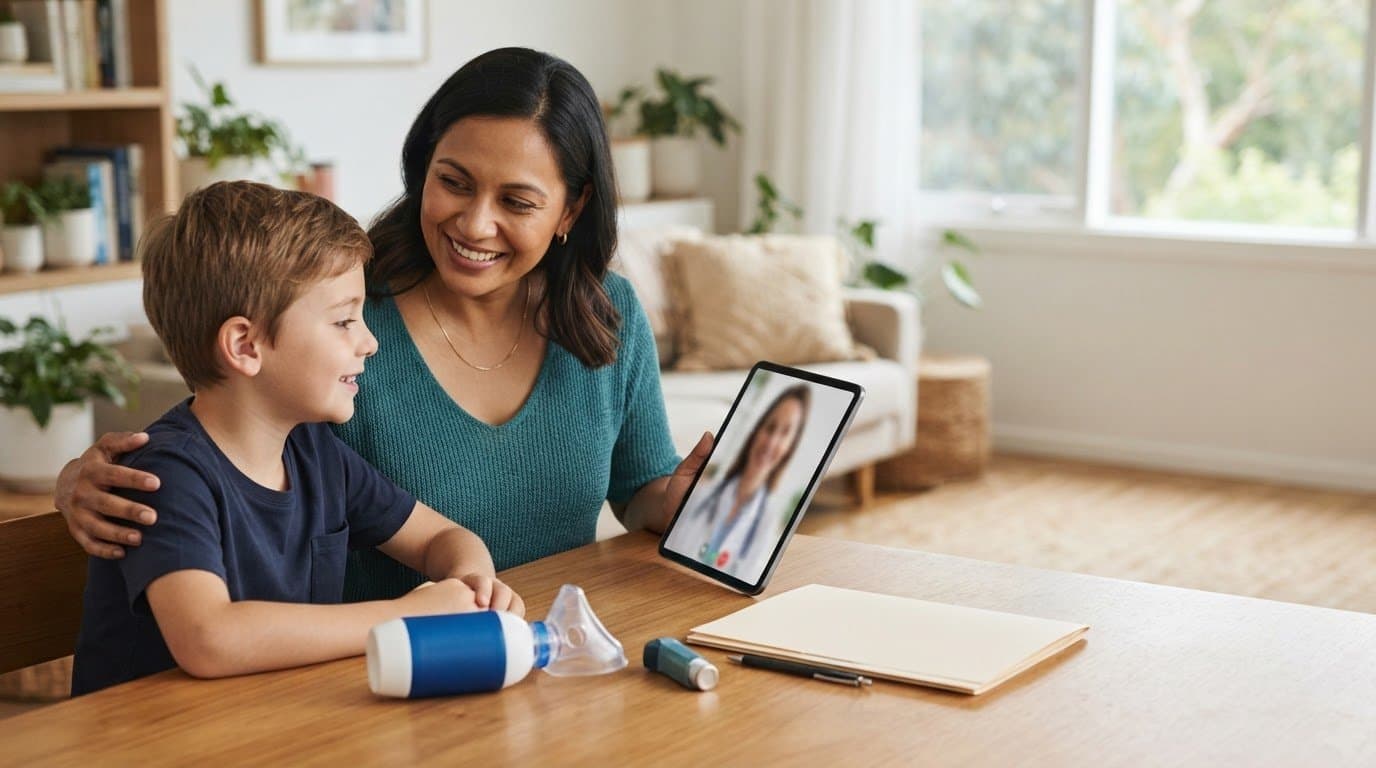
Could a phone or video consultation help with your child’s asthma, or do they need to be seen in person? Managing children's asthma with telehealth can provide access to a clinical assessment when the concern is suitable for remote care. But telehealth can’t replace an examination when one is needed, and it isn’t the right option for an emergency.
It’s reasonable to be unsure what a doctor can assess remotely, what information to have ready and when not to wait for an appointment. The right next step depends on your child’s circumstances. If they’re having severe breathing difficulty or you’re concerned they need urgent help, call 000.
This guide explains what telehealth may help with, what a doctor may need to assess and how to prepare useful details, such as your child’s symptoms, current medicines and Asthma Action Plan. It also covers when in-person assessment is important. An Australian-registered doctor can assess the information you provide and determine suitable next steps, while your child’s regular GP or specialist remains part of their ongoing care.
Key Takeaways
- Managing children's asthma with telehealth may suit non-urgent concerns, but the doctor decides whether remote assessment is sufficient.
- Describe what has changed, when you noticed it and how it affects your child to help the doctor understand the concern.
- Keep your child’s asthma history and existing care information nearby so you can answer questions clearly.
- A telehealth doctor may recommend an in-person assessment if they need more information to guide next steps.
- Use telehealth to support, not replace, the ongoing care provided by your child’s regular GP or specialist.
Managing children’s asthma: where telehealth fits in the care picture
Telehealth is a remote clinical consultation, usually by phone or video, where a doctor discusses a patient’s health and considers appropriate next steps. It can be a practical way to raise a child’s asthma concerns, but it isn’t a substitute for every type of care. As a broad overview, Telehealth includes health services delivered remotely. What a doctor can assess during a consultation depends on the information available and the child’s needs.
Telehealth can support asthma care when a child’s concern is suitable for remote assessment, but it cannot replace urgent or in-person care when that is needed. The doctor considers the child’s health history alongside your description of what is happening now. They decide whether the available information is enough to guide next steps or whether an in-person assessment is more appropriate.
Planned support and urgent assessment are different. A routine consultation may suit an ongoing, non-urgent concern, but it should not delay urgent care if your child needs immediate help. If it’s an emergency, call 000. Aussie Scripts is not an emergency service.
What parents may use a telehealth consultation to discuss
You can explain what you’ve noticed, when the concern began, whether it is changing and how it affects your child. Useful context may include your child’s asthma history, medicines they currently use, previous care advice and any written Asthma Action Plan. Share what you know in everyday language. You don’t need to diagnose the cause before speaking with a doctor.
The doctor will assess the information you provide and decide whether the concern can be evaluated remotely. If they need information that can’t be obtained through the consultation, they may recommend in-person assessment. A consultation does not guarantee a diagnosis, prescription or change to treatment. The clinician determines suitable next steps based on your child’s circumstances.
How telehealth relates to a child’s regular asthma care
Your child’s regular GP remains an important point of contact for ongoing asthma care. They may know your child’s history, previous assessments and existing care arrangements. A telehealth consultation can provide another route to clinical assessment when appropriate, but it doesn’t replace the regular GP or any specialist involved in your child’s care.
To support continuity, keep a record of the consultation’s outcome and share relevant information with your child’s regular GP or specialist, particularly if the doctor recommends follow-up or further assessment. A brief note of the date, the concern discussed and any recommended next steps can help you explain what happened at a later appointment. If your child has an established care plan, continue to use it as directed by their clinician and seek advice if their needs change.
For parents managing children's asthma with telehealth, the key is to treat remote care as one part of a broader care picture. An Australian-registered doctor assesses the information you provide and determines next steps, while urgent concerns require urgent attention.
How a telehealth doctor assesses a child’s asthma concerns
A telehealth assessment is a clinician-led conversation, not an automatic diagnosis or treatment decision. The doctor uses the information available during the consultation, including your child’s health history and your account of the current concern. They may ask follow-up questions to clarify what has changed, how long it has been happening and what care your child already receives.
The doctor determines whether a child’s asthma concern is suitable for remote assessment and what next steps are appropriate. The same concern can require different action depending on the child’s circumstances. General information about asthma can help parents understand the topic, but it isn’t individual medical advice. Follow the clinician’s advice for your child rather than treating general guidance as an instruction for their care.
What information may help the doctor assess the concern
Before the appointment, gather relevant details so you can describe the situation clearly. You don’t need to interpret symptoms or decide what they mean. A short, factual account helps the doctor understand your concern and ask focused questions.
- Your child’s asthma history and any relevant health conditions.
- What you’ve noticed, when it started and whether it has changed.
- Current medicines and any recent changes, as you understand them.
- Existing care-plan information, including a written Asthma Action Plan if your child has one.
For example, describe what you observed and when, rather than guessing at a cause. If you’re unsure about a detail, say so. Keep any existing care-plan instructions available and don’t change them based on an article or in preparation for the consultation. The doctor can consider the information and discuss suitable next steps.
When remote assessment may not be enough
A phone or video consultation cannot provide a physical examination. If the doctor needs to assess your child in person, or the information available remotely isn’t sufficient, they may recommend in-person care. This is a clinical decision, not a sign that you’ve prepared incorrectly. Explain your concern plainly and follow the clinician’s direction about further assessment.
Don’t use a routine telehealth appointment to manage an emergency. If your child needs immediate emergency help, call 000. Aussie Scripts is not an emergency service, and a remote consultation should not delay emergency care.
For non-urgent concerns that may be suitable for remote assessment, an Australian-registered doctor can review the information you provide and determine next steps. Aussie Scripts telehealth consultations provide access to a clinical assessment, while your child’s regular GP or specialist remains part of their ongoing care. This clinician-led approach is central to managing children's asthma with telehealth: the consultation supports assessment, but the doctor decides whether remote care is appropriate.
Telehealth or in-person care for a child with asthma?
Telehealth isn’t suitable for every asthma concern. It may be a useful way to discuss a non-urgent issue, but the clinician must decide whether the information available remotely is enough. A parent’s preference for an online appointment can’t determine clinical suitability on its own.
Use this comparison as a guide to the type of care to consider, not as a way to diagnose your child or judge how serious their symptoms are.
| Type of concern | Care to consider | What to keep in mind |
|---|---|---|
| A non-urgent question about ongoing asthma care or a change you’ve noticed | A telehealth consultation may be considered | The doctor assesses the concern and decides whether remote evaluation is appropriate. |
| A concern that may need an examination or more information than a remote appointment can provide | In-person assessment may be needed | The clinician may recommend this if they can’t assess the concern adequately by phone or video. |
| An emergency or a situation where you think your child may be in immediate danger | Call 000 | Don’t delay emergency care to book or attend a telehealth consultation. |
Situations where a remote consultation may be considered
You may want to discuss a non-urgent question about your child’s asthma history, current care or a change you’ve observed. A telehealth appointment gives the doctor an opportunity to hear the concern, ask questions and assess the information you provide. Whether it’s suitable depends on the clinical assessment, not simply on convenience or your preference.
The consultation may lead to advice about next steps, or the doctor may decide another type of assessment is needed. It doesn’t guarantee a diagnosis, prescription or change to your child’s asthma plan. Keep following existing clinician-provided instructions unless your child’s doctor advises otherwise.
When to seek urgent help instead of telehealth
If you believe your child may be in immediate danger, call 000. Don’t wait to complete an online booking, submit information or speak with a telehealth doctor before seeking emergency help. Aussie Scripts is not an emergency service.
For concerns that aren’t emergencies but may need your child to be examined, seek in-person assessment rather than relying on a remote appointment. The Australian Asthma Handbook, published by the National Asthma Council Australia, provides national guidance on asthma management. A clinician can advise how that guidance applies to your child. Don’t use a general article or checklist to decide that symptoms are safe to manage remotely.
For parents managing children's asthma with telehealth, the key distinction is the level of assessment required. A remote consultation may suit some planned discussions. If the doctor can’t assess the concern adequately from the information available, they may recommend in-person care. In an emergency, call 000.
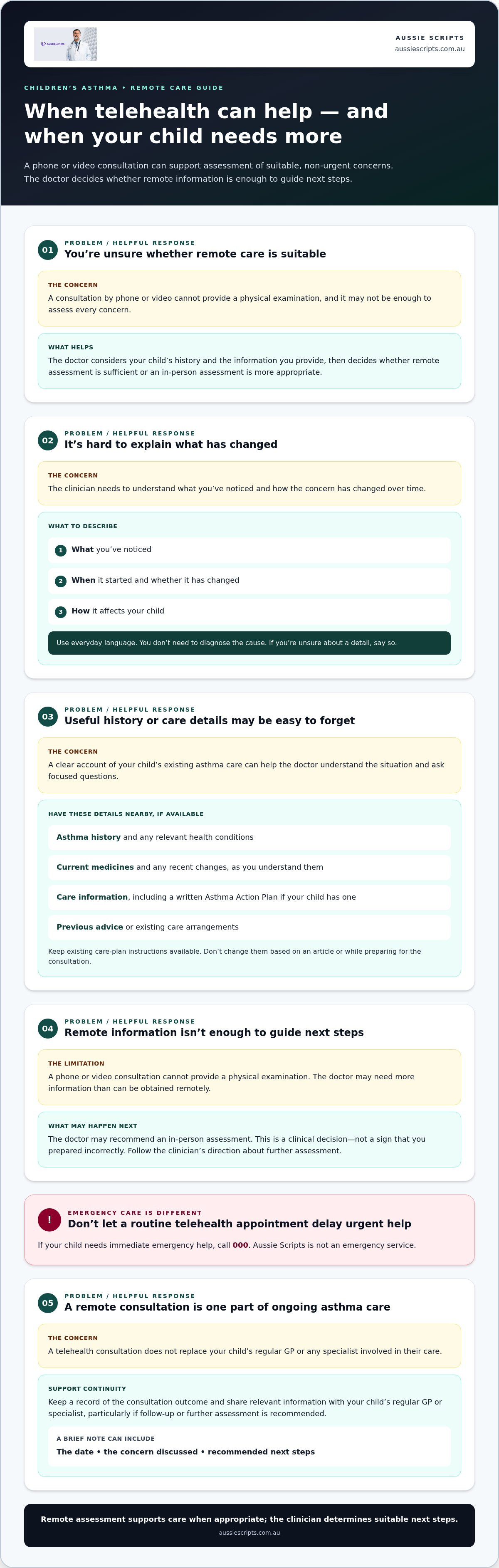
How to prepare for a child’s asthma telehealth consultation
A little preparation can help you explain your child’s concern clearly and find useful details during the appointment. You don’t need to diagnose the problem or decide what treatment is needed. Your role is to describe what you’ve observed and share relevant information; the doctor will ask follow-up questions and determine suitable next steps.
Information to have ready before the appointment
Keep the essentials together, either in notes or nearby documents. A concise timeline is often more useful than a long account that’s difficult to follow. Include what changed and when, and describe observations rather than guessing at their cause.
- Summarise the concern. Note when it began, what you’ve noticed and whether anything has changed since.
- Gather relevant history. Have information about your child’s asthma and other relevant health conditions available.
- Check current care details. Keep a list of medicines as you understand them, along with existing care-plan information and any written Asthma Action Plan.
- Write down questions. Record what you want to ask, including anything you’re unsure about or would like the doctor to explain.
For example, note when a change first caught your attention and how it has affected your child’s usual activities. If you don’t know an answer, say so rather than trying to fill in the gaps. Keep following your child’s existing care instructions. Don’t start, stop or change medicines based on general information in an article; ask the doctor about your child’s individual care.
Have your child available for the consultation if appropriate, and choose a setting where you can hear the doctor and describe your observations. The doctor may ask questions you didn’t anticipate. Clear, factual answers help them understand the concern, but you don’t need to have every detail perfectly organised.
What happens after the clinical assessment
There isn’t one outcome for every consultation. After considering the information provided, the doctor determines suitable next steps. They may discuss the concern with you or recommend another type of assessment if the issue can’t be evaluated adequately remotely. A telehealth consultation doesn’t guarantee a diagnosis, prescription or change to your child’s asthma care.
If a prescription is issued, it must be filled at a pharmacy, which may charge separately. The doctor can explain the next steps relevant to the consultation. To support continuity, share relevant outcomes or recommendations with your child’s regular GP where appropriate, especially if further assessment or follow-up is advised. Telehealth should complement, not replace, your child’s established care with their regular GP or specialist.
Preparing this information can make managing children's asthma with telehealth more straightforward, while leaving clinical decisions to the doctor. Aussie Scripts provides telehealth consultations for clinical assessment by Australian-registered doctors.
Accessing children’s asthma support through Aussie Scripts telehealth
Aussie Scripts is an Australian-owned telehealth service connecting people across Australia with Australian-registered doctors. For a non-emergency concern that may be suitable for remote assessment, select a relevant consultation and provide information about your child and the reason for seeking care. The doctor reviews what you share and determines appropriate next steps. A consultation doesn’t guarantee a diagnosis, prescription or change to asthma treatment.
Telehealth is not suitable for every situation. Aussie Scripts does not provide in-person physical examinations or emergency care. If your child needs immediate emergency help, call 000 rather than booking or waiting for an online consultation.
What families can expect from an online consultation
The doctor may ask questions to understand your child’s health history and current concern. They’ll assess the available information and decide whether remote consultation is suitable or whether another type of assessment is needed. The assessment fee covers the clinical consultation, not medicines from a pharmacy or other external services. If a prescription is issued, it must be filled at a pharmacy, which may charge separately.
Keep your child’s regular GP or specialist involved in ongoing care. Sharing relevant outcomes from a telehealth consultation can help maintain continuity, particularly if the doctor recommends follow-up or an in-person assessment. Telehealth can support access to a clinician; it doesn’t replace your child’s established care relationships or plan.
Choosing the next step for your child
For a non-emergency concern that may be suitable for remote assessment, a general telehealth consultation can provide access to a doctor who will consider the information you provide. The doctor, not the booking choice alone, determines whether remote assessment is appropriate. If they can’t assess the concern adequately through telehealth, they may recommend in-person care.
If the situation is urgent, seek urgent in-person care. In an emergency, call 000. Don’t delay urgent care to complete an online booking or consultation. Aussie Scripts is not an emergency service.
Before booking, consider whether the concern is non-urgent and whether you can share your child’s relevant health and care information with the doctor. This can help keep the consultation focused, while leaving assessment and next-step decisions to the clinician. For families managing children's asthma with telehealth, this distinction clarifies the service’s role: it offers a route to clinical assessment when appropriate, not a substitute for every form of asthma care.
If a non-emergency concern may be suitable for remote assessment, Aussie Scripts offers general telehealth consultations with Australian-registered doctors. Continue coordinating your child’s asthma care with their regular GP or specialist.
Make your child’s asthma information easier to carry forward
Keep a simple record of your child’s asthma-related appointments and the questions you want answered. Note when a concern arose, what you discussed with the doctor and any follow-up they recommended. This can make future conversations more focused without requiring you to interpret symptoms or make treatment decisions yourself.
Managing children's asthma with telehealth is one part of a longer care journey. Keeping relevant information together can help you explain what has changed at a later consultation and support communication between the clinicians involved in your child’s care. Follow the doctor’s advice for your child, and don’t alter an existing care plan based on general information alone.
If a non-emergency concern may be suitable for remote assessment, book a general telehealth consultation with Aussie Scripts to discuss it with an Australian-registered doctor. Keep your child’s regular GP or specialist involved in ongoing care.
Frequently Asked Questions
Can a telehealth doctor assess a child with asthma?
Yes, an Australian-registered doctor may assess a child remotely if the concern is clinically appropriate for telehealth. The doctor considers the information available, including your description and relevant health history, then decides what should happen next. Before the appointment, note any advice already provided by your child’s care team and what has changed since. The doctor may recommend in-person assessment if a remote review isn’t enough.
Is telehealth suitable if my child’s asthma symptoms are getting worse?
Worsening symptoms need prompt clinical judgement, and telehealth may not be enough on its own. Don’t wait for an online appointment if you think your child needs urgent help. For an emergency, call 000. If you’re unsure whether a remote consultation is suitable, prioritise timely clinical assessment rather than relying on a symptom checklist or trying to judge severity from general information.
Can an online doctor prescribe asthma medication for a child?
A doctor may consider prescribing only as part of an individual clinical assessment; a prescription isn’t guaranteed. The clinician decides what next steps are appropriate based on your child’s circumstances and the information available. If an electronic prescription is issued, Aussie Scripts doesn’t supply the medicine. You’ll need to have it filled at a pharmacy, and the pharmacy may charge separately for the medicine.
What should I prepare before a telehealth appointment about my child’s asthma?
Have your child’s relevant medical history, current concerns and existing asthma-care information nearby. A brief note with when the concern began and what you’ve observed can help you explain it clearly. Write down questions you want answered, such as what follow-up may be needed. Don’t change your child’s medicines or care plan before the consultation based on general advice; discuss any concerns with the doctor.
Can a telehealth consultation replace my child’s regular GP?
No. Telehealth can provide access to a clinical assessment, but it shouldn’t replace ongoing care with your child’s regular GP or specialist. Those clinicians may have important context about your child’s history and care. If you have a telehealth consultation, share relevant outcomes or recommendations with the regular care team where appropriate. This helps keep everyone involved informed as you manage your child’s asthma over time.
What should I do if my child is having an asthma emergency?
Call 000. Aussie Scripts is not an emergency service, and you shouldn’t delay urgent care to book or attend a telehealth consultation. If you already have a written Asthma Action Plan, follow the instructions provided by your child’s clinician while seeking emergency help. Don’t rely on this FAQ to assess symptoms or decide whether an emergency is occurring. Act promptly if you believe your child is in danger.
Will an Aussie Scripts telehealth consultation guarantee an asthma prescription?
No. The consultation is a clinical assessment, and the doctor determines the appropriate next steps. A prescription or treatment change isn’t guaranteed; the outcome depends on the clinical assessment. If the doctor issues an electronic prescription, it must be filled at a pharmacy. The pharmacy supplies the medicine and may charge separately. The consultation is for assessment, not a promise of a particular prescription or result.
Disclaimer
The information provided by AussieScripts is for general informational purposes only and does not constitute medical advice, diagnosis, or treatment. For advice tailored to your specific symptoms or health concerns, please consult one of our doctors or your regular GP.
