Non-injection medical weight loss options: A practical guide
Explore non-injection medical weight loss options in Australia. Learn about oral treatments, clinician guidance, and TGA versus PBS regulations in this guide.

Avoiding injections doesn’t mean choosing between medication and lifestyle changes alone. Non-injection medical weight loss options can include clinician-guided support for nutrition, activity and behaviour, and, for some people, prescription medicines taken by mouth. The right approach depends on your health and circumstances, so it helps to understand how the pathways differ and what their practical demands may be.
This guide compares common non-injection approaches and explains what an Australian-registered doctor may consider when assessing suitability, potential risks and next steps. It also clarifies the difference between TGA approval, a PBAC recommendation and an actual PBS listing. Wegovy, for example, is TGA-approved for chronic weight management in eligible adults but isn’t yet PBS-listed. Ozempic is PBS-listed for specific diabetes indications, not weight loss. A weight-loss consultation with Aussie Scripts gives you an opportunity to discuss your health background, preferences and questions with an Australian-registered doctor. A consultation doesn’t guarantee a prescription or a particular treatment.
Key Takeaways
- Non-injection medical weight loss options include clinician-guided lifestyle support and, where appropriate, oral prescription medicine. A doctor may discuss these approaches together.
- Compare options by their purpose, clinical oversight and practical demands, not by convenience alone.
- A doctor can assess your health history, current medicines, goals and potential risks before discussing suitable next steps.
- Before a consultation, note your preferences, why you want to avoid injections and any practical barriers that could affect your care.
- A telehealth weight-loss consultation with an Australian-registered doctor can help you discuss suitability and possible next steps without assuming a particular treatment is right for you.
What are non-injection medical weight loss options?
Non-injection medical weight loss options are approaches to managing weight that don’t require treatment to be administered by injection. They can include clinician-guided support for nutrition, physical activity and behaviour, as well as oral prescription medicines when a doctor considers them appropriate. These are distinct pathways, though lifestyle support and medicine may be discussed together.
Wanting to avoid injections is useful information to share, but it doesn’t determine which treatment is suitable. A doctor considers your health and circumstances before discussing options. Medicines can differ in their purpose, potential risks and suitability. For general background on medication types, see this overview of anti-obesity medications.
This video discusses medication alternatives to injectable GLP-1 medicines:
Which weight-management approaches do not involve injections?
A clinician-guided plan may address everyday factors involved in weight management, such as eating patterns, physical activity and routines. Support can be considered in light of your health needs and practical circumstances. This isn’t the same as taking medicine, although both may form part of a broader care plan.
Oral prescription medicines are another category to discuss with a doctor. They’re taken by mouth, but that doesn’t make them suitable for everyone or predict their effects. A doctor can assess whether a medicine-based approach is relevant to your circumstances and explain its potential risks and requirements.
Does medical weight management always mean injectable medicine?
No. Medical support can involve more than injectable medicines. Depending on the person, a doctor may discuss lifestyle support, medicine or a combination where appropriate. These pathways aren’t interchangeable: they can differ in purpose, potential risks, practical demands and suitability.
Share your preference with the doctor, along with any concerns about oral medicine or making changes to food, activity or routines. This context can help guide the discussion, while a clinical assessment informs recommendations. The aim is to consider a suitable next step, not to assume a treatment is right simply because it avoids injections.
Compare non-injection medical weight loss options by support and oversight
Non-injection medical weight loss options differ in more than how they’re delivered. Compare what each approach is intended to support, the clinical input involved and whether follow-up may be needed. The table is a starting point, not a ranking: suitability and individual outcomes vary.
| Pathway | Purpose | Clinical oversight | Practical considerations and questions |
|---|---|---|---|
| Lifestyle support | Support changes to nutrition, physical activity and behaviours as part of ongoing weight management. | May be guided by a clinician, depending on the care plan. | What changes are realistic for your routine? What support would help you maintain them? |
| Clinician-supported program | Bring assessment and ongoing support together, potentially including lifestyle guidance and discussion of medicine. | A doctor can consider your health information and guide recommendations. | What does the plan involve? How will progress and next steps be reviewed? |
| Oral prescription medicine | Consider medicine taken by mouth when a doctor assesses it as appropriate. | Requires clinical consideration of suitability, potential risks and follow-up. | Is a medicine appropriate for you? What are its Australian approval status, possible effects and practical requirements? |
Medicine-specific indications, availability and regulatory status should be checked against current Australian information. Overseas approval or availability doesn’t establish that a medicine is approved or available for the same purpose in Australia.
How does non-medication support differ from oral medicine?
Lifestyle and behaviour support focuses on daily habits and their ongoing management. Oral medicines are a separate treatment category, with their own indications, potential risks and requirements. A doctor can assess whether non-medication support, medicine or combined care may be appropriate. These approaches aren’t interchangeable, and the table shouldn’t be read as a comparison of expected weight loss.
What should an option comparison include?
Look beyond the route of administration. Consider the purpose of the approach, who provides oversight, the effort or routine it may involve, and whether follow-up is needed. Separate established information, such as a medicine’s Australian approval status, from individual outcomes, which can vary. A doctor can help interpret these details in light of your health history and preferences.
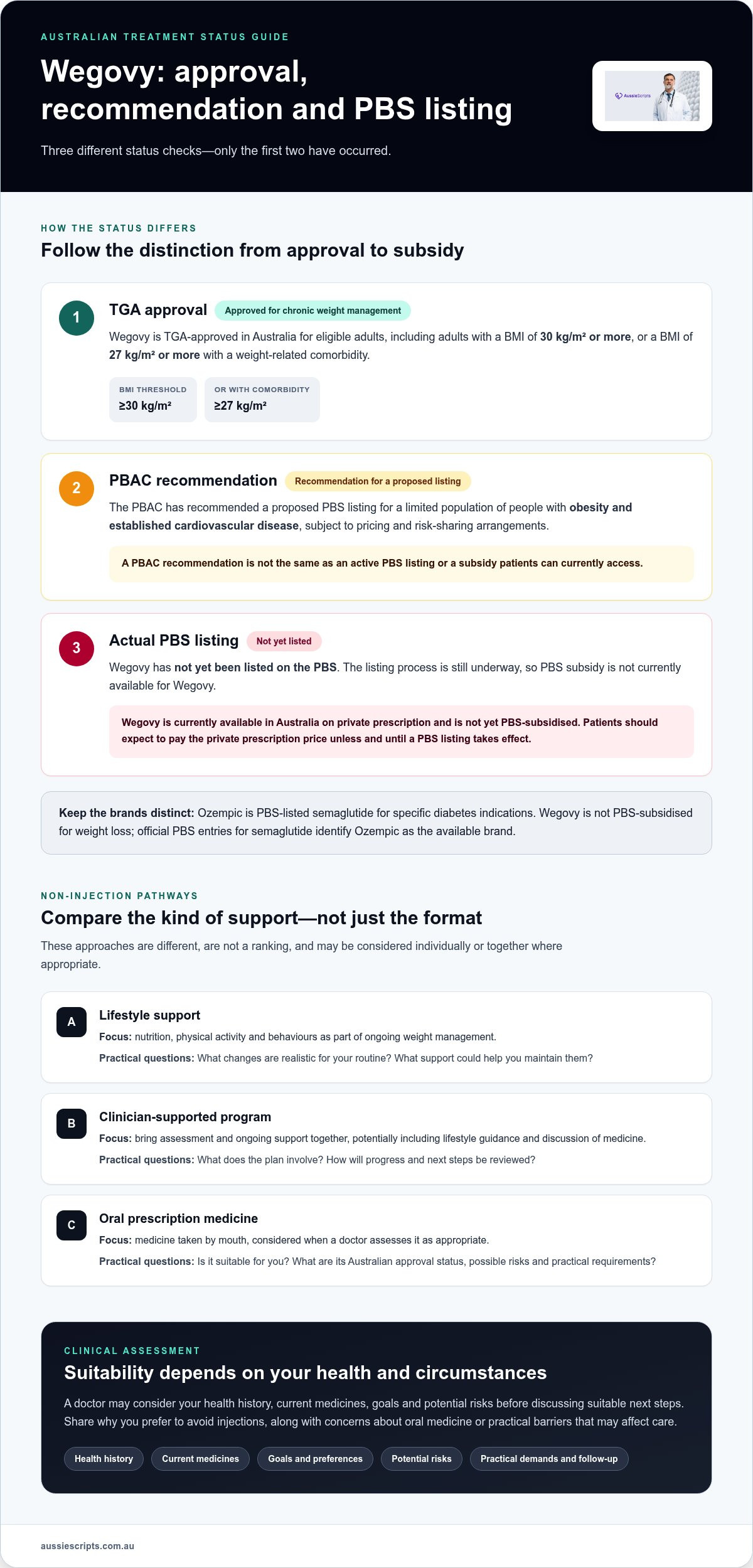
For example, the TGA has approved Wegovy for chronic weight management in eligible adults, including adults with a BMI of 30 kg/m² or more, or 27 kg/m² or more with a weight-related comorbidity. TGA approval is distinct from a PBS listing. The PBAC has recommended a proposed listing for a limited group of people with obesity and established cardiovascular disease, subject to pricing and risk-sharing arrangements, but Wegovy isn’t yet PBS-listed. The RACGP overview of Wegovy and the PBS explains this distinction.
If you’d like to discuss how these categories relate to your circumstances, an online weight-loss consultation with an Australian-registered doctor gives you an opportunity to discuss clinical assessment and possible next steps.
Safety, suitability, and the Wegovy and PBS distinction in Australia
A treatment’s route or approval status doesn’t determine whether it’s suitable for you. Before recommending an approach, a clinician considers your health history, current medicines, weight-management goals and potential risks. Share your preference to avoid injections, too. It can inform the discussion, but doesn’t replace an individual assessment.
What do TGA approval, PBAC recommendation, and PBS listing mean?
These terms describe different steps. TGA approval means a medicine is approved in Australia for specified uses. It doesn’t mean the medicine is subsidised by the Australian Government. PBAC recommendation means the Pharmaceutical Benefits Advisory Committee has recommended a proposed PBS listing. A recommendation isn’t an active listing or a guarantee that a subsidy is in place.
Wegovy is TGA-approved for chronic weight management in eligible adults: those with an initial BMI of 30 kg/m² or more, or 27 kg/m² or more with at least one weight-related comorbidity. The PBAC has recommended a proposed PBS listing for a limited population of people with obesity and established cardiovascular disease, subject to pricing and risk-sharing arrangements.
Wegovy is not yet listed on the PBS, and the listing process has not been completed. It’s currently available in Australia on private prescription and is not PBS-subsidised for weight loss. The PBAC recommendation should not be interpreted as access to a PBS subsidy.
Is Wegovy the same as a non-injection option or Ozempic?
No. Wegovy is an injectable medicine, so it isn’t one of the non-injection medical weight loss options. Its TGA-approved use for weight management is separate from its PBS status.
Wegovy and Ozempic both contain semaglutide, but they have different approved uses and PBS status. Ozempic is PBS-listed for specific type 2 diabetes indications. That doesn’t mean it’s PBS-subsidised for weight loss or that it should be treated as a substitute for Wegovy. A doctor needs to assess a medicine’s suitability and any appropriate use.
If you’re comparing options, keep three questions separate: is the medicine TGA-approved for the intended use, has the PBAC recommended a proposed subsidy, and is it actually listed on the PBS? A weight-loss consultation with an Australian-registered doctor can help you discuss your medical circumstances and possible next steps without assuming that a particular medicine is suitable.
Choosing the right non-injection weight loss pathway
A clear decision process can turn a preference to avoid injections into a useful clinical discussion. The aim isn’t to select a medicine independently. It’s to identify what matters to you, share relevant information and discuss a next step with a doctor.
- Identify your preferences. Explain why you’d rather avoid injections, such as discomfort, convenience or another concern. Mention practical barriers, including routines that could make regular treatment or follow-up difficult.
- Prepare your health information. Note relevant health history, current medicines, previous weight-management approaches and your goals. Include questions or concerns you’d like addressed.
- Discuss the available approaches. Ask about clinician-guided lifestyle support, oral medicine or a combination, if appropriate. Your doctor can explain what may be relevant to your circumstances.
- Review benefits and risks. Ask what the treatment aims to achieve, what’s uncertain, what potential effects to consider and what alternatives may be available. Don’t assume a non-injection approach is automatically safer or more suitable.
- Agree on follow-up. Clarify what monitoring or review may be needed and when to discuss how the plan is working. Recommendations may change as your health needs, response and clinical advice evolve.
This approach supports shared decision-making. Your preferences matter, and so do clinical considerations. A medicine isn’t guaranteed to be recommended, and no single pathway is universally best.
What information should you prepare for a medical discussion?
Bring a concise account of your health history, current medicines and previous approaches to weight management, including what felt manageable or difficult. Describe your goals and why you prefer not to have injections. Note practical considerations, such as routines or follow-up needs, that may affect your ability to continue a plan.
How can you compare benefits, risks and practical fit?
Ask the doctor to explain the intended aims, possible adverse effects, uncertainties and alternatives for each clinically appropriate pathway. Compare the practical requirements, too: what changes or treatment routines may be involved, what monitoring is needed and how follow-up will work. This helps you weigh options with clinical guidance rather than choosing based on a promise or headline claim.
A weight-loss consultation through Aussie Scripts connects you with an Australian-registered doctor for clinical assessment and discussion of next steps. Arrange a weight-loss consultation to discuss your preferences and circumstances.
Discuss non-injection weight loss options through Aussie Scripts
Comparing approaches can help you identify what you’d like to discuss, but an individual clinical assessment is needed to guide treatment decisions. Aussie Scripts connects patients across Australia with Australian-registered doctors through telehealth. In a weight-loss consultation, you can share your health information, goals and treatment preferences, including why you’d prefer to avoid injections.
What happens during a telehealth weight-loss consultation?
You can explain what you’ve tried, what matters to you and any concerns about non-injection medical weight loss options. The doctor considers the information you provide and discusses next steps that may be clinically appropriate. Depending on your circumstances, the discussion may include lifestyle support, medicine or other relevant considerations.
Use the conversation to raise practical questions. For example:
- What non-injection approaches may be relevant to my health and goals?
- What potential risks or effects should I understand?
- What follow-up or monitoring might be needed?
- How would we review whether a plan is suitable over time?
A consultation is an assessment and discussion, not a guarantee of a prescription or a particular treatment. The doctor’s recommendations depend on your individual circumstances and clinical assessment.
What is a practical next step after comparing options?
Before your appointment, note your current medicines, relevant health history, previous weight-management approaches and the questions you want answered. Be specific about why you prefer not to use injections and any practical barriers that could affect your choices. This helps the doctor understand both your health context and your priorities.
Keep the decision collaborative. Ask for clear explanations of the options considered appropriate, their potential benefits and risks, and what follow-up could involve. Your plan may need review as your health needs or response changes. An Australian clinical assessment, rather than a general online comparison, should guide decisions about your care.
Explore a weight-loss consultation through Aussie Scripts to discuss your circumstances and possible next steps with an Australian-registered doctor.
Take the next step with informed support
Non-injection medical weight loss options can include clinician-guided lifestyle support, oral medicine or a combination where appropriate. These pathways differ in practical demands, risks and clinical considerations, so a preference to avoid injections is a useful starting point, not a treatment decision.
Keep Australian medicine status in view as you compare options. Wegovy is TGA-approved for chronic weight management in eligible adults, but it isn’t yet PBS-listed. A PBAC recommendation for a proposed listing is not the same as an active subsidy. Ozempic’s PBS listing applies to specific diabetes indications, not weight loss.
A discussion with a doctor can help you consider your health history, goals, preferences and possible next steps. Aussie Scripts connects patients across Australia with Australian-registered doctors through telehealth, seven days a week. A consultation provides an opportunity for clinical assessment, but doesn’t guarantee a prescription or a particular treatment.
Explore a weight-loss consultation with Aussie Scripts to discuss an approach that may suit your circumstances.
Frequently Asked Questions
Can you lose weight without injections?
Yes. Non-injection pathways can include clinician-guided lifestyle and behaviour support and, where appropriate, oral prescription medicine. Suitability and likely outcomes vary between people. Choosing a non-injection approach doesn’t determine which treatment is clinically appropriate or guarantee a particular result. An Australian-registered doctor can assess your circumstances, discuss relevant options and explain potential risks without promising a specific medicine or prescription.
Are oral weight-loss medicines available in Australia?
Availability and approved use depend on current Australian information, while suitability depends on clinical assessment. An overseas medicine listing or approval doesn’t establish that the same medicine is approved or available for weight management in Australia. A doctor can discuss whether a medicine-based approach may be appropriate for you, its potential risks and possible alternatives. Not every patient can access or benefit from an oral medicine.
Is Wegovy a non-injection weight-loss option?
No. Wegovy is an injectable medicine, so it isn’t a non-injection option. In Australia, it’s TGA-approved for chronic weight management in eligible adults, including adults with an initial BMI of at least 30 kg/m², or at least 27 kg/m² with a weight-related comorbidity. TGA approval is separate from government subsidy: Wegovy is available on private prescription and isn’t yet PBS-subsidised.
Is Wegovy currently subsidised by the PBS in Australia?
No. Wegovy is currently available in Australia on private prescription and isn’t yet PBS-subsidised. The PBAC has recommended a proposed PBS listing for a limited population of people with obesity and established cardiovascular disease, subject to pricing and risk-sharing arrangements. However, the listing process hasn’t been completed. Patients should expect to pay the private prescription price unless and until a PBS listing takes effect.
Is Ozempic the same as Wegovy for weight loss?
No. Although both are semaglutide brands, their Australian indications and PBS status aren’t interchangeable. Ozempic is PBS-listed for specific type 2 diabetes indications. That doesn’t mean it’s PBS-subsidised for weight loss. Wegovy is approved for chronic weight management in eligible adults but isn’t yet PBS-listed. A clinician can assess your circumstances and explain which treatment, if any, may be appropriate.
Can a telehealth doctor help me consider non-injection weight-loss options?
Yes. A telehealth consultation gives you an opportunity to discuss your health history, goals, treatment preferences and concerns about injections with an Australian-registered doctor. The doctor assesses your circumstances and discusses clinically appropriate next steps. A consultation doesn’t guarantee a particular treatment or prescription. Aussie Scripts provides weight-loss consultations through a national telehealth service operating seven days a week.
Disclaimer
The information provided by AussieScripts is for general informational purposes only and does not constitute medical advice, diagnosis, or treatment. For advice tailored to your specific symptoms or health concerns, please consult one of our doctors or your regular GP.
