Overcoming a Weight Loss Plateau on Ozempic: A Clinical Guide for 2026
Learn the science of overcoming a weight loss plateau on Ozempic. Our 2026 clinical guide offers evidence-based strategies to break the stall and restart pro...

Recent May 2026 research from the National Institutes of Health reveals that weight loss stalls on GLP-1 medications are often caused by specific cellular responses in the brain rather than a lack of discipline. If you've noticed the scale hasn't budged in weeks, you aren't alone. It's common to feel anxious that the medication has failed or that you'll join the 60% of patients who regain weight after treatment ends. Understanding the science of overcoming weight loss plateau on ozempic is the first step toward restarting your progress safely.
This clinical guide explains why these metabolic checkpoints occur and how to navigate them using evidence-based strategies. You'll discover whether a dose increase is clinically appropriate under current TGA guidelines or if lifestyle recalibration is the more effective path. We provide a clear, step-by-step framework to help you prepare for your next weight loss consultation with confidence. By the end of this article, you'll have a pragmatic plan to break through the stall and maintain your long-term health goals.
Key Takeaways
- Identify the clinical markers of a true weight loss plateau to determine if your progress has stalled or if you are experiencing normal scale fluctuations.
- Explore the cellular mechanisms behind metabolic adaptation and how your body’s energy demands shift during sustained weight loss.
- Access evidence-based clinical strategies for overcoming weight loss plateau on ozempic, including medically supervised dose adjustments and treatment reviews.
- Implement targeted lifestyle interventions, such as prioritising protein and resistance training, to mitigate muscle loss and enhance your metabolic rate.
- Understand how to use telehealth for efficient weight loss consultations to ensure your treatment plan remains safe and clinically appropriate.
Defining the Ozempic Weight Loss Plateau: Is Your Progress Actually Stalled?
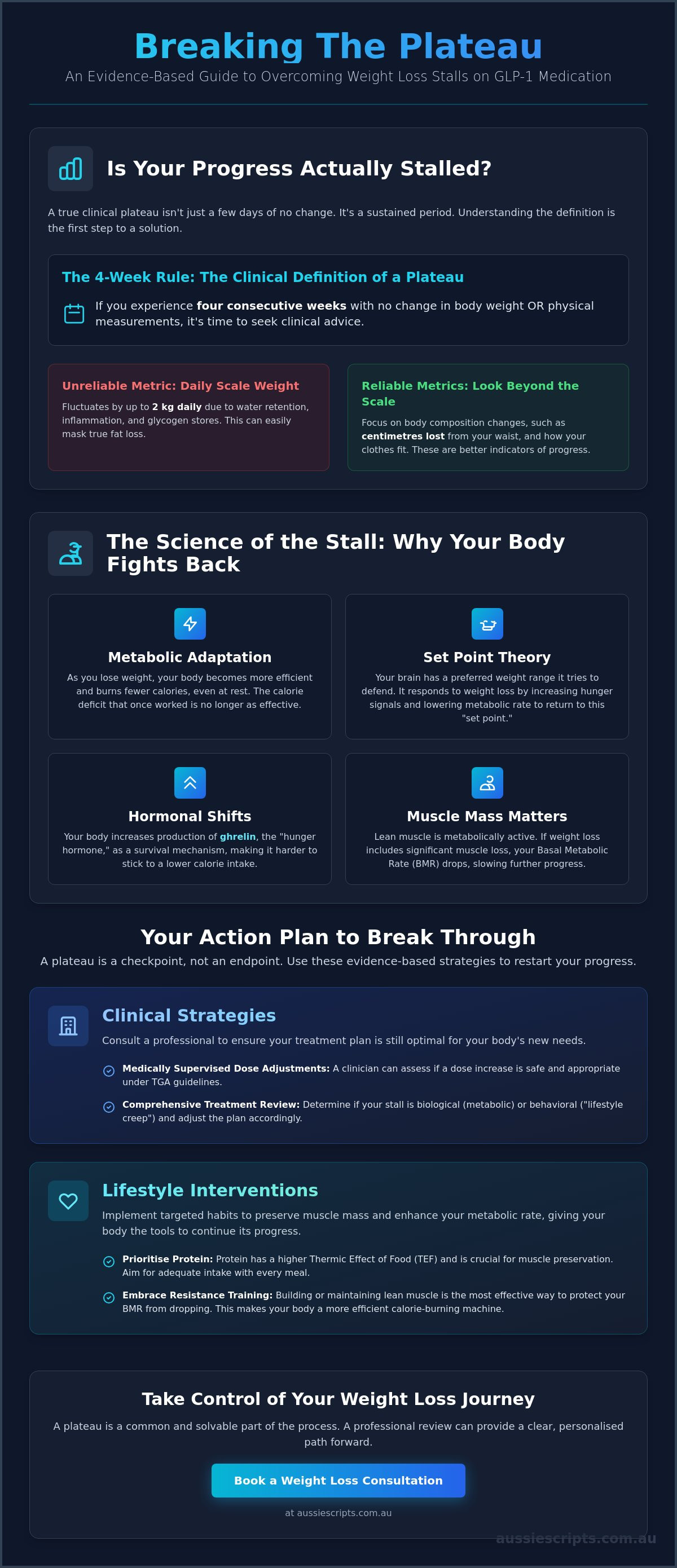
Weight loss on Semaglutide (Ozempic) is rarely a straight line. Many patients experience a period where the scale stops moving, which can trigger significant anxiety about regaining weight. However, this isn't always a sign of treatment failure. A clinical weight loss plateau is defined as four consecutive weeks without any change in body weight or physical measurements. Understanding this definition is the first step toward a pragmatic solution.
To better understand why your progress might have slowed, watch this complete guide:
Most Australians encounter their first significant stall after losing 10-15% of their starting body weight. This often aligns with the body's "Set Point Theory," a biological mechanism where the brain attempts to maintain a specific weight range by adjusting metabolic rate and hunger signals. When overcoming weight loss plateau on ozempic, it's vital to distinguish between a temporary fluctuation and a physiological stall. Your body is designed to defend its energy stores, and a plateau is often just a metabolic checkpoint.
The 4-Week Rule: When to Seek Clinical Advice
Daily scale readings are notoriously unreliable because they can fluctuate by up to two kilograms due to water retention, inflammation, or changes in glycogen storage. These shifts often mask fat loss. If you've recently increased your exercise intensity, muscle inflammation can cause temporary fluid retention. This is why body composition changes, such as losing centimetres from your waist, matter more than kilograms on a scale. If no changes occur across any measurement metrics for four weeks, you should book a Weight Loss Consultation for a professional progress review. A clinical assessment ensures your dosage and lifestyle plan remain aligned with your goals.
Biological vs. Behavioural Plateaus
As you lose weight, your body naturally produces more ghrelin, the hormone responsible for hunger, as a survival mechanism. This biological push can lead to "lifestyle creep," where portion sizes gradually increase or physical activity levels slightly drop without you noticing. Metabolic adaptation is the body's efficiency in burning fewer calories at a lower weight. This means the calorie deficit that worked at your starting weight may no longer be sufficient for continued progress. Addressing both the biological drive and behavioural habits is essential for overcoming weight loss plateau on ozempic. A clinical review can help determine if your stall is a result of your body reaching a new equilibrium or if external factors are at play.
Why Your Body Fights Back: The Science of Metabolic Adaptation
Semaglutide functions by mimicking the GLP-1 hormone, which targets the brain's appetite regulation centres to induce satiety. While this is highly effective, the human body is biologically programmed to defend its energy stores. When you lose weight rapidly, your system eventually triggers defensive mechanisms to prevent what it perceives as starvation. This process, known as metabolic adaptation, involves a downward shift in energy expenditure that can make overcoming weight loss plateau on ozempic a complex physiological challenge.
One often overlooked factor in this process is the Thermic Effect of Food (TEF). This represents the energy your body uses to digest, absorb, and process nutrients. As caloric intake decreases during your treatment, the total energy spent on digestion also drops. When this is combined with a lower body mass, your total daily energy expenditure (TDEE) can fall significantly. If your daily habits don't evolve alongside your changing body composition, your progress will naturally reach a standstill.
Muscle mass preservation is the most critical variable in maintaining a healthy Basal Metabolic Rate (BMR). Lean tissue is metabolically active and requires more energy to maintain than fat tissue. If your weight loss includes a high percentage of muscle loss, your BMR will decline more sharply than expected. This metabolic slowdown is a primary reason why progress often halts after the initial phase of rapid loss. Protecting muscle through specific nutritional and physical interventions is essential for long-term success.
The Basal Metabolic Rate (BMR) Shift
A body weighing 100kg requires more energy to function than one weighing 85kg. If you started your treatment at a higher weight, the caloric deficit that initially triggered loss may now be your new maintenance level. Clinical strategies for overcoming weight loss plateau on ozempic often involve recalculating these needs or implementing structured "diet breaks." These are medically supervised periods of maintenance-level eating designed to signal to the brain that energy supplies are stable, which can help reset metabolic hormones and prepare the body for further loss.
Hormonal Resistance and Semaglutide Efficacy
It's a common misconception that patients develop a "tolerance" to semaglutide. Clinical data doesn't support the idea of the body becoming immune to the medication itself. Instead, stalls are usually caused by the body reaching a state of hormonal homeostasis where weight loss and weight gain forces are balanced. Chronic inflammation or persistent insulin resistance can also interfere with the drug's efficacy. A Weight Loss Consultation allows a doctor to review these biomarkers and determine if a treatment adjustment is necessary to keep you moving toward your goal.
Clinical Strategies: Adjusting Your Treatment Programme
If lifestyle modifications and metabolic adjustments don't restart your progress, clinical intervention is the next logical step. The Therapeutic Goods Administration (TGA) confirmed in February 2026 that GLP-1 medication supply in Australia has stabilised, meaning patients now have more consistent access to various strengths and brands. Overcoming weight loss plateau on ozempic often requires a formal review of your current dosage to determine if you've reached a physiological ceiling at your current level. You must never adjust your dose independently; a practitioner's oversight is required to manage safety and monitor for adverse effects.
For many, moving beyond the 1.0mg dose is necessary to overcome a stall. While Ozempic is primarily TGA-approved for type 2 diabetes, doctors may prescribe it off-label for weight management or transition patients to Wegovy. Wegovy contains the same active ingredient, semaglutide, but is approved specifically for obesity with higher maintenance doses up to 2.4mg. As of May 2026, the private prescription cost for Wegovy maintenance doses remains between $400 and $460 per month. Your doctor will evaluate if switching medications or increasing your current titration is the most appropriate path based on your clinical history.
Dose Escalation Protocols in Australia
Australian clinical guidelines follow a strict titration schedule to minimise gastrointestinal side effects. When increasing a dose, doctors distinguish between a "maintenance dose," which keeps your weight stable, and a "therapeutic dose," which actively drives further loss. If you've been on 1.0mg for several months and your weight has plateaued for over four weeks, your doctor might suggest an escalation. This process requires careful monitoring of your renal function and gallbladder health. The transition to a higher dose often involves a four-week trial period to assess tolerance before the new level is confirmed as part of your long-term programme.
The Role of Specialist Referrals
Some plateaus are driven by complex underlying conditions like polycystic ovary syndrome (PCOS) or severe insulin resistance. In these cases, a general practitioner may suggest a specialist referral to an endocrinologist. Telehealth platforms provide an efficient way to secure these referrals without the typical wait times of physical clinics. If your stall requires extensive pathology testing or metabolic cart analysis, you can also request a medical certificate if you need to take time away from professional duties for clinical appointments. These specialists can provide a deeper analysis of why your body is resisting further weight loss and offer advanced pharmacological combinations to restart your progress.
5 Practical Steps to Break Through an Ozempic Plateau
Clinical adjustments are often necessary, but they work most effectively when paired with targeted lifestyle recalibration. Overcoming weight loss plateau on ozempic requires a tactical shift in how you support your metabolism daily. When the initial phase of rapid loss slows, your body requires different inputs to maintain a state of fat oxidation. If you've reached a four-week stall, implement these five evidence-based steps to restart your progress.
- Prioritise protein intake: Consuming adequate protein is the primary defence against sarcopenia, or muscle loss, which can otherwise lower your basal metabolic rate.
- Implement resistance training: Lifting weights or using resistance bands creates a metabolic demand that cardio alone cannot provide.
- Track Non-Scale Victories (NSVs): Monitor changes in waist circumference, clothing fit, and energy levels to maintain psychological momentum when the scale is stagnant.
- Audit sleep and stress: Elevated cortisol levels from poor sleep or chronic stress can lead to fluid retention and increased abdominal fat storage.
- Review administration technique: Ensure you're rotating injection sites and using the correct pen technique to maintain consistent medication absorption.
Nutritional Recalibration for Australians
To protect lean muscle tissue, aim for 1.2g to 1.5g of protein per kilogram of your current body weight. This level of intake supports repair and satiety, which is crucial as your body’s hunger hormones attempt to compensate for weight loss. Increasing dietary fibre is also essential, not only for digestive health but also for managing skin elasticity and overall vitality during treatment. While healthy fats are nutritionally dense, their high caloric concentration means that even minor, unmeasured portions can inadvertently eliminate a calorie deficit, effectively stalling progress for GLP-1 users. Using a digital food tracker for seven days can help identify these caloric leaks.
Physical Activity: Beyond Cardio
Strength training is the most effective antidote to a metabolic stall because it forces the body to maintain energy-expensive muscle tissue. As you lose weight, your body becomes more efficient at movement, meaning you actually burn fewer calories doing the same walk you did ten kilograms ago. You must increase your intensity or duration to avoid this adaptation. Focus on your "NEAT" factor, or non-exercise activity thermogenesis, by increasing incidental movement like taking the stairs or using a standing desk. These small, consistent energy expenditures often account for a larger portion of your daily burn than a single gym session.
If you've implemented these changes and still haven't seen progress after four weeks, it's time for a professional review. You can book a Weight Loss Consultation to discuss these lifestyle factors with an Australian-registered doctor and determine if a clinical change is required.
Managing Your Weight Loss Journey with Aussie Scripts
Addressing a stall requires more than just willpower; it necessitates clinical precision. Telehealth has transformed how Australians manage chronic conditions, providing a streamlined pathway for overcoming weight loss plateau on ozempic without the logistical delays of traditional clinics. When your progress stops for four consecutive weeks, a digital consultation allows you to connect with Australian-registered doctors who can evaluate your metabolic data and adjust your treatment plan in real time. This professional oversight ensures that any changes to your medication are both safe and clinically indicated.
The efficiency of digital healthcare is particularly beneficial for long-term weight management. Rather than waiting weeks for a physical appointment, you can engage in a focused review of your titration schedule and side effect profile from your own home. This rapid access to medical expertise means you can implement clinical changes, such as dose escalations or transitions to alternative GLP-1 medications, the moment a plateau is identified. Digital prescriptions are then sent directly to your phone or local pharmacy, maintaining the momentum of your journey.
The Convenience of Online Consultations
Regular clinical check-ins are vital because your body's needs change as you lose weight. To prepare for your telehealth review, have your weight history, current waist measurements, and a log of any gastrointestinal symptoms ready for discussion. This data allows your doctor to make an informed decision about whether you require a Standard Script renewal or a more comprehensive treatment recalibration. If you're currently stable but simply need to maintain your supply while waiting for a specialist review, express options can facilitate a faster turnaround. This level of agility is essential for navigating the biological checkpoints that often occur during the second year of treatment.
A Partner in Long-Term Health
Aussie Scripts functions as a reliable digital facilitator, bridging the gap between traditional professional standards and modern convenience. In the 2026 healthcare landscape, managing obesity requires a partnership that respects your time and intelligence. All consultations are conducted by practitioners who adhere to strict Australian regulatory standards, ensuring your care remains compliant with TGA guidelines. This commitment to safety is paramount, especially when discussing off-label use or escalating doses to therapeutic levels. Your next step is to book a formal consultation to review your progress. By recalibrating your plan with professional guidance, you can move past the frustration of a stall and continue toward your target weight with clinical confidence.
Restart Your Weight Loss Progress with Clinical Precision
A weight loss stall is a natural part of the metabolic journey. It signals that your body has adapted to its new weight and requires a recalibrated approach to continue progress. By prioritising lean muscle preservation and understanding the role of GLP-1 receptors, you can navigate these biological checkpoints effectively. Overcoming weight loss plateau on ozempic is achievable through a combination of evidence-based lifestyle shifts and professional clinical reviews.
Aussie Scripts provides a seamless way to access these reviews. Our platform is 100% Australian owned and operated, connecting you with Australian-registered doctors who conduct clinical reviews 7 days a week. If you've experienced four weeks without progress, a formal consultation is the most efficient way to determine if a dose adjustment or treatment change is appropriate for your specific health profile.
Book a Weight Loss Consultation with an Australian Doctor Today to restart your journey with confidence. You've already made significant progress; now is the time to refine your strategy for long-term success.
Frequently Asked Questions
How long does a weight loss plateau typically last on Ozempic?
A clinical plateau is defined as four or more consecutive weeks without a change in body weight or physical measurements. Without a change in treatment or lifestyle, a stall can persist for several months as your body defends its current energy stores. Monitoring your progress over this four-week window allows you to distinguish between temporary fluid fluctuations and a physiological halt that requires a formal medical review.
Is it safe to increase my Ozempic dose if I stop losing weight?
Increasing your dosage is safe only when conducted under strict medical supervision and according to TGA-approved titration schedules. If your progress has halted, your doctor may evaluate if moving to a higher therapeutic dose is appropriate for overcoming weight loss plateau on ozempic. You must never adjust your dose independently, as this significantly increases the risk of severe gastrointestinal side effects and clinical complications.
Why am I feeling hungrier even though I am still taking Ozempic?
Increased hunger is often a biological response to weight loss known as compensatory hunger. As your body mass decreases, your system naturally produces more ghrelin, the hormone that signals hunger, to protect its energy stores. This doesn't mean the medication has stopped working; rather, your body is attempting to maintain its current weight. A clinical review can help determine if a dose adjustment is needed to manage these signals effectively.
Can I switch from Ozempic to Wegovy if I hit a plateau?
Switching to Wegovy is a recognised clinical strategy because it contains the same active ingredient, semaglutide, but is approved for higher maintenance doses of up to 2.4mg. While Ozempic is primarily indicated for type 2 diabetes, Wegovy is specifically approved for chronic weight management. This transition requires a new prescription and a consultation with your doctor to ensure the higher dosage is safe for your specific health profile and metabolic needs.
Do I need to exercise to break a weight loss plateau on semaglutide?
Exercise, particularly resistance training, is essential for maintaining lean muscle mass and boosting metabolic demand during your journey. While the medication manages appetite, physical activity prevents the sharp decline in basal metabolic rate that typically follows rapid weight loss. Incorporating strength training at least twice a week helps ensure that the weight you lose comes from fat stores rather than muscle tissue, which is critical for breaking a stall.
Should I stop taking Ozempic for a week to 'reset' my system?
You shouldn't stop taking your medication to "reset" your system, as this is not a clinically recognised practice and can be dangerous. Discontinuing semaglutide causes the drug levels in your blood to drop, which often leads to a rapid return of hunger and potential weight regain. Additionally, restarting the medication after a break increases the likelihood of severe side effects like nausea and vomiting as your body is forced to re-adjust.
How many calories should I eat to break a stall on Ozempic?
There is no universal calorie count for overcoming weight loss plateau on ozempic because needs vary based on your current weight, age, and activity level. As you lose weight, your Total Daily Energy Expenditure decreases, meaning you require fewer calories than you did at the start of your journey. A practitioner can help you recalculate your specific caloric needs to ensure you remain in a sustainable deficit without triggering excessive muscle loss.
Can stress or lack of sleep cause a plateau on weight loss medication?
Chronic stress and insufficient sleep significantly impact weight loss by elevating cortisol levels. High cortisol can lead to increased insulin resistance and fluid retention, which often masks fat loss on the scale. Sleep deprivation also disrupts the hormones that regulate hunger and satiety, potentially making the medication feel less effective. Addressing these lifestyle factors is often just as important as adjusting your clinical treatment plan to restart your progress.
Disclaimer
The information provided by AussieScripts is for general informational purposes only and does not constitute medical advice, diagnosis, or treatment. For advice tailored to your specific symptoms or health concerns, please consult one of our doctors or your regular GP.
