Side Effects of Smoking Cessation Medication: What to Expect
Explore side effects of smoking cessation medication versus nicotine withdrawal. Compare NRT, varenicline, and bupropion to manage your quit journey safely.

A new symptom after starting a quit-smoking medicine can raise an immediate question: is it a side effect, or nicotine withdrawal? The side effects of smoking cessation medication vary by treatment, and the timing or type of symptom alone may not reveal the cause. An unwanted effect can also make quitting feel harder.
Understanding common patterns can help you discuss your options with a clinician and decide what to do next. This guide compares possible effects of nicotine replacement therapy, varenicline and bupropion, explains why responses vary, and outlines when to seek medical advice, including for emergencies.
If you’re unsure what’s causing a symptom, a smoking cessation consultation gives you the opportunity to discuss your symptoms, medical history and current medicines with an Australian-registered doctor. The doctor can assess your situation and discuss next steps without assuming every symptom is medicine-related. For a medical emergency in Australia, call 000.
Key Takeaways
- The side effects of smoking cessation medication depend on the treatment. Check the Consumer Medicine Information (CMI) for the specific product you use.
- Record when symptoms begin and how they change. This can help a clinician assess possible causes.
- Before stopping, restarting or changing a prescribed medicine, speak with your prescriber and follow their advice.
- A smoking cessation consultation can help you review symptoms, health history and current medicines, then discuss appropriate next steps.
Side effects of smoking cessation medication: what can you expect?
It’s reasonable to ask about side effects before starting a quit attempt or while using treatment. An unwanted symptom can be concerning, but it doesn’t automatically mean a medicine is unsuitable. Possible effects depend on the treatment, and symptoms may also occur as your body adjusts to quitting nicotine or for another reason.
Smoking cessation medicines are not interchangeable. Nicotine replacement therapy (NRT), varenicline and bupropion are different treatment approaches, each with its own product information and cautions. Start by identifying exactly which medicine or product you use.
For context on changes after quitting, watch What Happens When You Stop Smoking? from AsapSCIENCE:
A medicine side effect is an unwanted effect that may be associated with taking a medicine; a withdrawal symptom is a change that may occur as nicotine use is reduced or stopped. The distinction is useful, but it cannot diagnose the cause of an individual symptom. Cravings, irritability, restlessness or sleep changes may occur during nicotine withdrawal, while treatment can have its own possible effects. Timing may offer a clue, but it is not proof. A symptom may have another explanation too.
Which smoking cessation medicines are commonly discussed?
NRT provides nicotine through products such as patches or oral forms. Varenicline and bupropion are other medicines used to support quitting, and each has its own instructions and safety information. Their effects and cautions aren’t identical. For additional background, see Varenicline (Chantix) side effects, but use the current Australian Consumer Medicine Information (CMI) for practical guidance about a medicine supplied in Australia. A clinician can assess which options may suit you; not every treatment is appropriate for every person.
Why side effects vary from person to person
Your experience can depend on the medicine, how it is intended to be used, your health history and other medicines. Quitting at the same time can make the cause harder to identify because withdrawal changes may overlap with treatment effects. Note when a symptom began, how it changes and when you take your medicine. Share these details with your clinician rather than assuming the cause. Check the current Australian CMI for product-specific effects, cautions and instructions, and discuss anything you’re unsure about with a health professional.
Common side effects by smoking cessation medicine
Side-effect profiles differ by medicine and formulation, so check the current Australian Consumer Medicine Information (CMI) for the exact product you use. The examples below describe general patterns, not a complete list or a diagnosis. The CMI explains product-specific effects, administration instructions and warnings. If a symptom is severe, persistent or worrying, contact a health professional instead of assuming it is expected.
| Option | Possible effects | Important cautions | Where to verify |
|---|---|---|---|
| Nicotine patches | Skin irritation where the patch is applied; some products may also be associated with sleep disturbance or vivid dreams. | Application and wear instructions differ by product. Follow the specific leaflet, including directions about removing or changing a patch. | The patch’s Australian CMI and pack instructions. |
| Nicotine gum or lozenges | Oral irritation, hiccups, nausea or jaw discomfort may occur, depending on the product. | Use and administration directions vary by formulation. Don’t assume instructions for gum apply to lozenges, or vice versa. | The exact product’s Australian CMI and pack instructions. |
| Varenicline | Nausea, headache, sleep disturbance and unusual dreams are among the effects described in medicine information. | Check the CMI’s warnings and seek medical advice about concerning changes in mood or behaviour. | The Australian CMI for the prescribed brand; MedlinePlus offers supplementary Varenicline side effects information. |
| Bupropion | Possible effects include dry mouth, difficulty sleeping, nausea or headache. | Seizures are a serious warning. The CMI sets out who should not take the medicine and other precautions relevant to personal health history. | The Australian CMI for the prescribed product. |
Nicotine replacement therapy: effects depend on the product
A patch acts through the skin, so local irritation differs from discomfort associated with an oral product. Gum and lozenges have their own use instructions and possible mouth or throat effects. These products aren’t interchangeable: check the CMI for your exact product and formulation, especially if you’re unsure how to use it or experience a reaction.
Varenicline and bupropion: compare their information carefully
Some effects, such as nausea or sleep changes, can occur with more than one treatment, but their precautions are not necessarily the same. Read each medicine’s Australian CMI rather than judging suitability from a side-effect list or overseas summary alone. MedlinePlus can provide additional general information about varenicline, but the Australian CMI is the relevant product-specific reference. A clinician can assess your concerns in light of your health history and other medicines.
For a seizure, severe allergic reaction or other medical emergency in Australia, call 000. For non-emergency questions about symptoms or treatment options, an Aussie Scripts smoking cessation consultation lets you discuss your situation with an Australian-registered doctor. The doctor can assess your concerns and discuss next steps.
Medicine side effects or nicotine withdrawal: how can you tell?
A symptom that appears after you start treatment or stop smoking may have more than one possible explanation. Cravings, irritability, restlessness and sleep changes may occur during nicotine withdrawal, while a medicine can also cause unwanted effects. The two can overlap, and another health issue may be involved. Symptom timing alone cannot confirm whether medicine or withdrawal is responsible.
Timing is still useful context. Record a symptom that begins after you start a medicine or change how you use it, but remember that sequence alone doesn’t prove the medicine caused it. Changes can also emerge as you reduce or stop smoking, and effects may not begin at the same time for everyone. Don’t use a symptom checklist to diagnose yourself or change a dose without advice from your prescriber.
What to record when a new symptom appears
A clear record can help a doctor or pharmacist assess the pattern. Describe the symptom in your own words, when it started, how severe it feels, and whether it is improving, worsening or coming and going. Include the medicine and product formulation, how you’ve been using it, and any recent start, stop or treatment change. Also note when you reduced or stopped smoking, or if your smoking pattern changed.
- Describe what you notice and when it occurs.
- Record the medicine, dose instructions and any recent changes.
- Note when you cut down or stopped smoking, and whether the symptom changes over time.
Share this information with a health professional and have the medicine’s current Consumer Medicine Information (CMI) available. Your notes can support an assessment, but won’t establish the cause by themselves. If a symptom is severe or rapidly worsening, seek medical advice promptly rather than waiting to build a complete record.
When a medicine interaction deserves review
Stopping smoking can change how some medicines work. This is noted in Australian varenicline medicine information, and the change may relate to stopping smoking rather than to varenicline itself. Tell your clinician if your smoking changes, even if you haven’t started a quit-smoking medicine. Don’t assume an existing prescription is unaffected, and don’t alter it yourself.
When discussing the side effects of smoking cessation medication, give your clinician a complete list of prescription medicines, non-prescription medicines and supplements you take, along with any recent changes. Mention the treatment you’re using to quit and how much you’ve cut down or stopped smoking. A doctor or pharmacist can consider these details together, check relevant Australian medicine information and advise whether your treatment needs review. If you’re unsure whether a symptom or smoking change matters, ask for individual advice rather than relying on timing or adjusting a dose yourself.
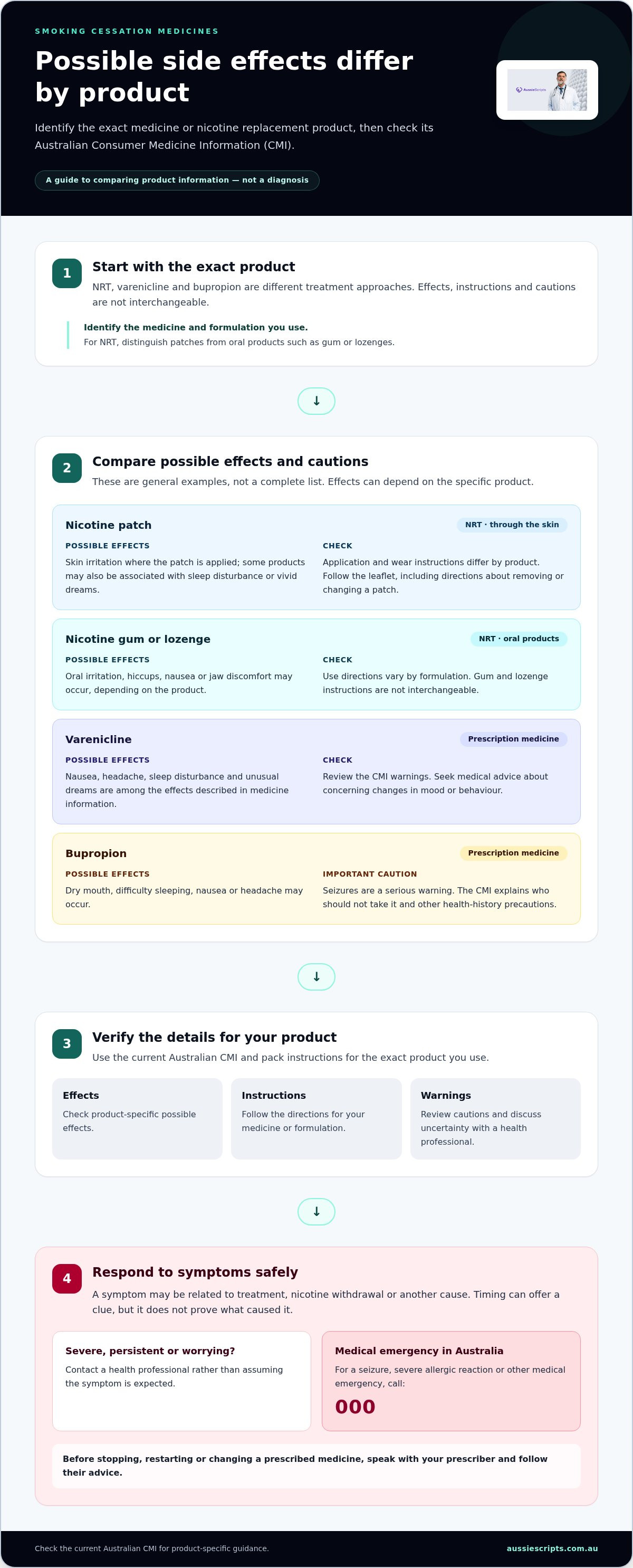
What to do about side effects: a safe, practical response
If you notice a new symptom while using a quit-smoking treatment, take a measured approach. The side effects of smoking cessation medication can vary, and a symptom may have another cause. Check the current Consumer Medicine Information (CMI) for your product and get individual advice rather than guessing or changing treatment yourself.
- Check the CMI. Read the information for your exact medicine and formulation. Look for possible effects, administration instructions and warnings. If anything is unclear, note your question for a doctor or pharmacist.
- Record what’s happening. Write down the symptom, when it began, how severe it feels and whether it is changing. Include your medicine, how you’ve been taking it, recent treatment changes and when you reduced or stopped smoking.
- Contact a clinician. Speak with your prescriber or pharmacist about persistent, troubling, worsening or unexpected symptoms. Have the medicine packaging and your notes available to support the discussion.
- Follow individual advice. Don’t stop, restart or alter a prescribed medicine without advice from your prescriber. If you’re told to change your treatment, follow the instructions given for your situation.
When to contact a doctor or pharmacist
Arrange a review if a symptom interferes with daily activities, isn’t settling, is getting worse or concerns you, even if it appears in the CMI. The leaflet can help you identify known effects and warnings, but it can’t determine what’s causing your symptom. Bring the medicine packaging, a current medicine list and your symptom notes so the clinician can consider them together.
What to do if symptoms feel severe
Severe or rapidly worsening symptoms need urgent medical assessment. Don’t wait for a routine appointment or an online consultation if you need urgent help. Follow the medicine’s current CMI for any specific warning signs and seek urgent care if they occur. This article and a telehealth consultation aren’t emergency care. For an emergency in Australia, call 000.
For non-emergency concerns, an Aussie Scripts smoking cessation consultation lets you discuss symptoms, health history and current medicines with an Australian-registered doctor. The doctor can assess your situation and discuss appropriate next steps.
Discussing smoking cessation medication side effects with an Australian doctor
A clinical discussion can help put a symptom in context and identify sensible next steps. A doctor can consider what you’re experiencing alongside when you started or changed treatment, your smoking timeline, health history and other medicines. Symptoms can have more than one possible explanation, so the right response depends on your circumstances.
What to prepare for a smoking cessation consultation
Gather a few details before the appointment. Clear information can make it easier to discuss your concern without relying on memory during the consultation.
- The medicine or nicotine replacement product you use, its dose instructions, when you started it and any recent changes.
- A description of the symptom, when it began, how it has changed and how much it affects you.
- When you reduced or stopped smoking, including any recent changes in your smoking pattern.
- A list of your other prescription and non-prescription medicines, plus relevant health history.
Keep the product packaging or Consumer Medicine Information (CMI) nearby. You can also note what you want clarified, such as whether a warning in the CMI applies to your situation. These details support an assessment but don’t establish a diagnosis on their own.
Continuity can help too. If your regular GP or specialist is involved in your care, let them know about the smoking change and any treatment you’re using. Sharing relevant information across your care team can help keep advice consistent, particularly if you take other medicines or have ongoing health conditions.
How telehealth can support next-step planning
Aussie Scripts offers a dedicated smoking cessation consultation through telehealth with Australian-registered doctors. You can discuss your symptoms, medical history and current medicines as part of a clinical assessment. The doctor can consider the information you provide and discuss appropriate next steps, including your concerns in light of the medicine’s current Australian information.
Treatment decisions are individual. A consultation doesn’t guarantee a prescription or a particular medicine, and Aussie Scripts does not dispense medicines. If a prescription or a change to treatment is being considered, it depends on the doctor’s assessment and clinical judgement. For urgent or emergency symptoms, use the appropriate urgent-care pathway rather than waiting for a consultation.
If you’re concerned about possible side effects of smoking cessation medication, an assessment can help you organise relevant details and discuss a suitable plan. Explore an Aussie Scripts smoking cessation consultation to discuss your concerns with an Australian-registered doctor.
Make your next quit attempt an informed one
A quit plan doesn’t have to work perfectly from day one. If a symptom shakes your confidence or makes treatment feel difficult, reassess your approach rather than taking it as proof that you can’t quit. Discuss the side effects of smoking cessation medication in context, especially if your experience differs from what you expected.
Choose a practical next step: write down the question you most want answered and what you hope to achieve by quitting, then bring both to a clinical conversation. Clear priorities can help you and your doctor consider what support may fit your circumstances. Treatment decisions should be guided by individual assessment, not pressure to persist with an option that concerns you.
Aussie Scripts offers a dedicated pathway for discussing smoking cessation concerns through telehealth. Explore an Aussie Scripts smoking cessation consultation to consider your next step with an Australian-registered doctor.
Frequently Asked Questions
How long do side effects of smoking cessation medication last?
There’s no reliable general timeline because duration depends on the medicine, formulation and individual response. Check the current Consumer Medicine Information (CMI) for your exact product rather than assuming an effect will pass by a certain date. If a symptom persists, worsens or makes treatment difficult to continue, contact your doctor or pharmacist. Before changing or stopping a prescribed medicine, get advice from your prescriber.
Can smoking cessation medication side effects start after I quit smoking?
Yes, symptoms may become noticeable around the time you quit, but timing can’t identify the cause. A change might coincide with starting treatment, reducing smoking or stopping altogether. Record when each change happened, including any new symptoms, and share the timeline with a clinician. Mention other medicines too, because a change in smoking habits can affect how some medicines work.
Should I stop taking smoking cessation medication if I have side effects?
Don’t stop, restart or change a prescribed medicine without advice from your prescriber, unless you’re following emergency instructions. Check the medicine’s current CMI and contact a doctor or pharmacist about concerning effects. If symptoms are severe or rapidly worsening, seek urgent medical assessment. For an emergency in Australia, call 000 rather than waiting for a routine appointment or online consultation.
Can smoking cessation medicines interact with other medicines?
They can, but possible interactions depend on the specific treatment and the other medicines you take. Australian varenicline medicine information notes that stopping smoking, with or without varenicline, can affect how some medicines work. Tell your doctor or pharmacist about all your medicines, including non-prescription products, and any recent change in smoking. They can consider your circumstances and advise whether your treatment needs review.
Are side effects from quitting smoking the same as medication side effects?
No. Nicotine withdrawal and medicine side effects are different possibilities, though some experiences can overlap. For instance, a change in sleep or mood may happen during a quit attempt, but that alone doesn’t show what caused it. Note when the symptom began and what changed around that time. Use the product’s CMI for its specific warnings, and discuss uncertain or troubling symptoms with a health professional.
What should I do if I have a serious reaction to smoking cessation medication?
Seek urgent medical assessment if a reaction is severe or rapidly worsening. If it’s an emergency in Australia, call 000. Don’t wait for an online consultation or rely on an article to assess what’s happening. For a concern that isn’t an emergency, contact your doctor or pharmacist and have the medicine packaging or current CMI available to help identify the product and its advice.
Disclaimer
The information provided by AussieScripts is for general informational purposes only and does not constitute medical advice, diagnosis, or treatment. For advice tailored to your specific symptoms or health concerns, please consult one of our doctors or your regular GP.
