Telehealth Consultation for Insulin Resistance: What to Expect
Need a telehealth consultation for insulin resistance? Learn what to expect, what details to prepare, and how an online doctor can guide your next health steps.

Could an online appointment do more than review a test result? A telehealth consultation for insulin resistance gives you the chance to discuss your health concerns with a doctor and understand what your results may mean in context. If you’re unsure whether previous blood tests need follow-up, or whether a virtual appointment can be thorough enough, those are useful questions to raise.
A doctor can discuss your health history, current concerns and available test results, then consider whether further assessment or follow-up may be appropriate. The consultation doesn’t guarantee a diagnosis or a particular treatment. Recommendations depend on your individual circumstances.
This guide explains what to expect, what information to prepare and what a doctor may recommend next. It also covers how telehealth can help turn uncertainty about insulin resistance into clinician-directed next steps.
Key Takeaways
- A telehealth consultation for insulin resistance lets you discuss your concerns and health information with a doctor, who can guide suitable next steps based on your circumstances.
- One symptom or test result alone may not establish a diagnosis. A clinician can consider results alongside your broader health context.
- Telehealth supports medical discussion and review. A doctor can advise when further assessment or other support may be appropriate.
- Before your appointment, gather relevant test results and note your concerns, health history, medicines and questions.
- Aussie Scripts connects patients across Australia with Australian-registered doctors for virtual consultations.
What does insulin resistance mean, and when might telehealth help?
Insulin helps move glucose from the blood into the body’s cells for energy. With insulin resistance, the cells respond less effectively to insulin, so the body may need to work harder to manage blood glucose. It isn’t the same as diabetes: insulin resistance describes a reduced response to insulin, while diabetes is a separate diagnosis made through clinical assessment. For a broader overview of the process and its relationship to other health conditions, see Insulin resistance.
One symptom or test result can’t, on its own, establish what’s happening for you. Signs associated with metabolic health concerns can have other explanations, and some people may have no obvious symptoms. A doctor considers the whole picture rather than drawing a conclusion from a single detail.
This video offers a wider discussion of insulin resistance and metabolic health:
What can a clinician consider during an insulin-resistance consultation?
A doctor may ask about your health history, current concerns and any relevant results you already have. This context helps clarify why you’re seeking advice and which questions need attention. Mention changes you’ve noticed, previous health conditions and any medicines you take.
Whether blood tests or other follow-up are appropriate depends on clinical judgement. A doctor can discuss results you share, explain what they may or may not indicate and recommend suitable next steps. Don’t treat an isolated result as a diagnosis without clinical review.
When can an online medical consultation be a practical first step?
A telehealth consultation for insulin resistance offers a convenient way to raise concerns with a doctor and discuss your health information. The clinician may ask follow-up questions to understand your circumstances and guide you on what to do next. Whether an online appointment suits your needs depends on your situation and the doctor’s assessment.
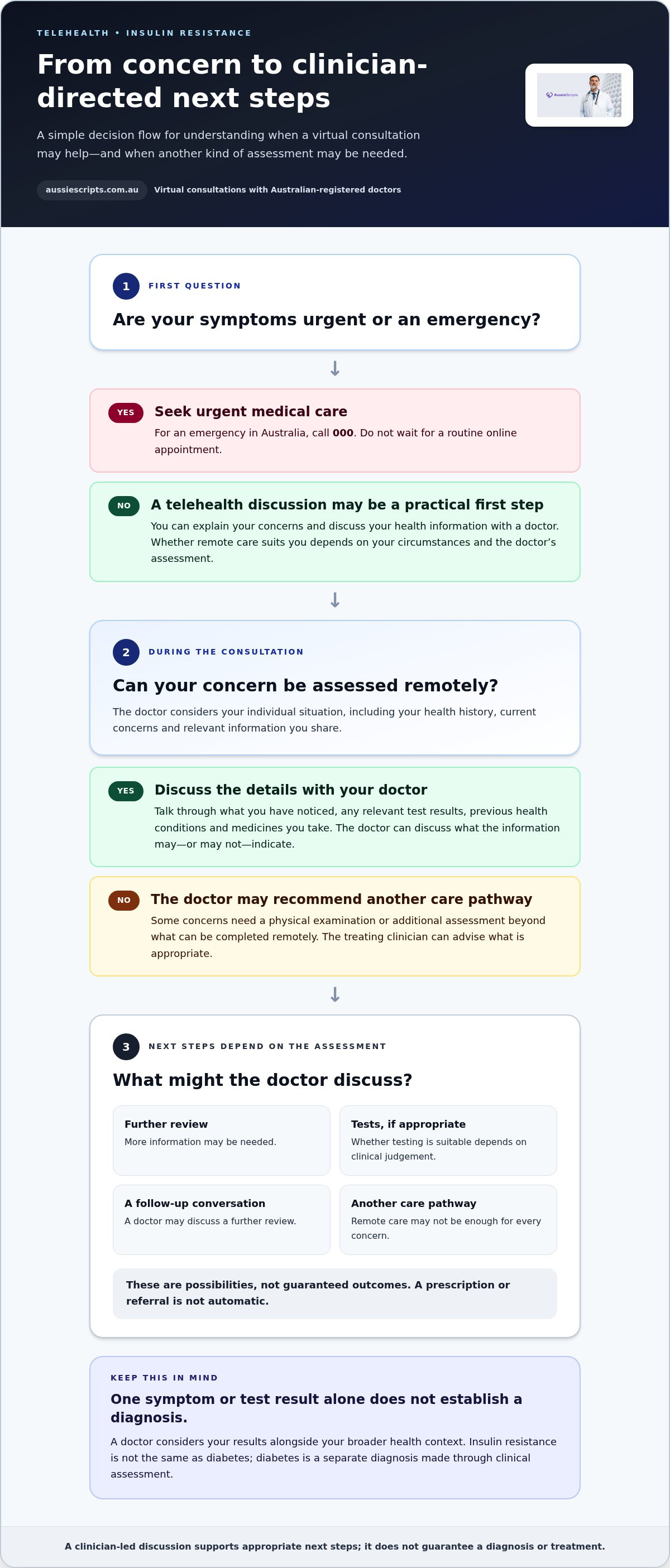
Telehealth has limits. If your concerns need assessment beyond what can be addressed remotely, the doctor can advise on an appropriate next step. For urgent or emergency symptoms, seek urgent medical care rather than waiting for a routine online appointment. In an emergency in Australia, call 000.
How does a telehealth consultation for insulin resistance work?
A telehealth appointment gives you a direct way to explain what prompted you to seek advice and discuss it with a doctor. The clinician may ask about your health history, current concerns and relevant information, such as previous test results or medicines you take.
In brief: share your concerns, discuss them with a doctor, then agree on clinically appropriate next steps based on the individual assessment. This describes the consultation process, not a guaranteed outcome. A prescription or referral isn’t automatic. The doctor will consider whether either is appropriate for your circumstances.
What may happen during the online appointment?
The appointment is a conversation focused on why you’re seeking care. Explain what you’ve noticed, the questions you have and any relevant health information you’d like to discuss. The doctor may ask for more detail to clarify the context and determine what can be addressed during the consultation.
If you have previous results, keep them available and share the relevant details. The doctor can discuss the information you provide while considering it alongside other aspects of your health. For additional background, the US National Institute of Diabetes and Digestive and Kidney Diseases provides authoritative information on insulin resistance.
What next steps might the doctor discuss?
Recommendations depend on the clinician’s assessment and your individual needs. A doctor may discuss further review, whether tests are appropriate, a follow-up conversation or another care pathway. These are possibilities, not guaranteed outcomes. Sometimes more information is needed before a decision can be made.
Ask what a suggested next step is intended to clarify and what you should do if your concerns change. Aussie Scripts offers virtual consultations with Australian-registered doctors, where you can discuss a health concern and receive advice on clinically appropriate next steps. Explore Aussie Scripts telehealth consultations.
Is telehealth enough for insulin resistance, or are there limits?
Telehealth can support a doctor-led discussion about insulin resistance, but it isn’t suitable for every assessment or concern. A doctor can talk through your health history and the information you provide. If an assessment needs a physical examination or evaluation that can’t be completed remotely, the doctor may recommend a different care pathway.
An online appointment can still help you explain your concerns, review relevant information and understand what the clinician thinks should happen next. Whether remote care is appropriate depends on your circumstances and the doctor’s assessment.
What can a doctor assess remotely, and what may need more?
During a remote consultation, a doctor can ask about your health history and current concerns, and discuss relevant results or other information you share. This can help frame the issue and identify questions that need further attention. Some concerns may require an examination or additional assessment beyond what telehealth can provide. The treating clinician will advise if that applies to you.
How does medical review differ from nutrition support?
These forms of support have different roles. A medical consultation focuses on discussing health concerns and considering clinician-directed assessment. Nutrition support focuses on food choices and practical eating patterns. They may complement each other, but neither replaces the other when a particular type of care is needed.
| Support | Purpose and scope | Possible next steps |
|---|---|---|
| Doctor-led medical review | Discuss concerns, health history and information provided; consider what clinical assessment may be appropriate. | Further review, consideration of tests, follow-up or another care pathway, depending on the clinician’s assessment. |
| Nutrition support | Focus on food choices and practical eating patterns. | Discuss approaches to eating that fit the person’s needs and circumstances. |
The right starting point depends on what you need help with. If your main concern is understanding symptoms or existing health information, a doctor can discuss whether medical review is appropriate. Nutrition support may help with practical food-related goals. Both roles may be relevant in some cases, and a clinician can guide you on suitable next steps.
How should you prepare for an insulin-resistance telehealth appointment?
You don’t need special preparation for an insulin-resistance appointment. A few notes and relevant information you already have can help you explain your concerns clearly and make good use of the conversation. You don’t need to decide what the cause is before speaking with a doctor.
What information should you have ready?
Keep the details concise. Write them down or have them accessible on your device:
- Your current concerns: What prompted you to seek advice, when you first noticed it and whether anything has changed.
- Relevant health history: Previous conditions or other background that may help the doctor understand your situation.
- Current medicines: Include the names of medicines you take and, if known, how you take them.
- Existing test results: Have relevant results available if you already have them. You don’t need to arrange tests just to prepare unless a clinician has advised you to.
- Questions and priorities: Note what you want to understand, such as whether a result needs review or what follow-up may be appropriate.
A short record can help you avoid relying on memory during the appointment. It doesn’t need to be formal or comprehensive. The doctor can ask follow-up questions if more context is needed.
How can you make the appointment focused and useful?
Choose a private setting where you can speak and listen without unnecessary interruptions. Describe what you’ve noticed in plain language. If you’ve read about insulin resistance online, share the questions it raised, but don’t treat general information as a diagnosis of your own health.
During a telehealth consultation for insulin resistance, ask the doctor to explain any recommended next steps. For example: What is the next step intended to clarify? Do I need follow-up, and when? Is there anything that should prompt me to seek care sooner? The clinician’s advice will depend on your assessment. Clear questions can help you understand the reasoning without assuming a particular test or outcome.
Once you’ve gathered your notes and results, you can book an online doctor consultation through Aussie Scripts. Australian-registered doctors provide virtual consultations, with care determined by the individual consultation.
How to take the next step with Aussie Scripts telehealth
Aussie Scripts connects patients across Australia with Australian-registered doctors through virtual consultations. The service operates seven days a week. If you want to discuss concerns about insulin resistance, a consultation gives you a chance to explain what’s on your mind and share relevant health information.
The doctor will decide what care, if any, is appropriate based on your consultation. A diagnosis, prescription or particular test isn’t guaranteed. Recommendations depend on the information available and the clinician’s assessment.
What to expect when accessing Aussie Scripts
Your consultation takes place remotely with an Australian-registered doctor. Explain what prompted you to seek advice and share relevant health information. The doctor may ask questions to understand your circumstances and determine what can be addressed during the consultation. Recommendations depend on the information available and the doctor’s assessment, rather than a predetermined outcome.
If further review or assessment is appropriate, the doctor can discuss a suitable next step. This may involve following an advised care pathway rather than relying on the online appointment alone. The purpose is to provide a clinically guided discussion, not to promise a particular result.
What should you do after the consultation?
Follow the clinician’s advice and make sure you understand any instructions. If something is unclear, ask the doctor to explain what the recommendation involves and what you should do next. It may help to note any follow-up advice so you can refer to it later.
If the doctor recommends further assessment, use the follow-up pathway they discuss. The next step depends on your needs and the clinician’s judgement. If your symptoms become urgent, seek urgent medical care rather than waiting for a routine telehealth consultation.
Ready to discuss your concerns with a doctor? Explore Aussie Scripts telehealth consultations.
Take the next step with clear clinical guidance
Insulin resistance can raise questions, but one symptom or test result doesn’t tell the whole story. A doctor can consider your concerns, health history and available results, then discuss appropriate next steps. A telehealth consultation for insulin resistance supports that conversation, while any tests, diagnosis or treatment depend on the clinician’s assessment.
Aussie Scripts connects people across Australia with Australian-registered doctors through telehealth, with the service operating seven days a week. Prepare by noting your concerns, medicines, relevant history and questions. This gives the doctor useful context without requiring you to diagnose yourself in advance.
To discuss your concerns, start your online consultation with Aussie Scripts. The doctor will guide you on suitable care based on your individual circumstances.
Frequently Asked Questions
Can a telehealth doctor diagnose insulin resistance?
A doctor may assess whether insulin resistance is a concern during a telehealth consultation, but a diagnosis isn’t guaranteed. They can discuss your concerns and health history, review information you provide and decide whether remote assessment is suitable. Depending on your circumstances and the information available, they may recommend further assessment or follow-up. An online appointment isn’t a substitute for urgent care if your symptoms need immediate attention.
What happens during a telehealth consultation for insulin resistance?
The doctor will discuss why you’re seeking care and may ask about your health history, current concerns and any existing results. This telehealth consultation for insulin resistance gives you an opportunity to explain what you’ve noticed and ask questions. The doctor can discuss possible next steps based on clinical judgement. Further assessment or follow-up may be appropriate, but a diagnosis, prescription or specific test isn’t automatic.
Can an online doctor review my blood test results?
Yes. You can have relevant existing results ready to discuss during an online consultation. A doctor may consider them alongside your health history and current concerns, rather than interpreting one result in isolation. Whether the results indicate a need for further assessment is a clinical decision. Don’t use an online result or a general reference range to diagnose yourself. The doctor can explain what the information may mean in your circumstances.
Do I need a referral for a telehealth consultation about insulin resistance?
Whether you need a referral depends on the service and type of care you’re seeking. Aussie Scripts connects patients with Australian-registered doctors for virtual consultations. During the appointment, the doctor can assess the information you share and advise on suitable next steps. A referral, prescription or particular care pathway isn’t automatic. Any recommendation depends on an individual clinical review.
Is telehealth suitable for everyone concerned about insulin resistance?
Telehealth can be a convenient way to discuss health concerns with a doctor, but it may not suit every situation. The clinician will assess whether a remote consultation can address your needs or whether another form of assessment is appropriate. If your symptoms feel urgent or severe, seek urgent medical care rather than waiting for a routine online appointment. Recommendations depend on your individual circumstances.
What should I prepare for an online insulin-resistance consultation?
Write down your main concerns, relevant health history, current medicines and questions for the doctor. If you already have relevant test results, keep them available to discuss. You don’t need to arrive with a diagnosis or decide which tests you need. Sharing clear information can help the doctor understand your circumstances and consider appropriate next steps. They may ask follow-up questions if they need more context.
Can a telehealth consultation lead to a prescription for insulin resistance?
A prescription isn’t guaranteed. The doctor will assess your concerns and decide what care, if any, is appropriate for your circumstances. Medication may not be the recommended next step. The doctor could instead discuss further assessment or follow-up. Booking an online appointment or describing a particular concern doesn’t guarantee a specific prescription. Any prescribing decision depends on the clinician’s individual assessment.
Disclaimer
The information provided by AussieScripts is for general informational purposes only and does not constitute medical advice, diagnosis, or treatment. For advice tailored to your specific symptoms or health concerns, please consult one of our doctors or your regular GP.
