Telehealth for Menopause Weight Gain: Choosing the Right Medical Support
Explore telehealth for menopause weight gain. Consult Australian doctors online for personalised support, clinical assessment, and safe weight management care.
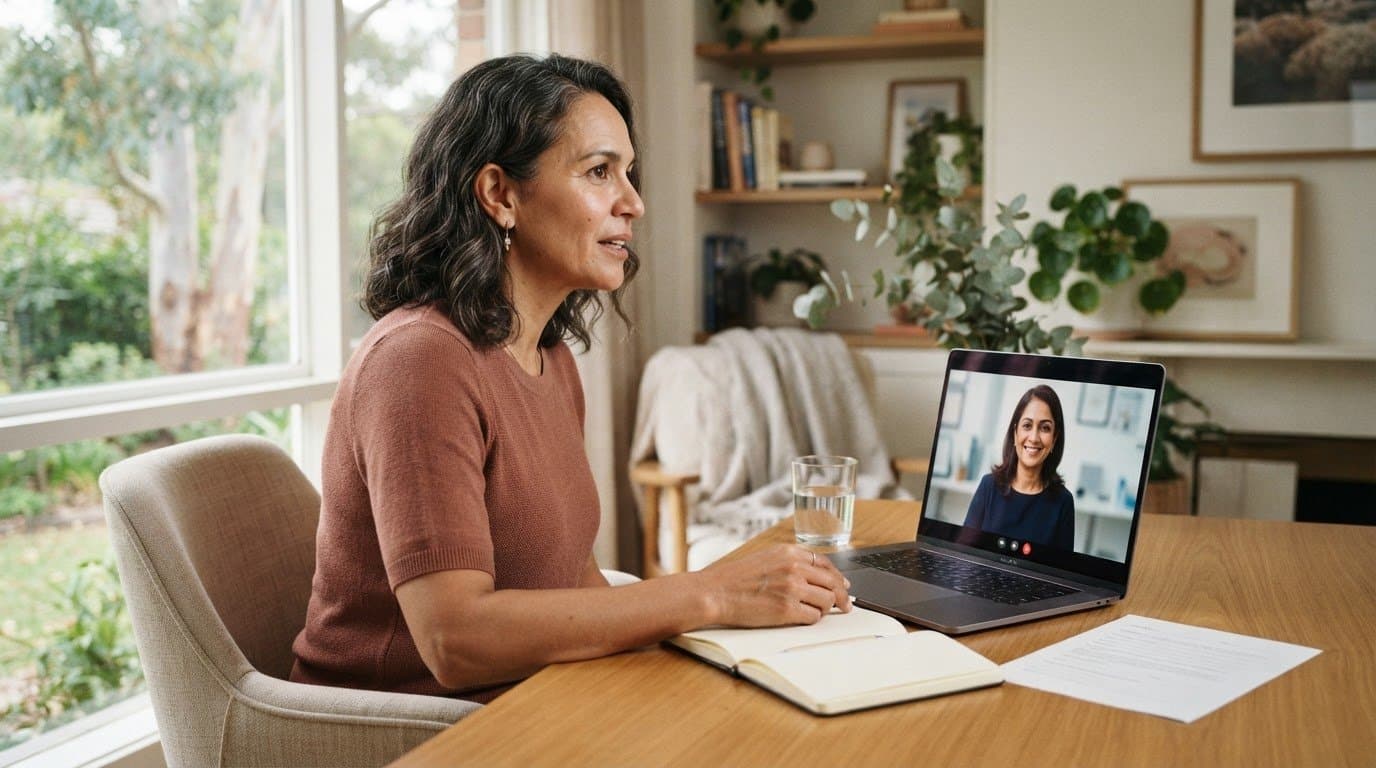
Could a change in weight during menopause have more than one explanation? Shifts in weight can coincide with menopause, but other health factors may also be relevant. That uncertainty is understandable, and a clinician-led consultation can help put your concerns in context. Telehealth for menopause weight gain offers a convenient way to discuss your health history, symptoms and goals with an Australian-registered doctor, without assuming one treatment will suit everyone.
This article explains what to expect from an online weight-management consultation and how menopause may be included in the discussion. You’ll learn what information to prepare, what questions a clinician may ask, and how they may consider appropriate next steps, which could include further assessment or a personalised management plan. A consultation doesn’t guarantee a diagnosis, prescription or particular outcome; decisions depend on your individual circumstances and clinical assessment. Aussie Scripts provides weight-loss consultations through a digital platform, giving people across Australia access to medical support seven days a week.
Key Takeaways
- Telehealth for menopause weight gain can provide a structured way to discuss weight changes without assuming menopause is the only factor.
- Prepare to discuss your health history, medicines, previous weight-management approaches and personal goals.
- Compare telehealth options by clinician credentials, the scope of their assessment, follow-up clarity and digital access.
- Medication is only one possible part of care. Wegovy is available on private prescription in Australia and is not yet PBS-subsidised.
- Aussie Scripts’ Weight Loss Consultation connects you with an Australian-registered doctor to discuss your health context and possible next steps.
Telehealth for menopause-related weight gain: what a clinician can help assess
Weight changes around menopause can prompt practical questions: is the timing relevant, could other health factors be involved, and what should I do next? Telehealth for menopause weight gain provides remote access to a clinician who can discuss your concerns and review relevant health information. It isn’t an automatic diagnosis or a promise of medication. The clinician considers your circumstances and whether a remote consultation is suitable for your needs.
Menopause can be discussed as part of a broader health picture, not treated as the assumed explanation for every change. The stages and physical changes associated with menopause may help frame questions, but your own history and experience matter. A useful starting point is to note when the change began and whether anything else changed around the same time.
For general context on menopause and weight care, you can watch this video:
How menopause fits into a weight-related health discussion
A clinician can consider menopause alongside your wider health and lifestyle context. Be ready to describe when you first noticed weight changes, how they have developed, and any other changes in your health or routine. This timeline can help guide the discussion without presuming a single cause. Sharing your concerns clearly also helps keep the consultation focused on what you want to understand or address.
What telehealth can and cannot do
Clinician-led telehealth weight support is a remote clinical review of your concerns and health information to help identify appropriate next steps. During a consultation, a clinician may ask questions about your history and current circumstances, then consider whether further assessment or another form of care is needed. The review takes place remotely; it does not mean an in-person physical examination has occurred.
Telehealth can make it easier to discuss weight concerns with a clinician from across Australia, but remote care has limits. The clinician determines whether telehealth is appropriate for your individual needs. If it is, they can discuss options based on the assessment. That discussion doesn’t guarantee a diagnosis, a particular treatment or a prescription. The aim is a considered next step, not a one-size-fits-all answer.
What a telehealth consultation for menopause-related weight gain should assess
A useful consultation starts with your concerns and relevant health history, not a predetermined treatment. The clinician may ask when weight changes began, how they’ve affected you, and what you’d like help with. Menopause is one part of the discussion. Your medicines, health conditions, previous approaches to weight management and personal goals can all help shape a clearer picture.
Prepare to describe what you’ve already tried and what was manageable or difficult. If you have questions about daily habits or possible changes, the Mayo Clinic’s guidance on preventing menopausal weight gain can provide background for a conversation with your clinician. The focus should be on advice suited to your circumstances, rather than a generic plan.
What information to prepare before the appointment
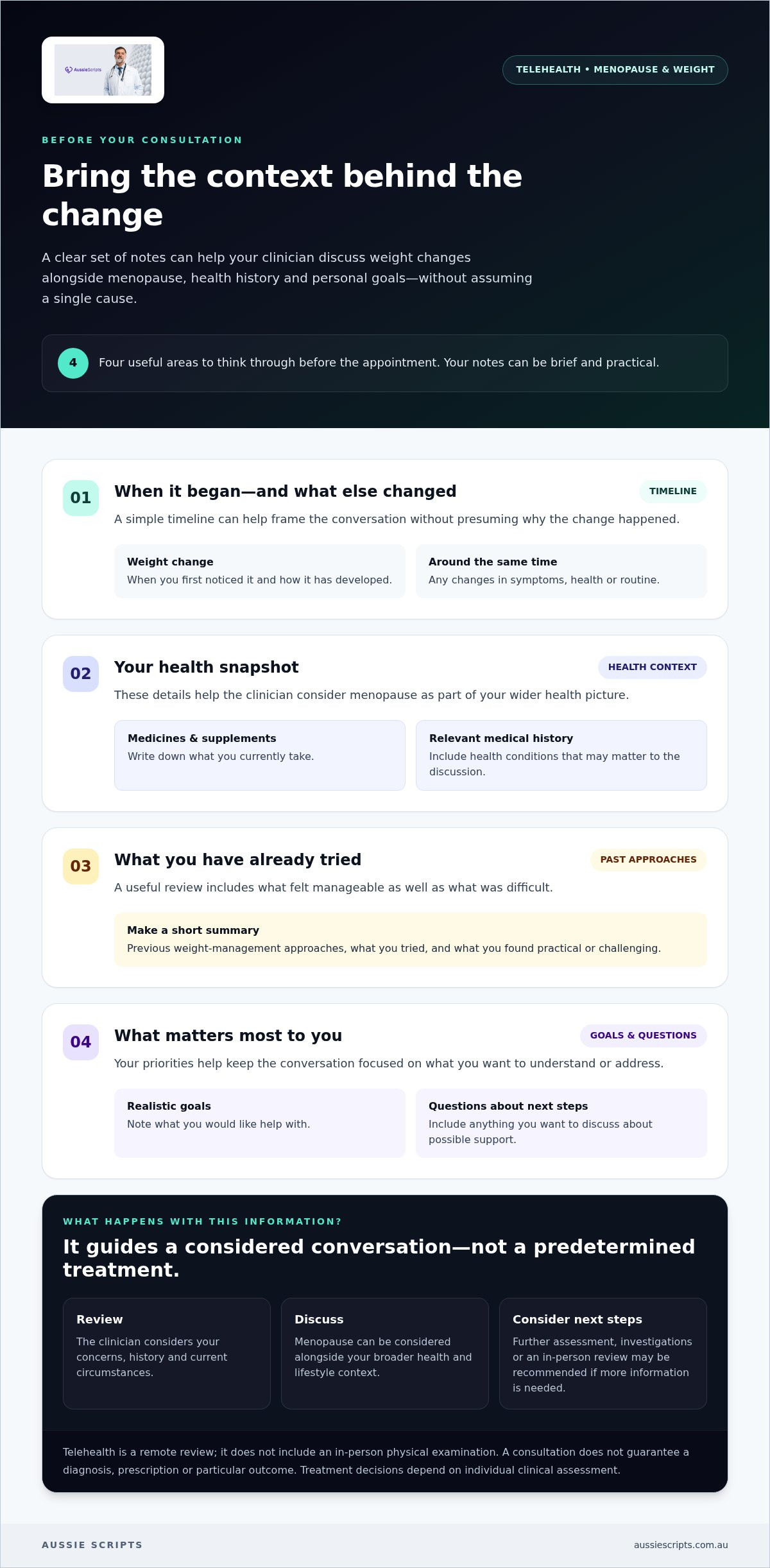
A short set of notes can make the appointment more focused. Include when the weight change started, any relevant changes in symptoms or routine, and a current list of medicines and supplements. Summarise relevant medical history and previous weight-management approaches, including what you found practical. It can also help to write down realistic goals and questions about possible next steps.
How the clinician may decide what happens next
The clinician can use your history and concerns to discuss management options that may be appropriate, without assuming a diagnosis or recommending a specific treatment in advance. Some concerns may be discussed and managed through telehealth; if your history indicates that more information is needed, the clinician may recommend further assessment, investigations or an in-person review. These are separate steps, not something a remote consultation automatically provides.
Treatment decisions depend on an individual clinical assessment, including your health history, needs and the clinician’s professional judgement. A prescription is not guaranteed. If medication is considered, its suitability must be assessed in your specific circumstances. This is why a clear review matters more than an online promise of a particular medicine or result.
For a more productive conversation, be direct about what matters most to you, whether that’s understanding possible contributors, discussing realistic changes or considering available support. If you’re ready to discuss your circumstances with an Australian-registered doctor, an Aussie Scripts weight-loss consultation offers a clinician-led starting point.
How to compare telehealth options for menopause-related weight support
For telehealth for menopause weight gain, compare the quality of the clinical process, not the certainty of a promised result. A clear review should leave room to discuss menopause alongside your health history and goals. A claim that a particular medicine or outcome is guaranteed doesn’t replace individual assessment.
Use these points as a practical comparison guide:
| What to compare | What to look for |
|---|---|
| Clinician credentials | Clear information that an Australian-registered doctor reviews your concerns and health information. |
| Assessment | A process that gives you space to explain your relevant history, medicines, menopause context and goals before options are discussed. |
| Follow-up clarity | A clear explanation of possible next steps, including whether the clinician may recommend further assessment. |
| Digital access | Practical details about how to access the consultation remotely and when the service operates, without relying on unsupported promises about speed. |
Signs of a clinically grounded consultation
A sound digital consultation explains who reviews your information and how the review informs the discussion. Look for transparent communication about individual suitability and possible next steps. Clinical care may lead to advice, further assessment or consideration of treatment, depending on your circumstances. It should not be presented as a guaranteed prescription, diagnosis or result.
Aussie Scripts connects patients with Australian-registered doctors through a digital platform and operates seven days a week. Its Weight Loss Consultation provides a way to discuss weight concerns and relevant health context with a clinician. The outcome depends on the individual review.
Questions to ask yourself before choosing a digital pathway
Before proceeding, consider whether the consultation process lets you share relevant information and explain what you want help with. Can you understand the service steps and who provides the clinical review? Does the approach allow the clinician to consider your circumstances, rather than directing you towards a fixed treatment?
Accessibility matters too. Remote consultations can offer a convenient way to access medical support across Australia, but the digital format still needs to support clear communication and appropriate professional judgement. Choose a pathway where the process is understandable and the focus stays on your health needs, not on a predetermined medication.
Medication, safety, and realistic expectations for telehealth weight care
Medication may be one option in weight management, but it isn’t suitable for everyone and shouldn’t be assumed to follow a consultation. A clinician considers your health information, needs and relevant prescribing requirements before discussing whether a medicine may be appropriate. In telehealth for menopause weight gain, the purpose of the review is to consider your circumstances and possible next steps, not to promise a prescription.
Don’t use someone else’s medicine, make changes to prescribed treatment, or decide that a medicine is right for you based on symptoms alone. Discuss questions or concerns with a clinician so decisions can be made with your health history in view.
What telehealth can say about weight-loss medicines
A remote consultation can provide an opportunity to discuss medication as part of a broader care plan. Whether it’s appropriate depends on individual clinical review and professional judgement. The clinician may discuss other approaches or recommend further assessment instead. Convenience doesn’t remove the need for a considered review, and an online consultation doesn’t guarantee a particular treatment or outcome.
Wegovy, Ozempic, and Australian subsidy status
It helps to separate three different decisions. The Therapeutic Goods Administration (TGA) has approved Wegovy in Australia for chronic weight management in eligible adults. TGA approval means a medicine is approved for specified use; it doesn’t mean the medicine is subsidised through the Pharmaceutical Benefits Scheme (PBS).
The Pharmaceutical Benefits Advisory Committee (PBAC) has recommended a proposed PBS listing for a limited population of people with obesity and established cardiovascular disease, subject to pricing and risk-sharing arrangements. A PBAC recommendation is not an active subsidy. The listing process has not been completed.
Wegovy is currently available in Australia on private prescription and is not yet PBS-subsidised. The PBAC has recommended a PBS listing for a limited population of patients with obesity and established cardiovascular disease, but the listing process has not yet been completed. Patients should therefore expect to pay the private prescription price unless and until a PBS listing takes effect.
Ozempic also contains semaglutide, but it is PBS-listed for specific diabetes indications, not subsidised for general weight loss. Its PBS status shouldn’t be confused with Wegovy’s. Medicine status can change, so check current Australian TGA and PBS information when reviewing treatment options.
For a clinician-led discussion of your health context and possible weight-management next steps, book a weight-loss consultation with Aussie Scripts.
How to take the next step with an Aussie Scripts weight-loss consultation
Aussie Scripts offers a Weight Loss Consultation with access to Australian-registered doctors. It provides a digital way to discuss weight concerns and relevant health context, including changes you’ve noticed around menopause. The consultation is a clinical review, not a promise of a diagnosis, prescription or particular treatment.
What to expect when starting a consultation
Begin through the digital service and share the information needed for a clinician to understand your concerns. Be specific about when weight changes began and any menopause-related symptoms or changes in your routine that feel relevant. Include your health history and current medicines so the doctor can review the broader context, rather than considering weight in isolation.
A doctor assesses the information provided and considers appropriate next steps based on your individual circumstances. Those steps may involve discussing management options or recommending further assessment if needed. The consultation process doesn’t guarantee a specific clinical outcome or prescription. Aussie Scripts operates seven days a week, offering digital access to medical support across Australia.
Prepare for a useful follow-up plan
Before you begin, organise a few notes to help you use the consultation effectively:
- Record when the weight changes started and any relevant changes in menopause symptoms, health or routine.
- Prepare a current list of medicines and a brief summary of relevant health history and previous weight-management approaches.
- Write down what you want to understand, such as possible contributing factors or management options that may suit your circumstances.
- Ask what follow-up or further assessment may be appropriate after the review.
These details can help the doctor understand what matters most to you and make the discussion more focused. You don’t need to arrive with a preferred treatment in mind. The purpose of telehealth for menopause weight gain is to support a clinician-led discussion and considered next steps, with any decisions guided by professional judgement and your individual health needs.
If you’re ready to discuss your concerns with an Australian-registered doctor, start a weight-loss consultation with Aussie Scripts.
Take a considered next step with clinician-led support
Weight changes around menopause can have several contributing factors, so a useful consultation looks beyond timing alone. Telehealth for menopause weight gain can give you a practical way to discuss your concerns, health history, current medicines and goals with a clinician. The doctor’s assessment, not a predetermined treatment pathway, guides possible next steps.
Medication may be considered, but it isn’t suitable for everyone, and a consultation doesn’t guarantee a prescription or specific outcome. Preparing a brief timeline of changes and questions can help make the discussion more focused.
Aussie Scripts offers a Weight Loss Consultation with access to Australian-registered doctors through a telehealth service operating seven days a week. If you’re ready to discuss your individual circumstances, start a weight-loss consultation with Aussie Scripts.
A clear conversation with a clinician is a practical place to begin. Take the next step at a pace that feels right for you.
Frequently Asked Questions
Can telehealth help with menopause-related weight gain?
Yes. A telehealth consultation can give you a chance to discuss weight changes, menopause context, health history and personal goals with a clinician. Telehealth for menopause weight gain is a remote clinical review, not an automatic diagnosis or prescription. The clinician can consider the information you share and discuss possible next steps, which may include further assessment if needed. Any recommendations depend on your individual circumstances and clinical judgement.
Is weight gain during menopause always caused by menopause?
No. Weight changes can have multiple contributing factors, so it isn’t appropriate to assume menopause explains every change. A clinician may consider menopause alongside your broader health history, medicines, symptoms and lifestyle context. Before your consultation, note when the change began and whether anything else changed around that time. This timeline can help focus the discussion, but it can’t establish a cause on its own.
What happens during a telehealth weight-loss consultation?
A clinician reviews your concerns and relevant health information through a remote consultation. You may discuss when weight changes started, current medicines, health conditions, previous weight-management approaches and your goals. The doctor then considers whether telehealth is suitable for your needs and what next steps may be appropriate. Depending on your circumstances, they may discuss management options or recommend further assessment. The consultation doesn’t guarantee a diagnosis, prescription or specific outcome.
Can an online doctor prescribe weight-loss medication for menopause-related weight gain?
An online doctor may consider prescribing if medication is clinically appropriate after reviewing your individual circumstances and current prescribing requirements. A consultation doesn’t guarantee a prescription, and medication is only one possible part of care. The clinician may instead discuss other options or recommend further assessment. Don’t start, stop or change medication based on assumptions about menopause; raise questions about treatment with a clinician who can consider your health information.
Is Wegovy available on the PBS in Australia in 2026?
No. Wegovy is TGA-approved in Australia for chronic weight management in eligible adults, but TGA approval doesn’t mean PBS subsidy. Wegovy is available on private prescription and isn’t yet PBS-subsidised. The PBAC has recommended a proposed listing for a limited population with obesity and established cardiovascular disease, subject to pricing and risk-sharing arrangements. The listing process isn’t complete, so patients should expect to pay the private prescription price unless and until a PBS listing takes effect.
Is Ozempic the same as Wegovy for weight loss?
No. Ozempic and Wegovy both contain semaglutide, but their PBS status and approved uses shouldn’t be treated as interchangeable. Ozempic is PBS-listed for specific diabetes indications; it isn’t PBS-subsidised for general weight loss. Wegovy is available on private prescription in Australia and isn’t yet PBS-subsidised. A clinician can discuss whether a medicine may be suitable for your circumstances, but a prescription isn’t guaranteed.
What should I prepare before an online consultation about menopause and weight?
Prepare a brief timeline of when weight changes began and any relevant changes in symptoms or routine. Have a current list of medicines and a summary of relevant health history, previous weight-management approaches and personal goals. Write down the questions you want answered, such as what factors may be considered or whether further assessment could be appropriate. Sharing clear, relevant information can help the clinician focus the review on your concerns.
Disclaimer
The information provided by AussieScripts is for general informational purposes only and does not constitute medical advice, diagnosis, or treatment. For advice tailored to your specific symptoms or health concerns, please consult one of our doctors or your regular GP.