TGA-Approved Nicotine Vapes in Australia: 2026 Guide
Searching for TGA approved nicotine vapes australia? Learn the truth about ARTG status, the notified list, and legal pharmacy access in our 2026 guide.

What if a nicotine vape available through a pharmacy isn’t actually TGA-approved? For Australians comparing product claims, that distinction matters. As of October 2026, no nicotine vaping products are formally approved by the TGA or included in the Australian Register of Therapeutic Goods (ARTG). Products on the TGA’s notified vape list have a different status: their sponsors declare that they meet relevant standards. That’s why the phrase TGA approved nicotine vapes australia can be misleading, and why checking the exact product against the right official record matters.
If you’re unsure what a product’s status means, this guide explains the differences between TGA approval, ARTG inclusion and notification, and shows how to check product information. It also outlines questions to raise when discussing smoking cessation with a clinician. An Aussie Scripts telehealth consultation connects you with an Australian-registered doctor for a professional assessment and discussion of appropriate next steps. It doesn’t guarantee a particular product or prescription.
Key Takeaways
- Check the exact brand and model against current TGA information. Similar names or marketing claims don’t establish a product’s status.
- Keep TGA approval, ARTG inclusion and supply status distinct when assessing claims about TGA approved nicotine vapes australia.
- A product’s regulatory status doesn’t determine whether it suits your smoking cessation needs. Your smoking history, health circumstances and goals are relevant to a clinician’s assessment.
- An Aussie Scripts telehealth consultation connects you with an Australian-registered doctor to discuss cessation support and possible next steps. It doesn’t guarantee a particular product or prescription.
What does TGA-approved mean for nicotine vapes in Australia?
TGA approval is a formal, product-specific regulatory outcome, not a blanket endorsement of every vape or a guarantee that it suits every user. For therapeutic goods, formal approval is associated with assessment and inclusion in the Australian Register of Therapeutic Goods (ARTG). Approval of one product would not automatically extend to another product from the same brand, or to every model, formulation or strength.
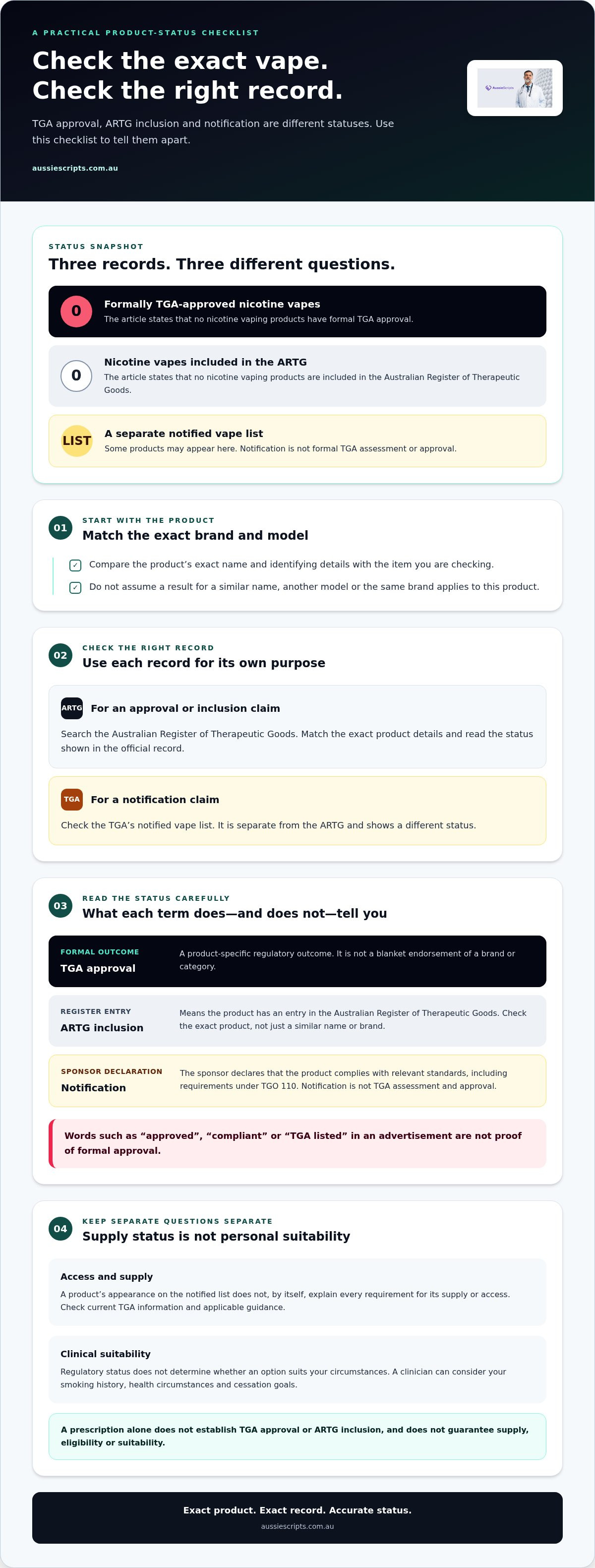
There is an important distinction for nicotine vapes. As of October 2026, no nicotine vaping products have been formally approved by the TGA or included in the ARTG. Some products may appear on the TGA’s notified vape list. That is a separate status: sponsors declare that their products comply with relevant standards, including requirements under TGO 110. Notification is not the same as TGA assessment and approval.
Claims about TGA approved nicotine vapes australia should therefore be checked against the exact product and the relevant official record. Words such as “approved”, “compliant” or “TGA listed” in an advertisement aren’t proof of formal approval. Look for a product-specific record and read the status it actually shows.
Does TGA approval mean a vape is safe for everyone?
No regulatory status establishes risk-free use or individual suitability. A product assessment concerns the product and its regulatory status. It does not assess your personal health circumstances, smoking history or cessation goals.
Those questions call for a separate clinical discussion. A clinician can consider your circumstances and discuss appropriate smoking cessation support. Regulatory status alone can’t determine whether a particular option is suitable for you, and this guide doesn’t make claims about comparative safety, effectiveness or long-term effects.
Why do approval, registration, and availability get confused?
These terms describe different things. “Approval” refers to a formal regulatory outcome for a specific therapeutic good. “ARTG inclusion” means a product has an entry in the Australian Register of Therapeutic Goods. “Notification” refers to a sponsor’s declaration that a vape meets applicable standards; it doesn’t mean the TGA has formally approved the product.
Marketing language can blur these distinctions. A claim that a vape “meets TGA standards” doesn’t establish that the product has been assessed for formal approval or appears on the ARTG. Check the wording against the product’s exact status rather than treating similar-sounding terms as interchangeable.
Availability is another separate question. A product’s presence on a notified list does not, by itself, explain every requirement that may apply to its supply or access. Those requirements can depend on current Australian rules. Check current TGA information for product status and applicable guidance before relying on a claim about supply.
TGA approval, ARTG inclusion, and access: how the terms differ
These terms answer different questions. A product’s regulatory record, its appearance on a notification list and the conditions that apply to supply aren’t interchangeable. The TGA’s current information states that no nicotine vaping products are formally approved or included in the ARTG. Some products are on a separate notified vape list.
| Term | What it tells you | What it doesn’t establish |
|---|---|---|
| TGA approval | A formal regulatory status for a specific therapeutic good following the relevant TGA process. | It isn’t a blanket endorsement of a brand or category. As of October 2026, no nicotine vaping products have this status. |
| ARTG inclusion | The product has an entry in the Australian Register of Therapeutic Goods, the TGA’s register of therapeutic goods that may be lawfully supplied in Australia, subject to applicable requirements. | A brand name, retailer listing or similar product name doesn’t prove that the exact product is included. |
| Access or supply status | Whether and under what current requirements a product may be supplied or accessed. | It doesn’t, by itself, establish formal TGA approval, ARTG inclusion or personal suitability. |
The notified vape list is distinct from the ARTG. A sponsor declares that a listed product complies with relevant standards, but notification is not formal TGA approval. If a product’s status or supply conditions remain unclear, don’t infer an answer from its appearance on one list. Check current TGA information and keep the different statuses separate.
What does the Australian Register of Therapeutic Goods show?
The ARTG is the TGA’s searchable register of therapeutic goods included on it. To check an entry, compare the product’s exact name and identifying details with the item you’re assessing, then read the status in the official record. Don’t assume that a result for a similar name, another model or the same brand applies to the product in front of you.
A product advertised online or described as “TGA listed” isn’t proof of ARTG inclusion. Search the ARTG for an approval or inclusion claim, and use the TGA’s notified vape list when checking notification. They are different records for different statuses.
Does a prescription automatically mean a product is TGA-approved?
No. A prescription relates to an individual’s clinical care and doesn’t, on its own, establish that a product has TGA approval or an ARTG entry. Nor does a prescription guarantee supply, eligibility or suitability. For product status, rely on the current TGA record rather than assuming one regulatory or clinical step confirms another.
Product status and individual access are separate questions: a product’s regulatory record doesn’t determine whether it’s suitable for a person or whether current supply requirements are met. Check claims about TGA approved nicotine vapes australia against the exact product record. Personal cessation needs can be discussed in a smoking cessation consultation.
How to check claims about nicotine vapes in Australia
Use a repeatable check rather than relying on a product page or promotional wording. Match the item being promoted with an official TGA record, then read what that record says. A close name match isn’t enough.
- 1. Identify the exact product. Note the brand, full product or model name, and any identifying details shown on the packaging or in the claim. Record the formulation and intended use if provided.
- 2. Search the relevant official record. Use the TGA’s ARTG search for claims of ARTG inclusion or approval. For a nicotine vape described as notified, check the TGA’s notified vape list. These records describe different statuses.
- 3. Compare the details and date. Check whether the record matches the exact product, then review its status and the date of the TGA information. Consult current TGA guidance for requirements that may have changed.
This process helps separate a verifiable status from promotional wording. Check terms such as “approved”, “registered”, “compliant” or “notified” against the record that corresponds to that specific term. The phrase TGA approved nicotine vapes australia doesn’t confirm that any particular product has formal approval.
Which product details should a reader compare?
Compare the exact brand and product identifiers in the claim with those in the official record. Check that the information refers to the same formulation and intended use, not simply another product from the same brand. If the spelling differs, a model detail is missing or a record appears to describe a different item, treat the match as unresolved. Don’t assume the products are equivalent without evidence.
A similar search result is a reason to check further, not a basis for concluding that the products are identical. Keep the wording of the claim separate from the wording in the official record. This makes any mismatch clear and prevents a brand-level match from being mistaken for product-specific status.
What should you do when a claim can’t be verified?
Treat an unverified claim as unconfirmed. A failed or unclear search doesn’t, on its own, prove approval or non-approval. Recheck the product name and identifiers, then consult current TGA information to confirm which record and terminology apply. Check publication dates too, since older pages may not reflect current guidance.
Don’t rely on an online claim alone to decide that a product is approved, or to import or use it. If the official information doesn’t resolve a mismatch, leave the status open rather than drawing a conclusion from an advertisement, retailer description or social post. This helps you assess claims without treating seller statements as regulatory confirmation.
Nicotine vapes and smoking cessation: weighing clinical questions
A product’s regulatory status can clarify what is known about its place in Australia’s therapeutic goods framework. It can’t answer whether that option is appropriate for a particular person. Smoking cessation decisions also depend on individual circumstances, including nicotine use, health considerations, past attempts to quit and what the person hopes to achieve.
Clinical suitability is individual and requires assessment by a health professional. A claim about TGA approval, ARTG inclusion or notification should not be treated as a personal recommendation. Nor should vaping be viewed as risk-free or suitable for everyone. A clinician can consider the person’s situation and discuss relevant support, rather than assume a particular outcome in advance.
Claims about TGA approved nicotine vapes australia address product status, not an individual cessation plan. Keep those questions separate: verify regulatory information through current official sources, then discuss personal needs with a clinician.
What should someone discuss with a clinician?
Start with an accurate picture of your nicotine use and what you’ve already tried. It can help to outline your smoking or vaping history, previous quit attempts, what made them difficult, any relevant health circumstances, and your current concerns or goals.
Be direct about what you want from support. You might be aiming to stop smoking, reduce nicotine use or work out what options are appropriate to discuss. A clinician can consider this information and talk through cessation support suited to your circumstances. The discussion doesn’t promise a particular treatment or prescription.
When is telehealth smoking cessation support relevant?
A virtual consultation provides a way to discuss smoking cessation needs with an Australian-registered doctor. It can be useful if you want to explain your history and goals in a clinical conversation without attending an in-person appointment. The consultation focuses on your circumstances, rather than assuming that a product claim determines the right next step.
During the consultation, the doctor assesses the information you provide and determines appropriate next steps. These depend on the individual assessment; a consultation doesn’t guarantee a prescription or a particular cessation option. You can use the discussion to clarify your concerns, understand what further information may matter and consider support in a measured way.
If you’re ready to discuss your circumstances and cessation goals with a clinician, book a smoking cessation consultation through Aussie Scripts. An Australian-registered doctor can assess your needs and discuss appropriate next steps.
Discuss smoking cessation with an Aussie Scripts clinician
After checking a product claim against current TGA information, separate what the record says from the question of what support may suit you. Product status and clinical suitability are different matters. A clinician can discuss your cessation needs without assuming that a particular vape or other treatment is the right option.
Aussie Scripts provides smoking cessation consultations by telehealth, connecting patients with Australian-registered doctors. The consultation is an opportunity to explain your situation, raise concerns and discuss possible next steps. It doesn’t promise a nicotine-vape prescription, access to a particular product or a specific treatment outcome.
What to expect from a smoking cessation consultation
The discussion focuses on your circumstances and cessation concerns. You can describe your smoking and nicotine use, previous attempts to quit, what you found challenging and what you hope to change. If you’ve checked a product claim, you can explain what you found while keeping its regulatory status separate from questions about your personal care.
The doctor assesses the information you provide and determines appropriate clinical next steps. Those steps depend on the assessment; a consultation doesn’t guarantee a prescription, product or particular treatment. The purpose is to support an informed clinical discussion, not to validate a product claim or predetermine the outcome.
Choose a clear next step
If you want guidance tailored to your circumstances, discuss smoking cessation with a clinician. Aussie Scripts offers national telehealth access and operates seven days a week. This gives you a way to raise your questions with an Australian-registered doctor; it doesn’t replace emergency care or guarantee that a particular option will be suitable.
Before the consultation, note your nicotine use, past quit attempts, current concerns and goals. Bring product-status questions as questions, not conclusions. This can help keep the conversation focused on both the information you’ve found and the support you need.
Understand what this information can and can’t do
Regulatory information can clarify a product’s recorded status, but it can’t determine whether using that product is appropriate for you. General information in this guide isn’t individual medical advice and doesn’t replace an assessment by a health professional. Check claims about TGA approved nicotine vapes australia against current official records, and discuss cessation decisions in light of your own health and goals.
For a clinical discussion about your cessation needs, discuss smoking cessation with a clinician.
Make your next decision with clinical context
Understanding claims about TGA approved nicotine vapes australia can help you ask clearer questions, but general regulatory information can’t tell you which cessation option is right for you. That depends on your circumstances and requires an individual clinical assessment. Use what you’ve learned as a starting point for a considered conversation, not as a substitute for personal medical advice.
If you’re weighing up how to move forward, focus on the change you want to make and the concerns you’d like addressed. A clinician can discuss your needs and appropriate next steps without assuming a particular product or treatment is suitable. You don’t need to make a decision based on a product claim alone.
Use the information you’ve gathered to prepare for a clinical conversation about your goals and concerns.
Frequently Asked Questions
Are nicotine vapes TGA-approved in Australia?
The topic of TGA approved nicotine vapes australia can be confusing: as of October 2026, no nicotine vaping products have been formally approved by the TGA or included in the ARTG. Some are on the separate notified vape list, which reflects a sponsor’s declaration about meeting relevant standards, not formal TGA approval. Check current TGA information for the specific product, as regulatory records and guidance can change.
Does TGA approval mean a nicotine vape is safe for everyone?
No. A product’s regulatory status doesn’t establish that it is risk-free or appropriate for every person. Personal suitability depends on individual circumstances, which a product record cannot assess. If you’re considering smoking cessation support, discuss your nicotine use, health circumstances and goals with a clinician. They can assess your situation and talk through appropriate next steps without assuming that one product or treatment is right for you.
How can I check whether a nicotine vape is listed on the ARTG?
Search the TGA’s ARTG using the exact product name and compare the result with the item you’re checking. Look beyond a matching brand: a result for another model or formulation may not refer to the same product. If the details don’t match, treat the result as inconclusive. Also distinguish an ARTG search from the TGA’s separate notified vape list, which records a different status.
Does having a prescription mean a nicotine vape is TGA-approved?
No. A prescription concerns an individual’s clinical care; it doesn’t establish a product’s regulatory status. Check the product’s approval or ARTG inclusion separately in the relevant TGA records. A prescription also doesn’t guarantee supply or determine whether a treatment is suitable for you. For a specific claim, use current official product information rather than relying on the prescription as evidence of approval.
Can an online doctor help with smoking cessation?
Yes. A telehealth consultation gives you an opportunity to discuss your smoking history, previous quit attempts and cessation goals with an Australian-registered doctor. The doctor assesses the information you provide and determines appropriate next steps. Aussie Scripts offers virtual consultations for smoking cessation. A consultation is a clinical discussion, not a guarantee of a nicotine-vape prescription or any particular treatment outcome.
What should I do if a seller claims its vape is TGA-approved?
Identify the exact product named in the claim, then compare its name and identifying details with current TGA records. Check whether the claim means ARTG inclusion, notification or something else; similar terms aren’t interchangeable. If you can’t find a matching record, regard the claim as unverified rather than assuming it proves approval or non-approval. Seller wording alone doesn’t confirm a product’s regulatory status.
Disclaimer
The information provided by AussieScripts is for general informational purposes only and does not constitute medical advice, diagnosis, or treatment. For advice tailored to your specific symptoms or health concerns, please consult one of our doctors or your regular GP.
