Timeline of Health Benefits After Quitting Cigarettes: What Changes and When
Understand the timeline of health benefits after quitting cigarettes. See how your body begins healing within minutes and continues recovering over years.

Your body can start responding to quitting cigarettes before you notice a clear difference. The timeline of health benefits after quitting cigarettes can begin within 20 minutes, when heart rate and blood pressure start to drop, according to the health milestones outlined by the CDC. Early nicotine withdrawal can overlap with changes you hope to feel, making progress difficult to judge.
It’s understandable to wonder whether years of smoking have caused lasting harm or whether benefits will take months to appear. Some changes begin within hours or weeks, while reductions in certain disease risks build over years. Timing varies from person to person, so another person’s experience is not a reliable measure of your own.
This guide covers possible changes from the first hours through the longer term, explains how withdrawal can feel different from improving health, and describes why timelines vary. If you want help discussing clinically appropriate quitting support, you can book a smoking cessation consultation with an Australian-registered doctor through telehealth.
Key Takeaways
- The timeline of health benefits after quitting cigarettes describes typical milestones, not a personal forecast or deadline.
- Some changes may emerge over the first year, while certain health risks can continue to decline over a longer period.
- Temporary nicotine withdrawal is different from longer-term health changes. Your smoking history and health can affect your experience.
- Use the timeline to set a quit goal, identify smoking triggers and consider discussing suitable support with a doctor.
What the timeline of health benefits after quitting cigarettes can, and cannot, tell you
Some measurable changes may begin soon after quitting, while others develop over months or years. The timeline of health benefits after quitting cigarettes is a guide to common milestones observed across groups, not a personal forecast. It includes changes in bodily processes, such as carbon monoxide levels, and longer-term changes in the likelihood of smoking-related disease. These follow different timeframes, so an early change does not mean every future risk has already fallen.
For a broad overview of the changes associated with stopping smoking, see Health benefits of quitting smoking. Treat general milestones as context, not a way to diagnose or assess your own health.
This video offers a visual introduction to changes after stopping smoking:
Why quitting can matter at any point
Past smoking does not make future health improvements irrelevant. Stopping removes ongoing exposure to cigarette smoke, which can support changes in the body even if you have smoked for many years. Some disease risks may decline over time, but they do not necessarily return to the level of someone who has never smoked. The likely benefit for an individual depends on personal health and smoking history.
If you have tried to quit before and started smoking again, that experience does not erase the value of another attempt. It can help you identify situations that make smoking more likely and consider what support might help next time. A smoking cessation consultation with an Australian-registered doctor provides a clinical assessment and an opportunity to discuss appropriate support. It cannot guarantee a particular outcome.
How to read the time ranges
Published timelines use estimates, and ranges can differ across health sources. A milestone describes a general pattern, not a deadline by which everyone should experience the same change. It also does not guarantee that you will feel a noticeable difference on that day or week.
General health milestones describe patterns across groups; they are not an individual clinical forecast. A measurable bodily change may occur without a sensation you can identify. How you feel on a particular day may also reflect several factors, not just changes linked to quitting.
Read the timeline as orientation, not a test of whether your recovery is “on schedule”. Population-level information explains why benefits may unfold in stages, but it cannot account for your full medical history or determine what a symptom means. If you have health concerns or want advice tailored to you, speak with a health professional. An Australian-registered doctor can assess your circumstances and discuss suitable next steps.
What may change in the first minutes, days, weeks, and months after quitting
Changes after quitting can begin before you notice a difference in how you feel. Public health timelines describe typical physiological milestones, not a schedule that everyone will experience. The ranges below summarise commonly reported changes, including those outlined by the CDC. They offer context, but cannot show what is happening inside your body at a particular moment.
The CDC reports that heart rate begins to drop within 20 minutes of quitting, although you may not feel that change. This is a measurable bodily response, not a promise of an immediate sensation or a complete reduction in future health risks.
The first hours and days
In the first day, different substances follow different patterns. Nicotine and carbon monoxide are not interchangeable: nicotine is the addictive substance in tobacco, while carbon monoxide is a gas in cigarette smoke that reduces the blood’s ability to carry oxygen. A change in one does not mean the other has changed at the same rate.
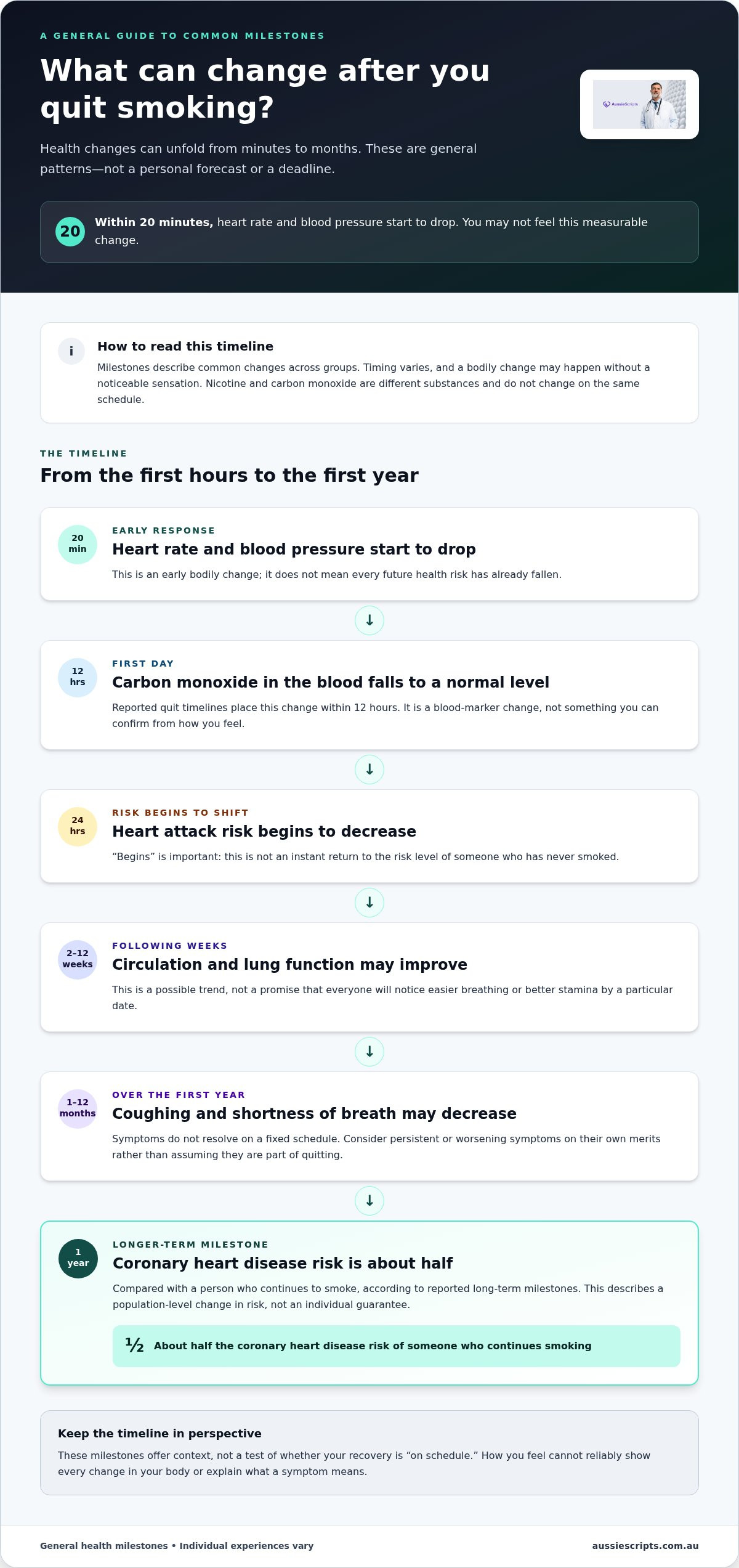
- Within 20 minutes: Heart rate and blood pressure start to drop.
- Within 12 hours: Carbon monoxide in the blood falls to a normal level, according to commonly reported quit timelines. This is a change in a blood marker, not something you can confirm by how you feel.
- Within 24 hours: The risk of a heart attack begins to decrease. “Begins” matters: this is an early change in risk, not an instant return to the risk level of someone who has never smoked.
The following weeks and months
Over the next several months, circulation and lung function may improve, while coughing and shortness of breath can ease. These trends are not universal, and symptoms do not resolve on a fixed schedule. A cough may also change during the adjustment period. Consider persistent or worsening symptoms on their own merits rather than assuming they are part of quitting.
- Two to 12 weeks: Circulation and lung function may improve.
- One to 12 months: Coughing and shortness of breath may decrease.
- By one year: The risk of coronary heart disease is about half that of a person who continues to smoke, according to the reported long-term milestones.
These ranges do not mean everyone will notice easier breathing or better stamina by a particular date. Changes in circulation and lung function refer to bodily processes, while the heart-disease milestone describes a change in risk across populations. Neither can be assessed reliably by checking how you feel alone.
If breathing problems, chest pain or another symptom concerns you, seek medical assessment instead of relying on a general timeline. To discuss clinically appropriate quitting support, a smoking cessation consultation with an Australian-registered doctor provides a clinical assessment. It can help inform next steps, but cannot guarantee a quit outcome.
How health benefits can continue over the years after quitting cigarettes
Some benefits continue to develop well beyond the first year without cigarettes. Long-term milestones describe changes in the risk of particular diseases, not a point when the body instantly returns to the health profile of someone who has never smoked. Public health sources such as the CDC present these milestones as broad estimates. They show why stopping matters over time, but cannot calculate an individual’s risk.
After quitting, disease risks change gradually, and the pace and extent of change differ by outcome and individual. The timeline of health benefits after quitting cigarettes therefore needs to be read condition by condition: heart disease, stroke and cancer do not share one recovery schedule.
Heart and circulation risks over time
By around 15 years after quitting, coronary heart disease risk is described as close to that of a person who has never smoked. “Close” does not mean identical for everyone. It describes a population-level pattern, not a guarantee about an individual’s cardiovascular health.
Risk comparisons need context. A relative-risk figure compares one group’s risk with another group’s. An individual’s absolute risk, their actual chance of developing a condition over a given period, depends on factors such as age, health and smoking history. A group estimate cannot tell you your personal likelihood or replace assessment by a health professional. Gradual change is also not a reason to delay quitting: exposure stops when smoking stops, while longer-term risk patterns unfold over years.
Lung and other disease risks
Long-term milestones differ by disease. Public health timelines commonly report that, within five to 10 years of quitting, stroke risk falls and risks of cancers of the mouth, throat, oesophagus and bladder are reduced. At around 10 years, the risk of dying from lung cancer is reported as about half that of someone who continues to smoke. These are comparisons between groups, not predictions for an individual.
A lower risk is not zero risk. Quitting reduces ongoing exposure, but it does not erase a person’s smoking history or guarantee that a smoking-related disease will not occur. The size of any change can depend on how long and how much someone smoked, along with other health factors. Milestones also describe different outcomes: a change in stroke risk cannot be used to infer the timing of a change in lung cancer risk.
Use long-range estimates as evidence that health gains can keep accumulating, not as a countdown to a guaranteed result. If you have risk factors or questions about screening and prevention, a clinician can consider your personal history and advise what is appropriate. The timeline gives an overview; individual clinical advice addresses your circumstances.
Why your recovery timeline may differ, and what early discomfort means
The timeline of health benefits after quitting cigarettes is a useful overview, but it cannot predict exactly how you will feel or when a particular change will happen. Age, smoking history, existing health conditions and other personal factors can influence symptoms and health risks. Two people who stop smoking on the same day may have different experiences, without either person’s progress being wrong.
Early discomfort needs careful interpretation. It may relate to nicotine withdrawal, another health issue or something else. It does not prove that a health benefit is occurring, and a general timeline cannot identify the cause of an individual symptom.
Factors that can affect the pace of change
Smoking duration and intensity contribute to a person’s overall exposure to cigarette smoke, but those details alone cannot calculate an individual recovery schedule. Age and existing health conditions also matter when assessing symptoms and future risk. A timeline cannot account for your full medical history, so do not use it to predict a personal outcome or decide whether a symptom needs attention.
Your starting point matters, too. Someone with a diagnosed respiratory or cardiovascular condition may have symptoms that need individual assessment rather than comparison with a general milestone. If you are managing a health condition, taking medicines or unsure whether a change in how you feel is related to quitting, a clinician can consider your circumstances and advise you.
Withdrawal, cravings and setbacks
Cravings and discomfort are possible when you stop smoking, but they do not happen in the same way for everyone. Nicotine withdrawal is different from the longer-term changes in circulation, lung function and disease risk described in quit timelines. Feeling irritable or having a strong urge to smoke does not tell you whether your lung function has changed. Feeling well does not confirm that a particular health milestone has occurred.
Treat symptoms as information, not a pass-or-fail test. Note what you are experiencing and when it happens. If symptoms are severe, persistent or worrying, seek medical advice instead of assuming they are withdrawal or evidence of recovery. A clinician can assess possible causes and discuss support suited to your situation.
A lapse does not erase the value of stopping or mean you cannot try again. It may show that a particular situation, routine or stressor needs a different plan. Consider what happened just before you smoked, what support could help in that moment and whether your approach needs adjusting. Previous attempts can provide useful information without being a reason for blame.
If cravings or past setbacks are making it difficult to plan your next attempt, you can book a smoking cessation consultation to discuss clinically appropriate support with an Australian-registered doctor. The consultation offers a clinical assessment, not a guaranteed quit outcome.
How to use the quitting timeline to plan your next step
Use the timeline as a reminder that change can happen in stages, not as a deadline for feeling better. You do not need to notice a particular milestone to know that stopping is worthwhile. Instead, use the information to make one practical decision: what will help you prepare for your next quit attempt?
A useful plan can be simple. Set a clear goal, then identify the situations in which you are most likely to smoke. If you have quit before, reflect on what helped and what made it harder. That information can guide the support you seek, without turning a difficult day or lapse into a reason to give up.
Create a realistic quit-support plan
Write down your reasons for quitting and the moments when smoking is part of a routine, such as a work break or a stressful situation. Think about what you could do instead and who you would feel comfortable asking for support. Planning for a predictable trigger can be easier to act on than a general intention to “smoke less”.
Consider discussing your circumstances with a qualified health professional. They can help you weigh suitable support options in light of your health and preferences. No single approach works for everyone, and no plan can guarantee success. If your first plan needs adjusting, treat that as useful information, not proof that you cannot quit.
When a telehealth consultation may help
If you want professional guidance as you plan, Aussie Scripts offers smoking cessation consultations with Australian-registered doctors. A telehealth consultation provides a clinical assessment and an opportunity to discuss support that may be appropriate for you. It is not emergency care and does not guarantee that you will quit.
Before a consultation, note your smoking patterns, previous quit attempts, health conditions and questions. You can also explain which situations tend to trigger smoking and what kind of support you are considering. This gives the doctor useful context for discussing your next steps.
Choose one manageable action now: set a quit goal, identify a trigger to plan for or arrange a conversation with a health professional. If a clinical discussion would help, explore a smoking cessation consultation with an Australian-registered doctor. Use the timeline for perspective, then focus on the support and plan that fit your circumstances.
Choose one practical step towards quitting
Your next step does not need to solve everything at once. Set a quit date, note a question for a clinician or decide how you will respond to a familiar smoking trigger. A clear, manageable action can turn intention into preparation.
Use the timeline of health benefits after quitting cigarettes as context, not as a measure of whether you are progressing quickly enough. Your plan can change as you learn what support is useful. If you are unsure how to begin or want guidance tailored to your circumstances, a clinical conversation can help you consider appropriate options.
Explore an Aussie Scripts smoking cessation consultation to discuss quitting support with a doctor. No single conversation or approach guarantees an outcome. Start with the step that feels achievable today, and build your plan from there.
Frequently Asked Questions
How soon does your body start to recover after quitting cigarettes?
Some measurable changes can begin within minutes of your last cigarette. Heart rate and blood pressure start to fall within 20 minutes, and carbon monoxide in the blood can return to a normal level within 12 hours. These are general milestones, not changes everyone can feel. Nicotine withdrawal may also begin early, so a craving or other discomfort does not mean your body is not responding to quitting.
What happens to your lungs after you stop smoking for a month?
After a month, lung function may be improving, but there is no single change everyone should expect to notice. Public health timelines place improvements in circulation and lung function across a broader period of weeks, while coughing or breathlessness may ease over subsequent months. If your breathing is worsening or a symptom concerns you, seek medical advice rather than assuming it is part of recovery.
Can your health improve after years of smoking?
Yes. Stopping smoking can benefit health even after a long smoking history because it ends continued exposure to cigarette smoke. Past exposure can still affect future disease risk, so quitting does not guarantee that every risk will return to the level of someone who never smoked. If you have a smoking-related condition or specific concerns, a health professional can advise you based on your medical history.
How long after quitting smoking does heart disease risk go down?
Heart attack risk begins to decrease within 24 hours of quitting. By one year, coronary heart disease risk is about half that of a person who continues to smoke. These are population-level comparisons, not a personal risk calculation or a guarantee that risk becomes identical for everyone. Your age, health and smoking history can affect your individual risk, which a clinician can assess in context.
Is coughing after quitting cigarettes normal?
Coughing can change after quitting, and it may take time to ease. A cough alone cannot confirm that your lungs are recovering or identify its cause. Pay attention to whether it persists, worsens or comes with other concerning symptoms. Seek medical advice if you are worried, rather than assuming the cough is a normal part of stopping smoking. A clinician can assess your symptoms and advise on next steps.
Do the health benefits of quitting smoking happen at the same time for everyone?
No. The timeline of health benefits after quitting cigarettes describes general milestones, not a schedule that applies to each person. Your experience can depend on factors such as smoking history, age and existing health conditions. You may not feel a measurable change, and feeling different does not confirm a specific health milestone. Use timelines for context, and seek individual medical advice if you have concerns about symptoms or personal risk.
What should I do if I have a cigarette after quitting?
One cigarette does not mean you have to abandon your plan. Pause, consider what led to smoking, and decide what support or change could help in a similar situation next time. Return to your quit goal and seek advice if cravings or setbacks are making it difficult. A smoking cessation consultation with an Australian-registered doctor provides a clinical assessment and an opportunity to discuss suitable support, without guaranteeing a particular outcome.
Disclaimer
The information provided by AussieScripts is for general informational purposes only and does not constitute medical advice, diagnosis, or treatment. For advice tailored to your specific symptoms or health concerns, please consult one of our doctors or your regular GP.