Vaping for Nicotine Withdrawal: A Guide for Australians
Explore managing nicotine withdrawal with a vape in Australia. Learn about regulation, craving relief, risks, and how it compares to clinical quit methods.

Could a vape ease the next craving while making it harder to leave nicotine behind? Cravings, irritability and trouble concentrating can disrupt daily routines, so it’s understandable to look for quick relief. Managing nicotine withdrawal with a vape may help some people manage cravings, but it doesn’t automatically end nicotine dependence or make vaping risk-free.
This guide explains what vaping may and may not do during withdrawal, and how it compares with options such as nicotine replacement therapy and behavioural support. Therapeutic vaping is regulated in Australia, with access requirements that can depend on factors such as age, nicotine strength and state or territory rules.
You’ll learn what to consider before relying on a vape, how to plan for cravings and ongoing nicotine use, and when to seek advice from a pharmacist, doctor or quit service. If withdrawal feels difficult or you want a plan tailored to your circumstances, a doctor-led smoking cessation consultation can support clinical assessment and next-step planning. Recommendations depend on your individual assessment.
Key Takeaways
- Notice when cravings and other withdrawal symptoms occur, then identify triggers you can plan around.
- When managing nicotine withdrawal with a vape, distinguish short-term craving relief from reducing or stopping nicotine use.
- Compare vaping, nicotine replacement therapy and behavioural support by how each is accessed, its nicotine exposure and whether clinical advice is needed.
- Prepare non-nicotine responses for cravings and track what helps, so you can review and adjust your plan.
- If symptoms persist, feel difficult to manage or are affected by other health conditions, discuss your options with a doctor or pharmacist.
What nicotine withdrawal feels like when you are trying to quit
Nicotine withdrawal is the body and brain adjusting when nicotine intake is reduced or stopped. A craving is a strong urge to use nicotine. Withdrawal is the wider set of possible changes, which can include cravings, irritability, restlessness, low mood, sleep disturbance and difficulty concentrating. Not everyone experiences the same symptoms or intensity.
Symptoms may come and go, and their pattern can change during a quit attempt. There’s no single timeline that applies to everyone. How much and how often someone used nicotine, their health and circumstances, and the support they have may all shape their experience. A general overview of nicotine withdrawal symptoms and causes can provide background, but it can’t determine what’s causing symptoms for you.
Why nicotine cravings and withdrawal symptoms occur
With regular nicotine use, the brain and body adapt to nicotine being present. When intake drops, that adjustment can produce urges to use nicotine and other changes while the body responds. This is a physical response to dependence, not evidence of weak willpower or a personal failing.
Cravings may be linked to routines or situations as well as reduced nicotine intake. For example, someone might notice an urge during a work break or after a meal. Other possible symptoms, such as irritability or difficulty focusing, may occur alongside cravings or separately. These experiences can have other causes too, so this description isn’t a diagnosis. If you’re considering managing nicotine withdrawal with a vape, tracking what you experience can help you discuss the pattern with a health professional.
What to track during a quit attempt
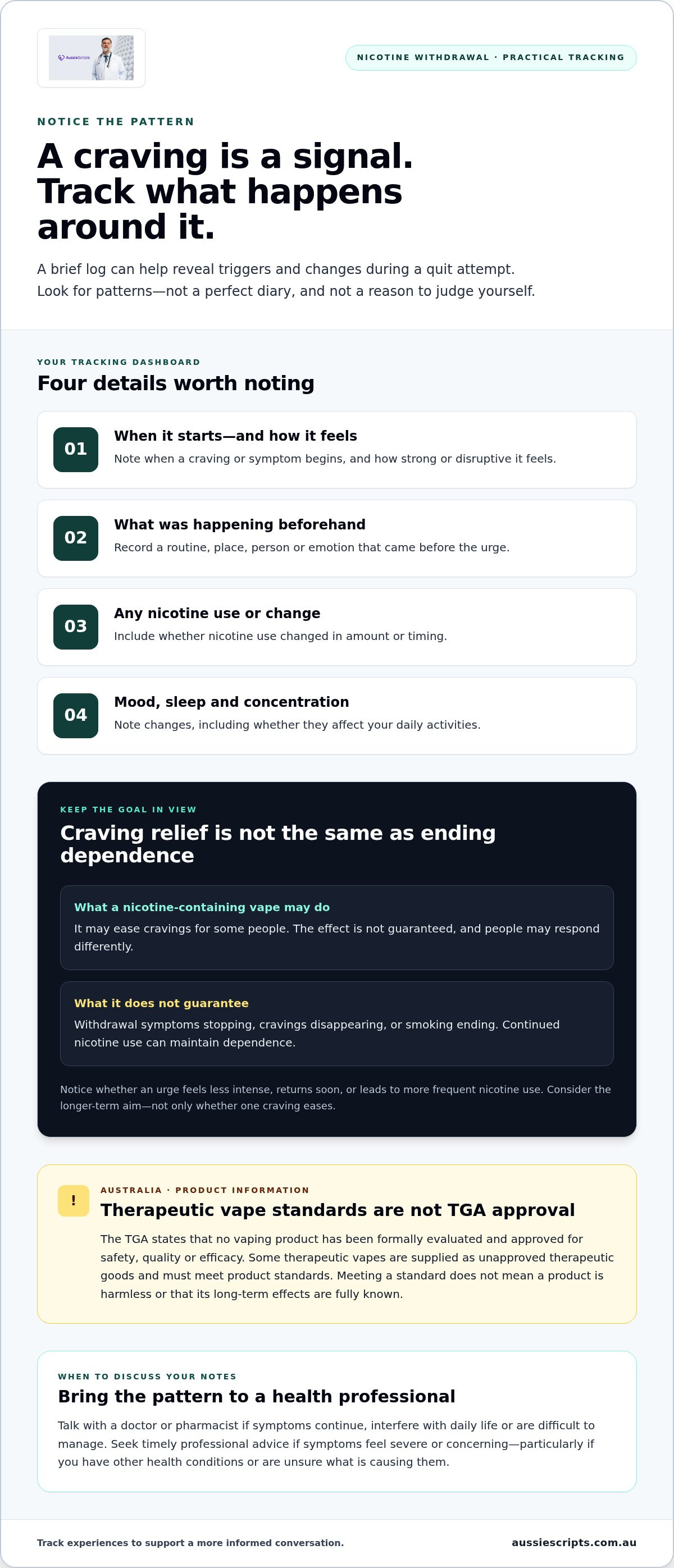
A brief log can help you spot what tends to happen before and during a craving. Record details as they occur, without aiming for a perfect diary. You could note:
- When a craving or symptom starts, and how strong or disruptive it feels.
- What was happening beforehand, such as a routine, place, person or emotion.
- Any nicotine use, including whether the amount or timing changed.
- Changes in mood, sleep or concentration, and whether they affect daily activities.
Look for patterns rather than judging yourself over individual entries. A craving after a familiar routine may point to a trigger you can plan for. Persistent sleep or concentration problems are useful context for a clinician. Take your log to a doctor or pharmacist if symptoms continue, interfere with daily life or are difficult to manage. Seek timely professional advice for symptoms that feel severe or concerning, particularly if you have other health conditions or aren’t sure what is causing them.
Can a vape help manage nicotine withdrawal? Benefits and limits
A nicotine-containing vape may ease cravings for some people by providing nicotine when an urge arises. The effect isn’t guaranteed, and a reduction in craving is not the same as resolving the broader effects of withdrawal. People may respond differently depending on their nicotine use, circumstances and the product involved.
Easing a craving does not resolve nicotine dependence. A vape may change how an individual experiences an urge in the moment, but continued nicotine use can maintain dependence. Managing nicotine withdrawal with a vape therefore needs to be considered separately from reducing nicotine use or stopping smoking.
What vaping may change during a craving
Nicotine can be absorbed when a person uses a nicotine-containing vape. The act of vaping may also become part of a familiar routine. For some, these factors may make a craving feel more manageable; for others, relief may be limited or inconsistent. Neither the sensation of relief nor the amount of nicotine delivered can be assumed to be the same for every person or product.
Notice what changes after a craving rather than relying on a general expectation. Does the urge feel less intense, return soon, or lead to more frequent nicotine use? These observations can help you assess whether your approach supports your broader goal. The CDC guidance on managing nicotine withdrawal symptoms also outlines strategies for responding to common challenges during a quit attempt.
What vaping does not guarantee
Vaping doesn’t guarantee that withdrawal symptoms will stop, cravings will disappear or smoking will end. A person may continue to smoke while vaping, or stop smoking but continue using nicotine through a vape. If nicotine use continues, dependence may also continue. The longer-term aim and a plan for reviewing nicotine use matter, not only whether an individual craving eases.
Vaping isn’t risk-free. In Australia, the Therapeutic Goods Administration (TGA) states that no vaping product has been formally evaluated and approved for safety, quality or efficacy. Some therapeutic vapes are supplied as unapproved therapeutic goods and must meet product standards. This is not the same as TGA approval, and meeting a standard does not mean a product is harmless or that its long-term effects are fully known.
Consider your smoking and vaping history, health circumstances and intended goal before deciding what support to use. Don’t treat a particular device, nicotine strength or routine as a guaranteed solution. If you’re unsure whether vaping is helping you move towards stopping smoking, or nicotine use is continuing, discuss your situation with a health professional who can assess your individual needs.
If you want tailored clinical guidance, a smoking cessation consultation can help you review your history and consider next steps. Recommendations depend on an individual assessment.
Vaping, nicotine replacement and other quit supports compared
There’s no single option that suits everyone. The right approach depends on factors such as your smoking and vaping history, health circumstances, preferences and whether you want to stop smoking, reduce nicotine use or both. Use this comparison to prepare questions for a pharmacist or doctor. It’s not a substitute for individual advice.
| Support | Purpose and access | Nicotine exposure | When clinical advice matters |
|---|---|---|---|
| Therapeutic vape | May help some people manage cravings. In Australia, supply is through pharmacies, and access requirements can depend on age, nicotine concentration and state or territory rules. | Present in nicotine-containing products; use patterns can vary. | Ask a pharmacist or doctor about access and suitability, especially if you have complex health needs. |
| Nicotine replacement therapy (NRT) | Designed as a cessation support. Products such as patches or oral forms are used according to their product instructions and are available through pharmacies. | Provides nicotine without vaping. | A pharmacist or doctor can help you understand product instructions and whether an option suits your circumstances. |
| Behavioural support | Helps with planning, coping with triggers and maintaining a quit attempt. Support may include Quitline or counselling. | No nicotine in the support itself. | Can be used alone or alongside another approach; seek clinical advice if symptoms or health concerns need assessment. |
| Clinician-guided support | A doctor or pharmacist can review your history and discuss appropriate cessation options. A doctor-led consultation can support individual assessment and next-step planning. | Depends on the approach recommended and chosen. | Relevant if you have health conditions, use multiple nicotine products or need help selecting a plan. |
How nicotine replacement therapy differs from vaping
NRT is designed specifically to support smoking cessation. Its product instructions explain how to use that particular option. Vaping involves a different product and routine, and use can vary between individuals. Neither description determines what will work for you. A pharmacist or doctor can help you compare suitable options, understand instructions and account for your health history.
When behavioural or clinician support can add value
Practical support can help turn an intention to quit into a plan: identify triggers, prepare alternative responses and review what is or isn’t working. In Australia, Quitline is a support option for people who want help with quitting. A clinician can also assess smoking and vaping history and discuss treatments, including medicines where clinically appropriate. Recommendations depend on individual assessment.
If you’re managing nicotine withdrawal with a vape, consider pairing your approach with a clear goal and a review plan. Compare options by the support they provide, how nicotine is involved and what advice you may need, rather than assuming one method is best for everyone.
A practical plan for managing cravings and withdrawal
A useful quit plan is specific enough to follow but flexible enough to adjust. It doesn’t need to predict exactly when cravings will occur or how symptoms will change. Focus on four actions: prepare for likely triggers, choose a response for the moment, track what happens and review the plan with support.
- Prepare. Note situations, routines or emotions that tend to prompt nicotine use. Choose a few responses in advance, such as taking a brief walk, drinking water or contacting a support person. Keep the options practical for places where cravings are likely, including work breaks or the trip home.
- Respond to a craving. Pause and identify what’s happening: where you are, what you were doing and what you need in that moment. Try one of your planned non-nicotine responses. If it doesn’t help enough, record that rather than treating it as a failure. A different trigger may need a different response.
- Track your progress. Make a brief note of smoking and vaping, cravings, symptoms, possible triggers and what you tried. Include changes in mood, sleep or concentration if they’re affecting daily life. This record can help you see patterns and give a doctor or pharmacist useful context.
- Review and adjust. Check what has been manageable and what needs more support. If vaping is part of your plan, discuss a longer-term goal for nicotine use with a clinician, rather than assuming that reduced smoking means nicotine dependence has ended. Recommendations should reflect your circumstances.
Prepare for predictable cravings
Think through an ordinary day and mark the moments when nicotine use is most likely. You might plan a short walk after a meal, keep water nearby during a break or message someone when stress is a trigger. Decide how you’ll seek professional advice if symptoms become difficult to manage. Planning ahead makes a response easier to use when concentration or patience is low.
Review progress and respond to a setback
If you smoke or vape outside your plan, treat it as information, not proof that you’ve failed. Record what happened beforehand, what you used and what might help next time. A lapse can reveal a trigger you hadn’t anticipated or show that your support needs adjusting. Return to your plan and seek clinical advice if you’re finding it hard to continue.
If you’d like a doctor to review your smoking and vaping history and discuss next steps, consider a smoking cessation consultation. The plan and any recommendations depend on an individual clinical assessment.
When to seek help for nicotine withdrawal in Australia
Speak with a doctor or pharmacist if symptoms persist, feel difficult to manage or interfere with daily activities. It’s also sensible to seek advice if you have a health condition, take medicines or are unsure whether symptoms relate to nicotine withdrawal. A clinician can review your smoking and vaping history, consider relevant health factors and discuss cessation support that may suit your circumstances.
Get prompt medical advice for symptoms that feel severe or concerning. If you think you may be experiencing a medical emergency, call 000.
What to discuss in a smoking cessation consultation
Before speaking with a clinician, note your smoking and vaping history, nicotine use, previous quit attempts and current symptoms. Include relevant medicines and health conditions, and explain what concerns you most, such as cravings disrupting work or sleep. This context helps the doctor assess your situation. Recommendations depend on the clinical assessment and your individual circumstances.
It can also help to describe what you want to change. For example, are you aiming to stop smoking, reduce nicotine use, or work out whether managing nicotine withdrawal with a vape is appropriate for you? Be clear about any vaping alongside smoking, since both are relevant to discussing your next steps. A consultation doesn’t guarantee a particular treatment or prescription.
How telehealth can support next steps
With a telehealth consultation, you select the relevant service and take part in a clinical assessment with an Australian-registered doctor. The discussion can inform next-step planning based on your history and needs. Telehealth is not emergency care, and an assessment doesn’t mean a specific treatment or prescription will be provided.
To prepare, keep your notes nearby and be ready to explain what you’ve tried, what has been difficult and what outcome you’re working towards. If you’re unsure about nicotine products or cessation options, raise those questions so the clinician can consider them as part of your assessment.
A doctor-led consultation may be useful if withdrawal is hard to manage or you want an individual plan. You can explore Aussie Scripts’ smoking cessation consultation pathway for information about the service and its clinical assessment process.
Choose one clear next step
You don’t need to decide on a complete quit strategy all at once. Start by clarifying what you want to change next: smoking, nicotine use, or how you respond when cravings interrupt your day. If managing nicotine withdrawal with a vape is part of that decision, write down the questions you still have and what you’d like a clinician to help assess.
A focused conversation can help turn uncertainty into a practical direction. Aussie Scripts’ smoking cessation consultation pathway offers clinical guidance and next-step planning, with recommendations based on individual assessment rather than a promised treatment or outcome.
Explore smoking cessation consultations with Aussie Scripts and take the next step at a pace that feels manageable. A plan can be adjusted as you learn what works for you, and seeking support is a constructive place to begin.
Frequently Asked Questions
Can vaping stop nicotine withdrawal symptoms completely?
No. A nicotine-containing vape may ease cravings for some people, but it can’t be relied on to remove every withdrawal symptom. For example, someone might notice fewer urges but still experience disrupted sleep or irritability. If symptoms remain disruptive, review your approach with a doctor or pharmacist rather than assuming you need to use more nicotine. Managing nicotine withdrawal with a vape should include a plan for reviewing ongoing nicotine use.
Is vaping a proven way to quit smoking in Australia?
Evidence indicates nicotine e-cigarettes can help some people stop smoking, but that doesn’t mean every vape or approach is suitable or guaranteed to work. A Cochrane review found high-certainty evidence of higher quit rates with nicotine e-cigarettes than with traditional nicotine replacement therapy. In Australia, vaping products are regulated therapeutic goods, and no vaping product has been formally evaluated and approved by the TGA for safety, quality or efficacy.
How long does nicotine withdrawal last when using a vape?
There’s no set timeline, particularly if you continue using nicotine through a vape. The pattern depends on individual circumstances and whether nicotine intake changes; symptoms may shift if you reduce or stop vaping. Track when symptoms appear and whether they affect daily activities. If they persist or become difficult to manage, take those notes to a health professional to discuss what may be contributing and what support could suit you.
Can I use nicotine replacement therapy and a vape at the same time?
Don’t combine nicotine replacement therapy (NRT) with a nicotine-containing vape without first getting advice from a pharmacist or doctor. Using both can increase nicotine exposure, and the right advice depends on your health, current nicotine use and the specific NRT product. Share what you use and how often, including any recent changes. A health professional can help you understand product directions and discuss a coordinated approach.
What should I do if I still crave cigarettes while vaping?
Don’t assume that stronger or more frequent vaping is the answer. Note when cigarette cravings happen, what was going on and whether you’re still smoking, then discuss the pattern with a pharmacist or doctor. For instance, cravings tied to a particular break may call for a plan for that situation as well as a review of cessation support. If you smoke during a quit attempt, treat it as a reason to reassess, not a reason to abandon support.
Can an online doctor help me manage nicotine withdrawal?
Yes. An online doctor can review your nicotine use, smoking and vaping history, medicines and relevant health conditions, then discuss possible next steps. At Aussie Scripts, the smoking cessation consultation connects patients with Australian-registered doctors for clinical assessment and planning. A prescription or specific treatment isn’t guaranteed, as recommendations depend on the doctor’s assessment. Telehealth isn’t emergency care, so call 000 if you need emergency help.
Disclaimer
The information provided by AussieScripts is for general informational purposes only and does not constitute medical advice, diagnosis, or treatment. For advice tailored to your specific symptoms or health concerns, please consult one of our doctors or your regular GP.