Get a Bariatric Surgeon Referral Online in Australia
Find out how to get a referral to a bariatric surgeon online in Australia, what assessment may involve, and how public and private pathways differ for patients.

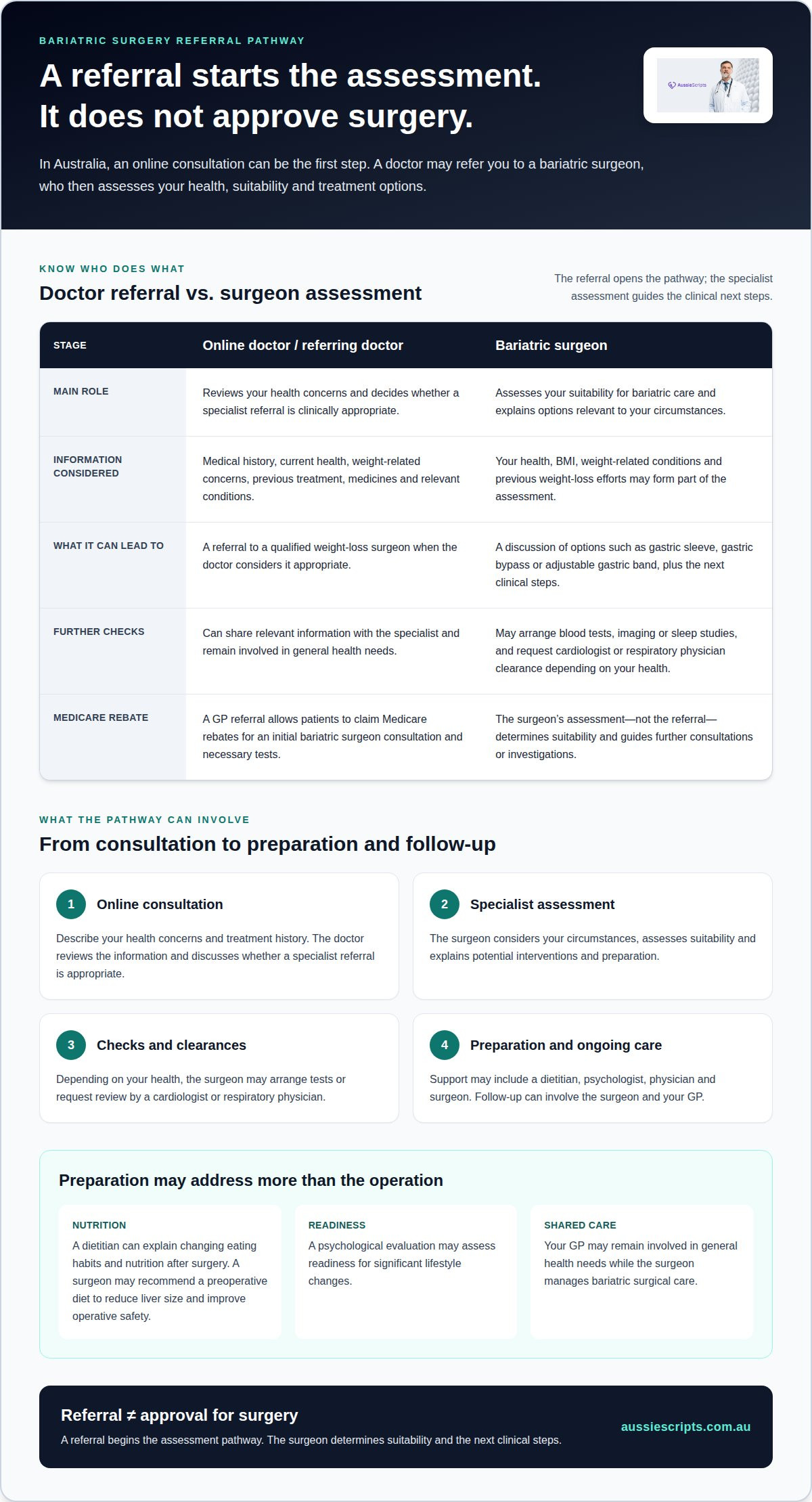
A referral starts an assessment; it does not approve surgery. In Australia, how to get a referral to a bariatric surgeon online begins with an online consultation with a GP or another doctor, who can review your health and decide whether a referral is appropriate. A referral is typically needed to start the weight-loss surgery process.
It is reasonable to want a clear view of the steps before arranging a consultation. A surgeon may consider factors such as your BMI, weight-related health conditions and previous weight-loss efforts. A referral helps you enter that assessment pathway, but it does not determine the outcome.
This guide explains how online referral requests work, which eligibility factors may be considered and how public and private surgery pathways differ in Australia. You will also learn what to expect from pre-surgery assessments and how an online specialist referral can fit into the process.
Key Takeaways
- An online consultation with a GP or another doctor can be the first step towards a bariatric surgeon referral in Australia.
- A referral begins the pathway, while the surgeon’s assessment considers your health, BMI and weight-loss history.
- Previous non-surgical weight-loss efforts may form part of the discussion about treatment options.
- Public and private pathways differ in access and requirements, so understanding the route can help you plan your next steps.
- Aussie Scripts’ Specialist Referral offers an online way to seek a referral when clinically appropriate.
Getting a referral from a primary care physician or specialist
A GP or another treating specialist can be your first point of contact for a bariatric surgery referral in Australia. During an online consultation, the doctor can review your medical history, current health and weight-related concerns. They may discuss previous treatment, medicines and any conditions that could affect surgery. A referral is typically needed to start the process, but it begins an assessment rather than confirming that surgery is suitable.
To refer you for bariatric care, the doctor considers why you are seeking a referral and what information the surgeon may need. Discuss relevant health conditions, previous weight-loss approaches and current treatment. The referral can direct you to a qualified weight-loss surgeon, who assesses your eligibility and explains suitable options. These may include a gastric sleeve, gastric bypass or adjustable gastric band. The surgeon’s assessment determines the next clinical steps.
After the referral, your pathway may include consultations or further checks. Depending on your health, the bariatric surgeon may request clearance from a cardiologist or respiratory physician. For example, they may review a heart condition or breathing-related concern before an operation. These specialist reviews help identify risks that need attention. The surgeon may also arrange blood tests, imaging or sleep studies as part of your preparation.
Care does not end when the referral is made. Preoperative support may involve a dietitian, psychologist, physician and surgeon, each addressing a different part of preparation. A dietitian can explain how eating habits may change and what nutrition after surgery involves. A psychological evaluation may assess your readiness for significant lifestyle changes. The surgeon may also recommend a special diet before surgery to reduce liver size and improve operative safety.
Postoperative bariatric care can involve follow-up with the surgeon and ongoing support from a GP. Shared care allows your referring GP to remain involved in your general health needs while the surgeon manages bariatric surgical care. The professionals involved and their roles depend on your treatment plan. Follow-up can also help address health concerns and support the lifestyle changes required after an operation.
For an online referral request, describe your health concerns and treatment history clearly during the consultation. The doctor reviews that information, discusses whether a specialist referral is appropriate and considers any additional care needs. In Australia, a GP referral allows patients to claim Medicare rebates for an initial bariatric surgeon consultation and necessary tests. The surgeon then assesses your case and guides further consultations, investigations or shared care with the referring GP.
Referral pathways for obesity and metabolic health
A bariatric referral connects obesity and metabolic health concerns with specialist assessment. A GP reviews your medical history, weight-related conditions, previous treatment and current health. For example, sleep apnoea or diabetes can influence which further assessments practitioners consider. The referral is an entry point, not approval for an operation. A surgeon assesses your suitability and discusses intervention options and preparation relevant to your circumstances.
Can I get a Medicare rebate for a bariatric surgeon consultation with a GP referral? In Australia, a GP referral allows patients to claim Medicare rebates for an initial bariatric surgeon consultation and necessary tests. The referral supports access to that consultation; it does not determine whether surgery is suitable.
Does a bariatric surgeon referral need to be renewed or sent to a specific surgeon in Australia? A referral should identify the specialist it is intended for. If you plan to see a different surgeon or return after a long interval, ask the referring GP to review whether an updated referral is needed. This helps ensure the referral matches the consultation you are arranging.
Which Australian telehealth services can provide bariatric surgery referrals? Telehealth services with Australian-registered doctors can assess a referral request online. A doctor reviews the information and decides whether a specialist referral is clinically appropriate. An online specialist referral is one way to seek this assessment without an in-person appointment.
What are the risks of bariatric surgery and what specialist assessments are required? Risks depend on your health and the procedure being considered. Assessment can include blood tests, imaging or sleep studies to identify underlying risks. Depending on your medical history, a surgeon may also request clearance from specialists such as a cardiologist or respiratory physician. Psychological assessment can explore your readiness for the lifestyle changes that follow surgery.
Preparation can involve more than medical tests. A surgeon may recommend a preoperative diet to reduce liver size and improve safety during the operation. A dietitian can explain how eating habits and nutrition change after surgery. This discussion also connects operative preparation with longer-term obesity management and lifestyle support.
Health insurance coverage for bariatric procedures can depend on BMI and obesity-related health conditions. Policies may also set documentation, qualification, pre-authorisation and waiting-period requirements. Before committing to a private pathway, review how your policy covers the proposed procedure and what paperwork it requires. Coverage terms shape the financial and administrative steps, but they do not replace the surgeon’s clinical assessment.
Share practical health and lifestyle information during the referral assessment, including current conditions, treatments, previous weight-loss approaches and concerns about surgery. These details help the doctor understand why you are seeking a referral and help the surgeon identify relevant investigations. If non-surgical treatment is part of your current care, include its duration and effects in the discussion.
Previous non-operative weight-loss attempts
Previous non-operative weight-loss efforts can inform a bariatric surgery assessment. Patients who have tried non-surgical approaches without long-term success may be considered for obesity surgery. This history gives the healthcare provider context about weight changes, treatment response and ongoing health concerns. It does not, by itself, establish that surgery is appropriate. A surgeon considers it alongside your medical history, current health and other eligibility factors.
Describe the approaches you have tried, such as changes to eating habits, increased physical activity or behavioural support. Include whether you pursued them independently or with a healthcare professional’s support. Explain what changed during treatment and what happened after it ended. For example, you might describe initial weight loss followed by regain. That detail helps distinguish a short-term response from a lasting outcome.
Useful details to discuss include:
- The type of weight-loss approach, such as a structured eating plan or activity changes.
- How the approach fitted into daily routines, work and other health needs.
- Any support from a GP, dietitian or other practitioner.
- Changes in weight and related health concerns during or after the approach.
- Reasons a plan stopped or became difficult to continue.
These examples make the discussion more specific. If a programme ended because it conflicted with another health condition, explain the connection. If lifestyle changes were sustainable but did not lead to lasting weight loss, describe both points. A balanced account helps the clinician understand what you have tried without treating one result as a complete measure of effort or suitability.
Weight-management treatment planning can include healthy eating, increased physical activity and support for behavioural change. A GP may discuss how these approaches fit your health and daily routine. More intensive options, including medication or bariatric surgery, may involve referral to other healthcare professionals. The next step depends on the clinical assessment and any treatment questions that remain.
If you are considering how to get a referral to a bariatric surgeon online, explain what non-operative care you have tried and what you hope to discuss. For example, someone who has tried dietary changes and activity support may want an assessment of further options. A referral lets a bariatric surgeon assess whether weight-loss surgery is appropriate and explain possible pathways. It does not mean non-operative care has failed in every respect or that surgery is the only next step.
For an online referral discussion, organise your treatment history in sequence: what you tried, what support you received, how your weight and health responded, and what followed. This is a practical way to prepare if you are asking how to get a referral to a bariatric surgeon online. Include relevant ongoing treatment, such as medication or dietitian support, so the GP can consider the context and discuss suitable next steps.
BMI categories and eligibility thresholds
Body mass index (BMI) is one measure used when considering bariatric surgery eligibility. For adults over 18 years, the commonly described categories include a BMI of 25 or higher as overweight and 30 or higher as obese. A healthy adult BMI is described as between 20 and 25. These ranges help frame a clinical discussion, but they don’t establish whether an operation is suitable.
In Australia, a BMI greater than 35 is identified as a criterion for considering obesity surgery. Aurora Medical lists a BMI of 35 or higher as an indication for bariatric surgery. These thresholds are not a substitute for a surgeon’s assessment. The clinician considers BMI alongside weight-related health conditions, medical history and previous weight-loss efforts.
Some pathways may consider patients with a BMI from 30 to 34.9 when non-surgical methods haven’t achieved durable weight loss or improved related health conditions. This means the effect of previous treatment matters, not just the number recorded at an appointment. A patient with a BMI in this range can discuss their treatment history and health concerns during a consultation.
BMI is a screening measure, not a complete picture of health. Two patients with the same BMI may have different weight-related conditions, treatment histories and surgical risks. A healthcare provider reviews current health and medical history to assess whether further specialist evaluation is appropriate. A surgeon’s eligibility assessment may include BMI, health conditions and weight-loss history.
Use a BMI result as a starting point for discussion, not as a decision about surgery. If your weight or health has changed since an earlier measurement, share that context during the appointment. The clinician can consider it alongside other assessments. A lower BMI may also be considered in certain circumstances, so a single threshold does not cover every possible case.
These figures describe different stages of consideration, not a guarantee of access to an operation. A referral allows a bariatric surgeon to assess your circumstances and explain whether further evaluation is relevant. The surgeon may also consider preoperative checks, such as blood tests, imaging or sleep studies, to assess underlying risks and inform planning.
For a weight-management consultation, organise information that helps explain your BMI and health: previous measurements, related conditions and weight-loss approaches you have tried. A clear record supports a focused discussion about eligibility and next steps. Even if a threshold appears relevant, the surgeon needs to consider the full clinical picture before recommending a treatment pathway.
Public and private bariatric surgery pathways in Australia
In Australia, public and private pathways differ in access, funding arrangements and waiting times. Around 5% of bariatric surgeries were performed in public hospitals as of 2023. Public services may prioritise access according to clinical need and local service criteria. Waiting times can range from several months to years, so the referral is only the start of the process. A GP can discuss the pathway and refer a patient for specialist assessment.
Private bariatric care also begins with a GP appointment. The surgeon assesses your health, BMI, weight-related conditions and previous treatment before discussing whether surgical weight loss is suitable. Private care may offer a different route to consultation, but it still involves clinical assessment and preparation. A referral does not guarantee surgery; the surgeon determines the appropriate next steps after reviewing your circumstances.
How much does a private bariatric surgeon consultation and surgery cost in Australia? Private costs vary according to the surgeon, hospital, procedure, required tests and your health insurance cover. Consultation, hospital and surgical charges may be separate, so the total depends on your treatment plan and applicable cover.
Health insurance can affect the private pathway. Policies may set coverage criteria, require supporting documents or pre-authorisation, and include waiting periods. These conditions can influence when you can proceed and which expenses remain out of pocket. Review the policy requirements alongside the proposed surgical plan. Insurance approval and clinical suitability are separate decisions, so meeting a policy condition does not establish eligibility for surgery.
Public and private pathways both involve assessment before an operation. The surgeon may request blood tests, imaging or a sleep study to identify health risks. Depending on your medical history, preparation may also include clearance from a cardiologist or respiratory physician. A dietitian can explain the preoperative diet and post-surgery nutrition, while a psychologist may assess your readiness for significant lifestyle changes.
The practical difference is often the route into care and the funding arrangements, not the need for specialist oversight. Public hospital access may involve a longer wait, while private treatment requires understanding consultation, hospital and insurance costs. In either pathway, start by discussing referral options with a GP. The referral supports the surgeon’s assessment, where BMI, related conditions and previous weight-loss attempts inform the clinical discussion.
To compare your next steps, identify which pathway you intend to pursue, then clarify its referral and documentation requirements. For private care, understand how your policy covers the proposed procedure and which expenses it includes. For public care, ask your GP how the referral process fits local services. These steps help you plan without treating the referral as a decision about surgery.
Aussie Scripts: Specialist Referral
Aussie Scripts’ Specialist Referral service offers an online way to discuss whether a referral is clinically appropriate. During a virtual consultation, a fully registered and insured Australian doctor can review your health information and consider your request for a bariatric surgeon referral. The consultation supports a referral assessment; it does not determine whether you are eligible for surgery or replace the surgeon’s assessment.
Use this pathway when you want to discuss your referral needs with a doctor online. Share relevant medical history, weight-related conditions and previous treatment so the doctor can assess your request. Surgical advice or clearance remains part of the specialist care pathway.
For help with an online referral request, contact Aussie Scripts.
Plan your next clinical discussion
Your next step is to decide what you need the referral discussion to clarify. You might want to understand whether a bariatric surgeon’s assessment is appropriate, what further evaluations could involve, or how surgical care could fit with ongoing weight management. A clear priority can keep the conversation focused on your health goals and the decisions ahead.
Understanding how to get a referral to a bariatric surgeon online can help you approach the discussion with a practical plan. An online consultation gives you a way to request a doctor’s assessment, not a substitute for a surgeon’s advice or a decision about surgery. Aussie Scripts also offers Standard Script, Express Script and Medical Certificate services.
For an online referral discussion, contact Aussie Scripts about your referral. Take the next step at your own pace, with your questions ready for the clinical conversation.
Frequently Asked Questions
Can I be recommended for weight loss surgery?
You may be considered for weight loss surgery if your BMI, health conditions and previous treatment make a specialist assessment appropriate. A BMI of 35 or higher is one indication used in bariatric surgery assessment. Some patients with a BMI from 30 to 34.9 may also be considered if non-surgical approaches haven’t achieved durable weight loss or improved related conditions. The surgeon assesses your circumstances before recommending a treatment pathway.
Do you need a GP referral to see a bariatric surgeon in Australia?
A GP referral is typically needed to begin the weight-loss surgery process in Australia. It directs you to a bariatric surgeon for an eligibility assessment and can support a Medicare rebate claim for an initial consultation and necessary tests. If you already have a specialist involved in your care, that clinician may also provide a referral. The surgeon’s assessment is separate from the referral itself.
How can I get an online GP referral to a bariatric surgeon in Australia?
Book an online consultation with a doctor who can assess referral requests. Explain why you are seeking bariatric care and discuss relevant health conditions, current treatment and previous weight-loss approaches. The doctor reviews your information and decides whether a specialist referral is appropriate. Aussie Scripts offers online Specialist Referral assessments with fully registered and insured Australian doctors. A referral supports access to specialist assessment; it does not book surgery or determine eligibility.
What information and tests should I prepare for an online bariatric referral appointment?
Be ready to discuss your medical history, current medicines, weight-related conditions and previous weight-management approaches. A recent BMI measurement can help frame the discussion, but it does not determine the outcome on its own. You generally do not need to arrange surgical tests before requesting a referral. If the surgeon considers further investigation relevant, assessments may include blood tests, imaging or a sleep study.
How do public hospital referrals and private bariatric surgery pathways differ in Australia?
Public hospital access and private treatment differ mainly in access arrangements, waiting times and funding. Around 5% of bariatric surgeries in Australia were performed in public hospitals as of 2023, and public waits can range from several months to years. Private patients usually begin with a GP referral and may need to meet insurer documentation or pre-authorisation requirements. Both pathways involve specialist assessment before surgery.
Disclaimer
The information provided by AussieScripts is for general informational purposes only and does not constitute medical advice, diagnosis, or treatment. For advice tailored to your specific symptoms or health concerns, please consult one of our doctors or your regular GP.