How to get prescriptions while travelling in Australia
Learn how to get prescriptions while travelling in Australia, arrange an Australian consultation, use medication records and plan refills in remote areas.

Can you use a prescription from home at an Australian pharmacy? No. Australian pharmacies can’t dispense prescriptions written by doctors outside Australia. You’ll need a valid Australian prescription to obtain a refill here.
Understanding how to get prescriptions while travelling in Australia starts with knowing who can issue one: an Australian-registered prescriber, such as a GP, Nurse Practitioner or dentist. They’ll consider your medication needs during a consultation. For some medicines, including Schedule 8 controlled drugs, telehealth isn’t an option.
If you’re travelling through a remote area, arranging a refill may be more difficult because access to prescribers and pharmacies varies. This guide explains what to do with an overseas prescription, how to seek an Australian prescription, and how to plan medication refills while travelling. It also covers what to expect from an online consultation and when one may not be suitable, helping you plan your next step.
Key Takeaways
- Carry medication documentation that identifies each medicine and dosage, and plan ahead if you may need a refill during your trip.
- For children or chronic conditions, organise medication records and continuity of care before travelling so a clinician can understand the treatment needs.
- Australian pharmacies can dispense prescriptions from Australian-registered practitioners; arrange an Australian consultation if you need a local prescription.
- Remote travel can make refills harder to arrange, so consider access to prescribers and pharmacies when planning your medication supply.
- Telehealth may not be suitable for every medicine, including Schedule 8 controlled drugs.
Table of Contents
- Doctor’s letters and prescription documentation
- Extra considerations for children and chronic conditions
- Foreign prescriptions and Australian pharmacies
- Getting a refill when travelling in a remote area with help from an Australian doctor
- Obtaining a prescription in Australia through a doctor
- Aussie Scripts
Doctor’s letters and prescription documentation
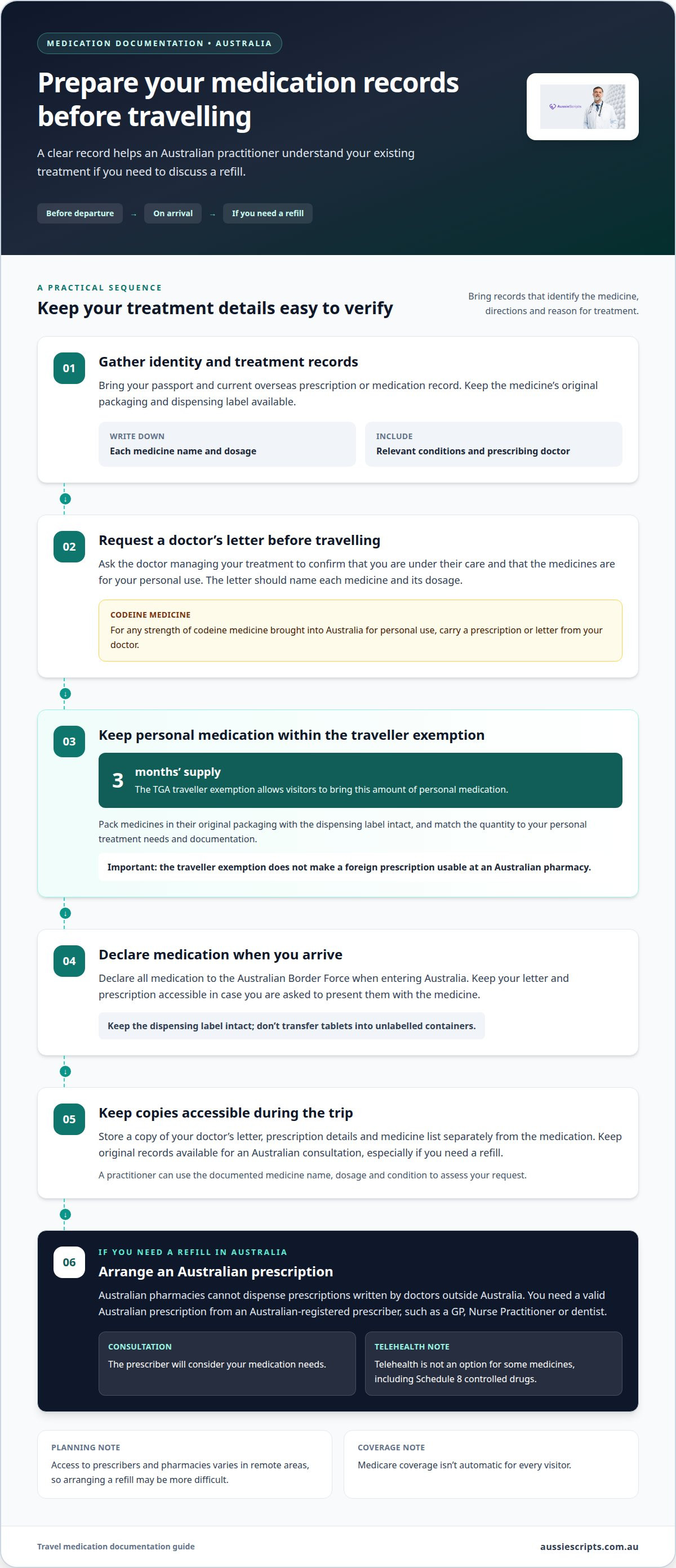
For an Australian doctor, provide identification, your current prescription and the medicine’s original packaging. Include a doctor’s letter listing each medicine, its directions and the condition it treats.
Medicare coverage isn’t automatic for every visitor.
For medicines brought into Australia, the Therapeutic Goods Administration’s traveller exemption allows visitors to bring a three-month supply for personal use. Keep medicines in their original packaging and declare them on arrival.
- Gather your identity and treatment records. Bring your passport and the prescription or medication record from your doctor overseas. Keep the medicine packaging and dispensing label available, so the product and prescribed directions can be identified. If you take several medicines, prepare a written list with each name and dosage. Include relevant medical conditions and the name of the prescribing doctor. These details help an Australian practitioner understand your existing treatment before considering a local prescription.
- Request a doctor’s letter before travelling. Ask the doctor managing your treatment to state that you are under their care and that the medicines are prescribed for your personal use. The letter should identify each medicine by name and dosage. Carry it with your prescription and original packaging, rather than relying on a photograph or memory. For any strength of codeine medicine brought into Australia for personal use, carry a prescription or letter from your doctor.
- Keep the quantity within the traveller exemption. The Therapeutic Goods Administration allows visitors to bring a three-month supply of personal medication under the traveller exemption. Pack medicines in their original packaging with the dispensing label intact. Match the quantity you carry to your personal treatment needs and available documentation. The exemption concerns medicines for personal use, so it doesn’t make a foreign prescription usable at an Australian pharmacy.
- Declare medicines when required on arrival. Declare all medication to the Australian Border Force when entering Australia. Keep the letter and prescription accessible, so you can present them with the medicine if asked. Don’t transfer tablets into unlabelled containers before travelling. Original packaging and a clear dispensing label help connect the medicine with the documentation you carry.
- Keep copies accessible during the trip. Store your doctor’s letter, prescription details, and medicine list separately from the medication itself. A separate copy can help if your bag is lost or the documents become difficult to access. Keep the original records available for an Australian consultation, especially if you need a refill. A doctor can use the documented medicine name, dosage, and condition to assess your request.
Extra considerations for children and chronic conditions
For a child or someone managing a long-term condition, organise treatment information around the person taking the medicine. A clear record helps an Australian doctor understand the existing care plan and the reason for the refill request.
- Prepare a separate record for each child. Include the child’s full name, date of birth, medicine names, prescribed directions, and the condition being treated. Keep the record with the child’s original medicine packaging and any prescription or letter from their overseas doctor. If several children travel together, separate records reduce confusion between medicines with similar names or packaging.
- Make the accompanying adult’s role clear. Keep the child’s identification and treatment records together, and note which adult is responsible for discussing their care. If another family member will attend a consultation, share the child’s medication list and relevant history with them beforehand. This gives the Australian doctor a consistent account, even when the usual caregiver is not present.
- Build a concise history for chronic conditions. List the condition, current medicines, prescribed directions, and the clinician who manages treatment. Add relevant changes or problems during the trip, such as a medicine being lost or a supply running low. A dated medication list can help distinguish the current plan from an older prescription or an original overseas treatment that has since changed.
- Bring supporting records, not just medicine names. Gather available prescriptions, letters, and relevant medical records before seeking a refill. For example, a traveller with a long-term condition can provide the current treatment plan alongside a recent prescription record. Keep digital copies available as a backup, while retaining original documents where possible. Clear records help explain what has been prescribed and why.
- Explain the travel timeline during the consultation. Tell the doctor where you are travelling and when the current supply is expected to run low. For a family travelling between locations, mention any planned time away from a town or usual pharmacy. This context helps the practitioner assess the request and discuss a suitable next step. Don’t change a child’s or adult’s prescribed directions without clinical advice.
If you need an Australian consultation to discuss a repeat prescription, an online prescription consultation may be a practical option. Provide the relevant treatment information so the doctor can assess the request, including when the medicine is for a child or a chronic condition.
Foreign prescriptions and Australian pharmacies
An Australian consultation can establish whether you can obtain a local prescription. The rules differ for ordinary and controlled medicines.
-
Have an Australian doctor assess foreign prescription requirements
If you need medicine from an Australian pharmacy, arrange an assessment with an Australian-registered prescriber. Australian pharmacies can’t dispense prescriptions written by doctors outside Australia. An overseas prescription and medication record can help the practitioner understand your treatment, but they don’t replace an Australian prescription.
Provide the medicine name, prescribed directions, reason for treatment and relevant medical records. Explain whether you need a refill or a new assessment. The Australian practitioner can consider this information and issue an Australian prescription if clinically appropriate. Don’t assume a prescription accepted in your home country will be accepted here. Pharmacy dispensing requirements are strict, and an overseas document cannot replace assessment by an Australian-registered practitioner.
Once you have an Australian prescription, present it at a pharmacy. An Australian eScript token can generally be used at pharmacies throughout Australia, so you aren’t restricted to one pharmacy. If you don’t have an Individual Healthcare Identifier, a prescription can still be issued on paper rather than electronically.
-
How a doctor assesses controlled medicine rules
Tell the practitioner if your medicine contains codeine, is an opioid, or is used for ADHD. Australian telehealth doctors can’t prescribe Schedule 8 controlled drugs, including strong opioids and certain stimulants. A foreign prescription doesn’t override that restriction or authorise an Australian pharmacy to dispense the medicine.
If your medicine contains codeine, tell the practitioner so they can assess the appropriate next step. Some Schedule 4 medicines, including certain sleeping tablets and anxiety medicines associated with dependence risk, may be declined through telehealth or require an in-person assessment. Give the practitioner the exact medicine name and strength, rather than describing it only by its use. This helps distinguish medicines with different controls and supports an appropriate assessment. Don’t rely on an overseas prescription to secure a controlled medicine refill in Australia.
-
What affects the cost of a consultation and prescription medicine?
Ask about consultation fees before booking. The cost of seeing a GP without Medicare depends on the practice and consultation. Medicine prices also vary: visitors who aren’t eligible for the PBS pay the private price set by each pharmacy. The total depends on the pharmacy and prescribed medicine.
A medicine still needs an Australian prescription for dispensing. If you’re paying privately, ask the pharmacy for the medicine’s price after the prescription is issued. This separates the consultation cost from the medicine cost and clarifies what you’ll pay before dispensing.
Getting a refill when travelling in a remote area with help from an Australian doctor
Yes. An Australian-registered prescriber can assess your medication needs and issue an Australian prescription after a consultation. A refill isn’t automatic, and some medicines can’t be prescribed through telehealth.
A doctor can assess your treatment and provide an eScript when appropriate. If pharmacies may be harder to access along your route, plan ahead and confirm dispensing arrangements before travelling further.
- Arrange the consultation before your supply runs low. Tell the Australian doctor where you are travelling, when you expect to need the refill, and how long you’ll be away from larger towns. Share your current medicine list, treatment details, and the reason for the request. A clear timeline helps the practitioner assess the situation and consider how the prescription can be dispensed along your route.
- Provide enough information for a clinical assessment. Have your existing prescription, medicine details, and relevant treatment records available. Keep the medicine in its original packaging, especially if the label identifies the product and directions. Explain any changes in your health or treatment since the prescription was issued. The doctor needs to assess your current circumstances, not simply copy an overseas prescription into an Australian one.
- Ask about an eScript for travel between locations. An Australian eScript token can generally be used at pharmacies throughout Australia, so it doesn’t restrict you to one pharmacy. This can help if your itinerary changes or you reach a different town than planned. Keep the token accessible on your phone, and retain the prescription information so the pharmacy can identify what has been prescribed.
- Plan separately for controlled medicines. Tell the doctor if the medicine is a Schedule 8 controlled drug, such as a strong opioid or certain stimulants. Australian telehealth doctors can’t prescribe Schedule 8 controlled drugs. Some Schedule 4 medicines, including certain sleeping tablets and anxiety medicines associated with dependence risk, may also require an in-person assessment or be declined through telehealth.
- Confirm a pharmacy can dispense before changing your route. A doctor can assess your treatment and issue a prescription, but that doesn’t establish whether a particular pharmacy is open or has the medicine available. Use current pharmacy details for the town you’re visiting and contact the pharmacy directly about opening hours and stock. For an after-hours medical need, seek an available local medical service; a prescription token alone doesn’t provide clinical care.
Obtaining a prescription in Australia through a doctor
For visitors, how to get prescriptions while travelling in Australia depends on the reason for the request and the doctor’s assessment. Explain what you need, what has changed and what outcome you’re seeking. The doctor can then consider your request in context.
- Explain the purpose of the appointment. Say whether you’re seeking ongoing treatment, a review because your circumstances have changed, or advice about an interrupted routine. A clear purpose helps keep the consultation focused. Describe the practical issue you need addressed, rather than treating the appointment as a request for a predetermined prescription.
- Describe your treatment routine in your own words. Explain how the medicine fits into your day and whether anything has affected how you take it. Mention concerns you want the practitioner to consider, such as an unexpected change in routine while travelling. This adds useful context beyond the medicine’s name and helps the doctor understand your current request.
- Tell the doctor what has changed since treatment began. If your health, symptoms, or circumstances differ from when the medicine was first prescribed, explain the change and when it occurred. A concise timeline can help the practitioner understand whether you’re asking for continuation or a fresh review. Avoid leaving out changes simply because the original treatment was prescribed overseas.
- Use the consultation to clarify the next step. Ask the practitioner to explain the decision and any directions associated with the prescription. If the doctor recommends a different course, make sure you understand what action to take and when. Clear instructions matter when you’re away from your usual care arrangements and need to follow the plan consistently.
- Keep your ongoing care in view. If you have a regular doctor or specialist, consider how the Australian consultation fits with that care. Tell the practitioner about any relevant advice you’ve already received, and ask what information would help your usual clinician understand the visit. This can support a more coherent handover after your travels without assuming that a repeat prescription is the only suitable outcome.
Knowing how to get prescriptions while travelling in Australia also means using the appointment to discuss the clinical decision, not just the paperwork. If you need a clinician to assess a prescription request, request an online prescription consultation.
Aussie Scripts
Aussie Scripts connects travellers with Australian-registered doctors for virtual consultations about prescription needs. If you need an Australian prescription, a Standard Script or Express Script consultation lets you discuss your request with a doctor. Provide your medicine details and relevant treatment history so the doctor can assess your circumstances.
Prescribing depends on clinical assessment and medicine requirements. Telehealth isn’t suitable for every medication, including Schedule 8 controlled drugs, and it doesn’t replace emergency medical care or an in-person examination when one is needed. For a routine prescription request while travelling, contact Aussie Scripts to discuss your next step.
Plan your next step before your supply runs low
Knowing how to get prescriptions while travelling in Australia helps you plan for continuity of care. Before setting off on your next leg, consider when you’ll need a refill, where you’ll be staying and whether an Australian consultation is suitable for your medicine. Planning ahead can help you avoid leaving a prescription request until your route or pharmacy access changes.
If you need a doctor to assess a prescription request, Aussie Scripts offers Standard Script and Express Script consultations. A Medical Certificate is available for a different need, but it doesn’t replace a prescription or a medication assessment. The doctor considers your request and relevant health information during the consultation.
Contact Aussie Scripts for help with your next step. Travel plans can change, but a clear plan for medication gives you a practical place to start.
Frequently Asked Questions
Can I use my prescription from another country in Australia?
No. An overseas prescription may not be enough for an Australian pharmacy to dispense your medicine. Give the document to an Australian-registered practitioner as evidence of your current treatment. Include the medicine name, strength and directions, along with relevant medical history. The practitioner assesses your request and may issue an Australian prescription. Even if your overseas prescription is still valid at home, a repeat request needs local assessment.
Do I need a Medicare card to use a telehealth service for a prescription?
A Medicare card isn’t the only way to receive an Australian prescription. Visitors without an Individual Healthcare Identifier can still receive one, although it will be on paper rather than electronic. Bring identification and treatment details to your consultation so the doctor can assess your request.
Do tourists need an IHI to get an eScript?
Visitors can receive an Australian prescription without an Individual Healthcare Identifier, but the prescription will be on paper rather than electronic. An IHI is a unique 16-digit number used to help health services identify a person. If you’re travelling without one, explain this during the consultation and ask how the paper prescription can be provided and presented to a pharmacy.
How can an Australian doctor arrange an eScript if I am travelling in a remote area?
An Australian doctor can issue an eScript after assessing your medication request, if clinically appropriate. The token can generally be used at pharmacies throughout Australia, which may help if your route changes. Tell the practitioner where you’re travelling and when you need the medicine. A prescription doesn’t confirm a pharmacy’s opening hours or stock, so allow time to arrange dispensing before travelling onward.
What should I do if I lose my medication while on holiday in Australia, and when should I contact a doctor?
Contact an Australian doctor promptly if lost medication interrupts your treatment or your supply is running low. Explain which medicine is missing, when you last took it, and the treatment details you have available. Don’t take someone else’s medicine or change your prescribed directions without clinical advice. For chest pain or trouble breathing, call 000 or go to an emergency department instead of waiting for a routine consultation.
How can a visitor arrange to see a GP or telehealth doctor in Australia to get a prescription?
A visitor can seek an assessment from an Australian prescriber, such as a GP, Nurse Practitioner or dentist. Explain that you need medication and provide the medicine details, treatment history and reason for the request. A telehealth consultation may suit some requests, but it isn’t appropriate for every medicine. For example, Australian telehealth doctors can’t prescribe Schedule 8 controlled drugs.
Can an overseas prescription be used at Australian pharmacies?
No. An overseas prescription may not be accepted by an Australian pharmacy, so check whether you need an assessment from an Australian practitioner. Keep the overseas prescription as supporting information, but arrange an assessment by an Australian-registered practitioner for a local prescription. A printed prescription from your home doctor can explain ongoing treatment, but it doesn’t authorise an Australian pharmacy to supply the medicine.
How can an Australian doctor help replace lost or stolen prescription medication while I am travelling?
An Australian doctor can assess your request and consider whether an Australian prescription is appropriate. Provide the medicine name, strength, directions, reason for treatment and any records you have. Explain how the medication was lost or stolen and whether you have missed a dose. The doctor considers this information alongside medicine-specific requirements. A replacement isn’t automatic, and some controlled medicines cannot be prescribed through telehealth.
Disclaimer
The information provided by AussieScripts is for general informational purposes only and does not constitute medical advice, diagnosis, or treatment. For advice tailored to your specific symptoms or health concerns, please consult one of our doctors or your regular GP.