How to Request a Medical Certificate for University Stress
Learn how to request a medical certificate for university stress, what details it may include, and how to check your university's evidence requirements.

University stress can affect your capacity to study, and you can seek medical support for its impact. A medical certificate for university stress may document a health-related absence from classes or exams, but a doctor decides whether issuing one is appropriate after a consultation.
It’s reasonable to want a clear explanation of what to provide and what a certificate can say. University requirements vary, so check your institution’s special consideration process and evidence criteria before applying. For example, Monash College requires a certificate for a mental health condition to state that you were unfit to complete the assessment by its due date and how long you were affected.
This guide explains when a certificate may help, what information it can include, and how to request one through a consultation. It also covers what to prepare, how online consultations work, and when a certificate may not meet your university’s requirements. You’ll get a practical overview of the process, while keeping in mind that a certificate documents a doctor’s assessment, not a guaranteed extension or other academic adjustment.
Key Takeaways
- A medical certificate may document how stress or another mental health condition affected your ability to attend classes or complete an assessment.
- Before applying for special consideration, review your university’s evidence requirements, including what the certificate must say and who can provide it.
- Prepare to explain your symptoms, how they affect your studies, and the period when you were unable to complete academic tasks.
- A certificate should include relevant dates and the period of incapacity; requirements can differ between institutions.
- A consultation can assess whether a medical certificate is appropriate and how to access it, including through an online service.
Can you get a medical certificate if you're struggling with mental health?
Yes. A doctor may issue documentation after assessing how mental health symptoms affect your studies. A certificate can support an absence or special consideration application, but your university decides whether it meets its requirements.
University counselling services may provide supporting documentation, depending on their processes and your institution’s rules. For example, Monash College accepts certificates from psychologists or counsellors registered with a relevant professional body, provided the certificate states how long the student was unfit to complete the assessment.
Mental Health Absence Documentation
A useful document connects your health situation to a specific impact on study. Persistent fatigue, difficulty concentrating or making decisions, anxiety, reduced motivation, and unexplained headaches or tension can affect attendance or assessment work. During a consultation, describe these effects, when they began, and which academic tasks became difficult.
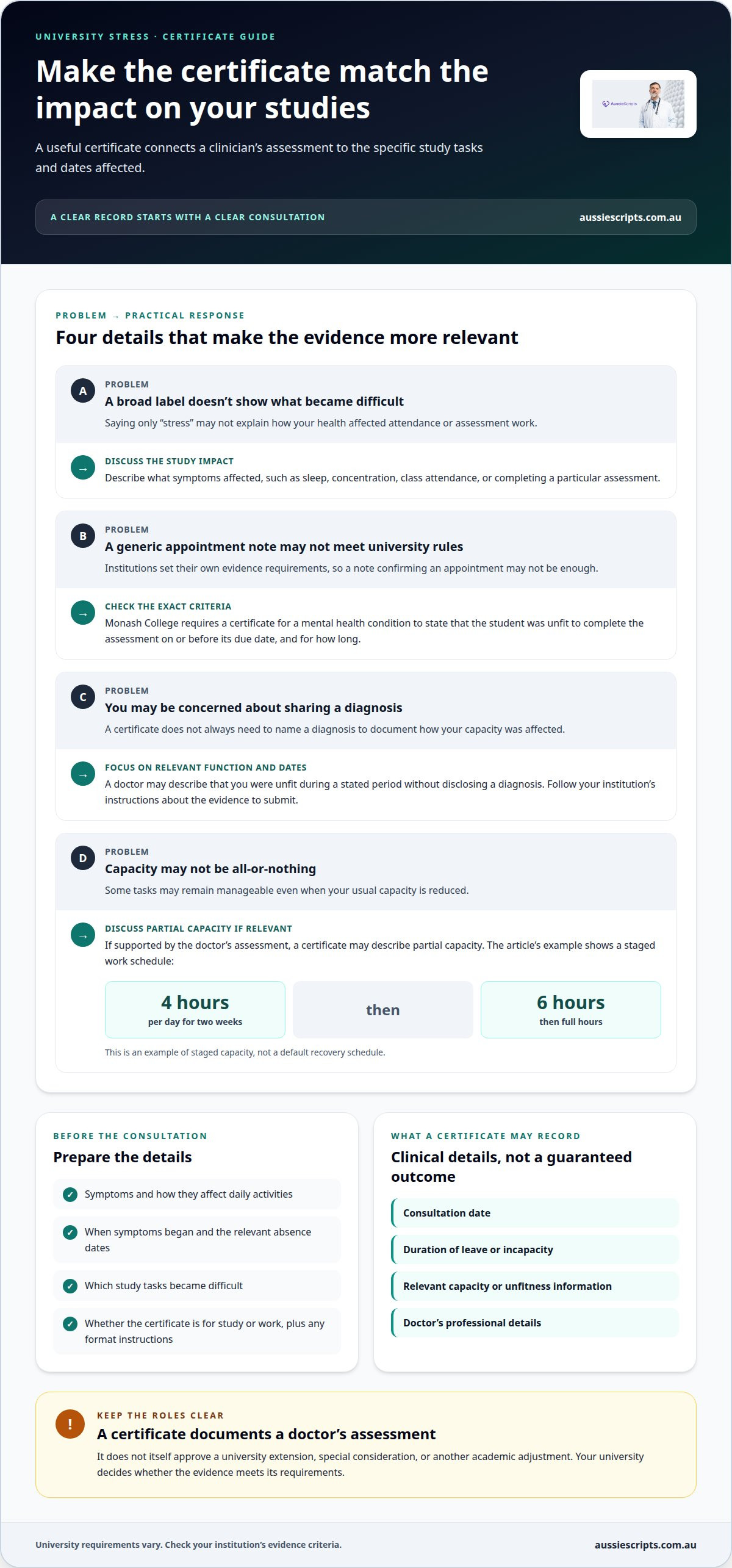
Review your institution’s evidence criteria before applying for special consideration. Monash College requires a medical certificate to state that the student was unfit to complete the assessment on or before its due date, and for how long. A general note confirming an appointment may not meet those requirements.
Certificates for Mental Health Leave
A certificate may document that a person was unfit for work or study during a stated period without disclosing a diagnosis. A doctor assesses the reported symptoms, their effect on daily tasks, and the dates involved. Explain whether stress has affected your sleep, concentration, class attendance, or ability to complete a particular assessment.
For a university application, focus on the institution’s requested evidence rather than assuming a workplace certificate will be accepted. The Privacy Act 1988 is relevant to protecting mental health information in Australia, according to the Australian Government. Share only the documentation your process requires, and follow the university’s instructions for submitting it.
Mental Health Sick Leave in Australia
University study absence and employment sick leave are separate processes. In Australia, the Fair Work Act 2009 is relevant to workplace absences connected with mental or physical illness. According to the Australian Government, section 107 allows an employer to require evidence that would satisfy a reasonable person supporting a leave absence.
According to the Australian Government, section 96 of the Fair Work Act 2009 provides full-time employees with 10 days of paid personal/carer’s leave each year. A mental health day may be appropriate when stress or anxiety makes work or study difficult, but a certificate records a clinician’s assessment; it does not itself approve university extensions or workplace leave. Check the applicable process and submit evidence through the required channel.
What Your Doctor Should Include In The Stress Leave Medical Certificate?
A certificate should reflect the doctor’s assessment, not simply repeat your description of stress. During the consultation, explain how symptoms affect your capacity and what support or time away you’re seeking. For example, describe whether you can manage ordinary study or work tasks and whether your capacity changes during the day. Clear details help the doctor assess what the document can accurately state.
Discuss the symptoms that are most disruptive, when they occur, and whether they are getting worse. Persistent or worsening symptoms that interfere with daily tasks or relationships are reasons to consult a doctor or psychologist. Also raise feelings of hopelessness or thoughts of self-harm directly. These details help the clinician understand your situation and consider suitable care alongside any certificate.
If a certificate is clinically appropriate, it may record the consultation date, the duration of leave, that you were unfit for work, and the doctor’s professional details. The document can describe your capacity without naming a diagnosis. Explain whether you need it for work or study, since the purpose affects which functional details matter. For instance, inability to complete usual tasks may be more relevant than a broad label such as burnout.
Time away is not the only possible arrangement. A certificate may describe partial capacity where the doctor’s assessment supports that approach. For example, a GP may specify 4 hours of work per day for two weeks, followed by 6 hours and then full hours. This is an example of staged capacity, not a default recovery schedule. The doctor considers your symptoms and circumstances when assessing what to document.
Use the consultation to discuss what a safe return to study or work could involve. Explain which tasks cause difficulty, whether your concentration changes during the day, and what duties remain manageable. The doctor can consider those details when assessing your capacity. A certificate records the clinical assessment; it does not prescribe a university’s adjustments or an employer’s return-to-work plan.
Before the appointment, note your symptoms, their effect on daily activities, and the dates relevant to your absence. State the document’s purpose and any format instructions you’ve received. If symptoms are serious or include thoughts of self-harm, tell the clinician rather than focusing only on paperwork. Accurate, specific information supports a useful discussion about care and documentation.
To discuss your circumstances with a clinician, you can request an online medical certificate. The clinician assesses whether issuing a certificate is appropriate and what it can cover.
Information included in a medical certificate
A medical certificate communicates a clinician’s opinion for a defined administrative purpose. Its wording should clearly explain what the doctor assessed, without turning the document into a full account of the consultation. For a university, the relevant context is usually your capacity to meet a study obligation. For an employer, the concern may instead be your capacity to work.
Keep the document focused on its intended recipient. A university needs to assess the effect on study, while a workplace may need information about work absence. These are different decisions, even when the health concern is the same. Tell the doctor which organisation will receive the certificate and what process it supports. That context helps shape relevant wording without asking the clinician to guarantee an outcome.
Medical certificates are formal documents, so accuracy matters more than persuasive language. Describe the practical issue you need assessed rather than suggesting wording that overstates your condition. The certificate should reflect the clinician’s professional judgement. If stress affected your ability to complete study tasks, explain that impact clearly during the consultation. The doctor determines what their assessment can support.
A certificate is distinct from a detailed clinical record. It serves a specific administrative purpose and does not need to reproduce every symptom or discussion from the appointment. Keep personal supporting notes separate. This can make it easier to provide the university with the requested document, while discussing broader health concerns privately with the clinician.
Before submitting a digital certificate, open the file and make sure it’s readable and complete. Check that the recipient can identify its purpose and issuing practitioner. If your university uses an online application portal, follow its file and submission instructions. Keep a copy so you can refer to the exact document lodged if the institution asks about it.
Use neutral, direct language when discussing what you need. “I need evidence for an assessment affected by stress” gives the doctor useful context without dictating a clinical conclusion. Explain whether the document is for a university process or a workplace absence. The doctor can assess the circumstances and decide whether a certificate is appropriate.
A certificate supports an administrative decision; it does not make that decision. The university applies its own process to the evidence it receives. A clear, purpose-focused document communicates the clinician’s assessment without unnecessary detail or claims beyond what the consultation supports.
Medical certificates for stress-related study absence
Yes, an Australian university may accept a medical certificate for stress or anxiety, depending on its rules. Evidence requirements and application deadlines differ, so follow the process for your institution and course.
Certificates for University Absence
A certificate can help explain why stress affected attendance, an exam, or another study obligation. Describe the practical effect, such as being unable to attend a scheduled class or focus during an assessment. Identify each affected activity rather than describing the whole study period as one general absence. This gives the university a clearer account of what was disrupted and distinguishes missed attendance from an assessment you could not complete.
If stress affects several parts of your study, organise the details by course or assessment. Keep your account consistent with the dates and information discussed with the practitioner. A certificate supports your explanation; it does not decide whether an extension or other adjustment is granted.
University Evidence Requirements
Each institution sets its own special consideration process. The university may specify how to apply, what evidence to attach, and the deadline for submitting a request. Read those instructions before preparing your application. Note the course, affected assessment, relevant dates, and the adjustment sought, such as extra time or an alternative arrangement.
Deadlines matter, especially when an assessment is imminent or already missed. Submit through the channel specified in the university’s process and keep a copy of your application. If the process asks for supporting details beyond the certificate, provide only information relevant to the effect on study. Don’t assume the process for one course applies to another.
Acceptance of Stress Certificates
Universities may consider certificates relating to stress or anxiety, but acceptance depends on their own criteria. The certificate should relate to the study impact you’re raising, rather than simply confirm that you attended a health appointment. If the university provides a form or specifies particular evidence, follow those directions as part of your application.
A telehealth consultation may result in documentation, but the university’s rules determine whether that evidence suits its process. Keep the distinction between evidence and outcome clear: the practitioner assesses your health circumstances, while the institution considers your application. A certificate does not guarantee an extension, special consideration, or approval of an absence.
For a clear application, match each requested adjustment to the disruption you experienced. Explain whether you missed a class, couldn’t complete an assessment, or need another arrangement to continue studying. Keep a record of what you submit and any response, so you can follow the institution’s process without having to reconstruct the situation later.
How to request and access a medical certificate
Start by identifying what the document needs to support: a university absence, an assessment application, or sick leave. Then arrange a consultation with a doctor or other eligible practitioner. Telehealth can provide a way to discuss mental health concerns remotely. A certificate is a clinical document, not an automatic result of submitting a request.
Prepare relevant information before the consultation. A short timeline can help explain when symptoms began and how they affected study or work. Include the assessment date, missed classes, and specific tasks you couldn’t complete. If you’re seeking workplace sick leave, explain how your illness affected your ability to work. Keep your account factual and focused.
- Describe symptoms. Explain concerns such as anxiety, fatigue, or difficulty concentrating, and their effect on daily activities.
- Set out relevant dates. Identify when symptoms affected study or work, including any assessment deadline.
- Explain the document’s purpose. Say whether you need evidence for special consideration, absence, or sick leave.
- Discuss the required format. Mention university criteria, such as a stated period of incapacity or practitioner details.
During the consultation, answer the doctor’s questions about your symptoms, their impact, and your current capacity. The doctor assesses this information and decides whether a certificate is clinically appropriate. Issuing one is at the doctor’s discretion. If symptoms feel serious, describe their effect plainly and raise any immediate safety concerns during the consultation.
How much does a GP appointment or medical certificate cost in Australia? Costs depend on the consultation and documentation required; the amount is provided after a quote request. The consultation type and clinician’s assessment can affect what is needed.
If issued, check that the certificate’s dates and purpose reflect the consultation. If a doctor covers an illness period before the consultation, the certificate must show the actual issue date rather than appear to have been issued earlier. Any retrospective period must reflect the doctor’s assessment and supporting information.
An online medical certificate may be delivered digitally after the consultation, depending on the service process. Save it securely and submit it through your university’s required channel. Keep a copy and any submission confirmation. A medical certificate for university stress can support an application, while the university decides whether it meets its requirements.
To discuss a medical certificate for university stress with a clinician, request an online medical certificate. The consultation determines whether a certificate is appropriate and what period it can cover.
Aussie Scripts: Medical Certificate
Aussie Scripts provides Medical Certificate assessments through virtual consultations with Australian-registered doctors. If university stress is affecting your studies, a consultation gives you the opportunity to discuss your symptoms, relevant dates, and your institution’s documentation requirements.
The doctor assesses your circumstances and decides whether a certificate is clinically appropriate. If issued, the document can record the period assessed and relevant details for your university application. Your university determines whether the evidence meets its special consideration rules, so review its submission requirements before applying.
If you need to discuss a Medical Certificate consultation, contact Aussie Scripts.
Make your next step manageable
Once you have the university’s requirements, consider what academic support to request alongside health documentation. You might need to discuss an assessment adjustment, a revised study plan, or help catching up after an absence. Keep your requests specific to the impact stress has had on your study, and use the university’s designated process.
A clinician can assess whether a medical certificate for university stress is appropriate for your circumstances. The certificate is evidence of that assessment; your university separately considers whether it meets its requirements. If your symptoms continue to affect daily life, arrange appropriate medical support rather than waiting for study pressures to resolve on their own.
For help with your next step, contact Aussie Scripts about your options. Taking action can help you address your health needs and make a clearer plan for study.
Frequently Asked Questions
Are online medical certificates valid?
An online certificate can document a clinician’s assessment after a genuine consultation. The doctor decides whether the information supports issuing one, and the organisation receiving it decides whether it meets its requirements. A university may require evidence tied to an assessment deadline, while an employer may request documentation for a work absence. A digital format alone doesn’t determine whether the certificate will be accepted.
What should a medical certificate for university absence include in Australia?
It should provide enough information for the university to assess the absence, including the relevant period and its effect on study. Some institutions require specific wording. For example, Monash College requires evidence that the student was unfit to complete the assessment on or before its due date, and how long they were affected. A note confirming attendance at an appointment may not explain why an assessment couldn’t be completed.
Can a GP issue a medical certificate for stress in Australia?
Yes. A GP may issue a certificate after assessing how stress affects your capacity, but that decision rests with the doctor. Describe practical effects, such as being unable to concentrate long enough to complete an assessment or attend classes. The GP can assess your circumstances and whether the requested document is clinically supported. A certificate records that assessment; it does not itself approve an extension or special consideration.
How do I apply for special consideration or an extension at an Australian university due to stress?
Use your university’s formal application process and submit evidence in the required format. Identify the affected assessment, explain how stress affected your ability to complete it, and state the adjustment you’re seeking, such as an extension. Submit by the university policy’s deadline. Keep a copy of your application and submission confirmation so you can follow up through the appropriate student support channel.
Are telehealth medical certificates accepted by Australian universities?
Some universities accept certificates following telehealth consultations. Monash College recognises a medical certificate for a mental health condition after an in-person or telehealth consultation. Acceptance still depends on the institution’s evidence rules and the certificate’s contents. Before applying, find out whether your university sets requirements for the practitioner, assessment period, or supporting information. A remote consultation does not remove the need for an individual clinical assessment.
What are the risks of using a fake or backdated medical certificate at university?
A fabricated document may fail to meet university evidence requirements and undermine an application. Never alter a certificate or use an issue date that misrepresents when it was created. If a doctor covers an earlier illness period, the certificate must show the actual issue date. Separately, making a false statement in a Victorian statutory declaration can be a criminal offence. Use accurate documentation and explain the circumstances honestly.
Disclaimer
The information provided by AussieScripts is for general informational purposes only and does not constitute medical advice, diagnosis, or treatment. For advice tailored to your specific symptoms or health concerns, please consult one of our doctors or your regular GP.
