Managing the Tretinoin Purge Period: Irritation and Breakouts
Learn what to expect when managing the tretinoin purge period, how to ease dryness and irritation, and when breakouts may need medical advice from a clinician.

Tretinoin doesn’t always cause irritation or an initial increase in breakouts. A purge typically lasts about 4 to 6 weeks, although it can continue for up to 12 weeks. Managing the tretinoin purge period starts with knowing what can happen as your skin adjusts and recognising when symptoms need professional attention.
More breakouts or dryness after starting treatment can be concerning, especially if you’re unsure whether to continue. This guide explains why these changes may occur, how applying tretinoin to completely dry skin fits into treatment, and what may help reduce irritation.
You’ll also learn when persistent or intense breakouts are a reason to seek medical advice. The aim is to help you understand the adjustment period and make informed decisions about your skin care.
Key Takeaways
- Tretinoin doesn’t cause a purge or irritation for everyone. Gradual use and a lower strength may help your skin adjust.
- A gentle moisturiser can support the skin barrier and help reduce dryness and irritation while using tretinoin.
- Applying tretinoin to completely dry skin matters; waiting after washing can help limit irritation.
- Track how your skin changes over time. Persistent or intense breakouts may need professional attention.
- A healthcare consultation can help assess whether tretinoin is suitable for you and discuss your concerns about treatment.
What is a tretinoin purge?
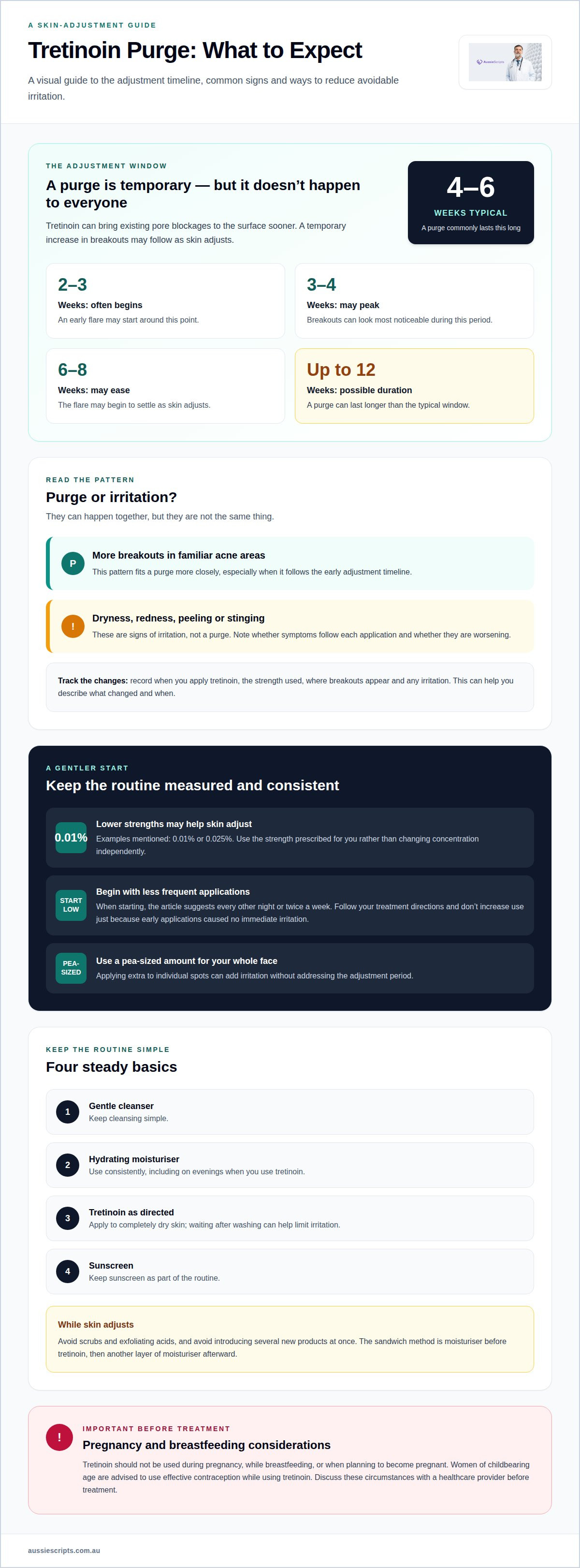
A tretinoin purge is a temporary increase in visible breakouts after treatment begins. Tretinoin speeds the movement of skin cells through pores, bringing existing blockages to the surface sooner. A purge typically lasts about 4 to 6 weeks. It commonly starts around weeks 2 or 3, may peak around weeks 3 to 4, and can ease around weeks 6 to 8. In some cases, it can last up to 12 weeks.
The timing can help explain why a breakout soon after starting tretinoin may be part of the adjustment period. However, not every new spot is a purge. Breakouts in areas where acne usually appears fit this pattern more closely than irritation or spots in areas that are usually clear. Track where changes occur and when they begin. These details can help distinguish a temporary flare from another skin reaction.
Dryness, redness, peeling, or stinging can also occur as skin adjusts. These are signs of irritation, not a purge, which means more breakouts. They may happen alongside acne changes, especially if tretinoin is introduced too frequently or the skin barrier becomes irritated. Note whether symptoms follow each application and whether they are worsening.
Introducing tretinoin gradually can give skin time to adjust. Starting with a lower strength, such as 0.01% or 0.025%, may help reduce purge symptoms. Use the strength prescribed for you rather than changing concentrations independently. A stronger product does not make the adjustment period something to rush through; persistent irritation can make consistent use harder.
Frequency matters, too. When starting treatment, applying tretinoin every other night or twice a week can give skin time to adjust. Follow your treatment directions, and don’t increase use just because a few applications caused no immediate irritation. Use a pea-sized amount for your whole face rather than applying extra to individual spots.
Pregnancy and breastfeeding are important considerations before starting treatment. Tretinoin should not be used during pregnancy, while breastfeeding, or when planning to become pregnant. Women of childbearing age are advised to use effective contraception while using tretinoin. Discuss these circumstances with a healthcare provider before treatment. A gradual-start routine does not make tretinoin appropriate in these situations.
When managing the tretinoin purge period, keep a simple record of application days, strength, breakout locations, and irritation. A change that follows the expected early timeline may differ from worsening irritation or breakouts that continue beyond the usual adjustment period. This record can help you describe what changed and when.
Does tretinoin always cause irritation or skin purging?
No. Some people experience a purge, dryness, redness, peeling, or stinging, while others have little irritation. A purge means a temporary increase in breakouts; irritation affects the skin’s comfort and appearance. These changes can occur together, but one doesn’t prove the other. Tretinoin-related irritation is commonly an early tolerability effect, not necessarily an allergy or a sign that treatment is failing.
A purge may occur when using tretinoin, but experiences vary. However, supporting the skin barrier may help limit avoidable irritation. Keep your routine simple: use a gentle cleanser, a hydrating moisturiser, and sunscreen. Avoid introducing several new products at once. If your face feels dry after cleansing, for example, a plain moisturiser can reduce the number of potential irritants in your routine.
Choose a moisturiser that feels comfortable and helps relieve dryness. Hydrating ingredients can support skin comfort, but you don’t need a long ingredient list. Apply moisturiser consistently, including on evenings when you use tretinoin. If a product stings or seems to worsen redness, stop using it and note the reaction. That record can help distinguish a product response from changes associated with tretinoin.
Which skincare ingredients should you avoid while using tretinoin? Avoid scrubs and exfoliating acids, which can add irritation to a routine that already includes tretinoin. Leave other potentially irritating products out of your routine unless they’ve been recommended for your skin.
The sandwich method means applying moisturiser before and after tretinoin. First, apply a layer of moisturiser; then use tretinoin as directed; finish with another layer of moisturiser. This creates a buffer between the product and skin while maintaining moisturising support. It may help if direct application leaves your face dry or tight. Keep the amount and frequency consistent with your prescribed directions.
Watch the pattern, not just one symptom. Mild dryness after application differs from persistent burning, marked redness, or discomfort that interferes with routine activities. Record which products you used, when symptoms appeared, and whether moisturiser changed how your skin felt. Don’t respond to every breakout by adding another active ingredient. That can make it harder to identify what’s causing irritation.
A practical routine has a few stable parts: gentle cleansing, moisturiser, tretinoin used as directed, and sunscreen. Keep scrubs and exfoliating acids aside while your skin adjusts. If irritation is making treatment difficult to manage, an online medical consultation can provide a way to discuss your symptoms with an Australian-registered doctor.
Why tretinoin can cause an initial increase in breakouts
During an early flare, keep tretinoin use at the prescribed frequency and avoid adding acne treatments on impulse. Tretinoin-related breakouts usually last two to six weeks, so track their timing and location as they develop.
Causes of an Initial Breakout Increase
Tretinoin changes how skin cells move through pores, which can bring existing blockages to the surface sooner. As a result, acne may look temporarily worse after treatment starts. An early flare doesn’t automatically mean tretinoin is unsuitable or that you need more product. Applying extra can add irritation without addressing the underlying adjustment.
Breakouts may appear as clogged pores develop into visible pimples. The change can feel sudden, but it may reflect acne that was already developing beneath the skin before you started tretinoin. For example, a spot in an area where you often get acne may fit this pattern. Tretinoin-related breakouts usually last two to six weeks, although timing alone can’t identify every skin reaction.
Manage the flare by keeping your routine stable. Use tretinoin only as directed, and don’t increase the amount or frequency to clear spots faster. Use a gentle cleanser and moisturiser, and avoid scrubs or exfoliating acids that can add irritation. Leave individual spots alone rather than squeezing or picking them, which can further inflame the skin.
Purging Versus Regular Breakouts
A purge is a temporary increase in acne during the early adjustment to tretinoin; regular breakouts may follow a different pattern. Compare new spots with your usual acne: their location, appearance, and timing offer useful clues. A flare in familiar acne-prone areas differs from new breakouts in places that were previously clear.
Keep a simple record of when you apply tretinoin and where new spots appear. For example, note whether blemishes are limited to your usual forehead or chin areas or appear elsewhere. Record redness, peeling, or stinging separately, as these symptoms indicate irritation rather than acne lesions. A dated note or photo can make changes easier to compare.
Don’t treat every new spot as proof of purging. Breakouts that spread to unfamiliar areas, keep worsening, or continue beyond the usual early window deserve closer attention. Don’t add another active ingredient to test a theory; it may make the cause harder to identify. If acne becomes intense or irritation is difficult to tolerate, discuss the pattern with a healthcare provider. Bring your application record and product list.
Applying tretinoin to completely dry skin
Apply tretinoin at night to completely dry skin. After washing your face, wait 20 to 30 minutes before applying it. This pause gives water on the skin time to evaporate. Applying treatment while your face is still damp can increase irritation, so don’t treat a freshly washed, wet face as ready.
Use the waiting time to complete another part of your evening routine, such as brushing your teeth. Then check that your face feels dry, including around your nose and hairline. If it still feels damp, wait longer. The aim is to apply tretinoin to dry skin, not to follow the clock while moisture remains.
For a simple sequence, wash your face, let it dry fully, and apply tretinoin according to your prescribed directions. Use the amount and frequency recommended for your treatment. Don’t apply extra product because a particular area has breakouts. A thin, even application is different from repeatedly covering individual spots.
- Wash: Cleanse your face gently at night.
- Wait: Allow 20 to 30 minutes after washing before applying tretinoin.
- Check: Make sure your skin feels completely dry.
- Apply: Follow your treatment directions and use the prescribed amount.
The instruction to wait after washing is about skin moisture, not a requirement to leave your face untreated for a set period after applying tretinoin. The usual routine places application at night, 30 minutes after washing. If your own directions differ, follow those directions rather than adding extra steps or changing the schedule.
Dry skin also means not applying tretinoin immediately over damp skincare products. For example, after rinsing your face or applying a water-based product, let your skin dry before applying tretinoin. If you use moisturiser, place it in your routine according to your treatment directions. Don’t mix tretinoin into another product unless directed.
Consistency makes reactions easier to interpret. If you apply tretinoin to dry skin one evening and damp skin another, irritation may be harder to assess. Keep the time between washing and application steady, and note any dryness, redness, or stinging alongside the timing. This gives you a clearer record than changing several routine steps at once.
If you forget to wait and your face is still damp, pause until it dries rather than applying tretinoin immediately. Don’t compensate by using more later. The key points are simple: apply at night, allow 20 to 30 minutes after washing, and check that your skin is completely dry before treatment.
When to consult a healthcare provider
Intense breakouts after 3 months of tretinoin use are a reason to contact a healthcare provider. The usual early adjustment period should not be treated as an explanation for every worsening flare. A provider can assess whether the pattern fits acne, irritation, or another skin concern, and review how you’re using the treatment.
Seek advice sooner if irritation makes it difficult to follow your prescribed directions. Describe symptoms such as persistent redness, peeling, stinging, or discomfort, and explain when they started. These details can help distinguish a manageable adjustment from a reaction that needs a treatment review. Don’t increase the amount or frequency to compensate for spots that remain.
Before an appointment, prepare a concise record. Include when you started tretinoin, how often you apply it, the product strength, and where breakouts appear. Note whether symptoms follow application and list other skincare products, including scrubs or exfoliating acids. If you have dated photos, they can show how the affected areas have changed.
A healthcare provider can use this information to review your routine and symptoms. For example, breakouts limited to familiar acne-prone areas differ from widespread irritation or new spots in previously clear areas. Mention whether you apply tretinoin to completely dry skin and whether moisturiser changes dryness or stinging. Specific observations are more useful than describing every change simply as a “purge”.
Don’t wait for a time threshold if symptoms are already intense or difficult to tolerate. The 3-month point is a clear reason to seek review for intense breakouts, not a requirement to endure worsening symptoms until then. Keep using tretinoin only as directed while arranging advice, and don’t add another active product to test whether it helps. That may further complicate the picture.
Mention pregnancy, breastfeeding, or plans to become pregnant before continuing treatment. These circumstances affect whether tretinoin should be used, so raise them even if your appointment focuses on acne. If you’re unsure how to describe a reaction, write down the exact symptom, its location, and the application day it followed.
Use the consultation to clarify what the next step should be: whether your application routine needs review, whether irritation requires attention, or whether another cause needs consideration. The key takeaway is straightforward: contact a healthcare provider for intense breakouts after 3 months of use, and seek advice earlier when symptoms are severe or interfere with treatment.
Aussie Scripts: Standard Script
Aussie Scripts’ Standard Script service provides online access to a doctor for prescription needs. If you’re using tretinoin and need a prescription-related consultation, you can discuss your treatment and concerns through this service. A doctor can consider your circumstances and determine the appropriate next step; a prescription isn’t guaranteed.
For intense breakouts after 3 months of tretinoin use, or troublesome irritation, seek a healthcare provider’s assessment rather than changing your dose yourself. Prepare details about your application routine, symptoms, and other skin-care products to support the discussion.
For prescription support, visit aussiescripts.com.au.
Make your next step a considered one
Use your experience with tretinoin to guide a focused discussion, rather than making several changes to your routine at once. Note what you want help deciding, such as whether to continue your current approach or discuss a prescription concern. A clear question can make a healthcare conversation more useful.
Managing the tretinoin purge period also means knowing when you need prescription support. Aussie Scripts offers Standard Script and Express Script services, as well as Medical Certificates. These options address different needs, so choose the one that fits your reason for seeking support. A consultation gives you an opportunity to discuss your circumstances, but doesn’t guarantee a particular prescription or outcome.
If you’re ready to discuss prescription support, contact Aussie Scripts. A measured next step can help you approach treatment decisions with greater clarity.
Frequently Asked Questions
Why does tretinoin purging or tretinoin redness occur?
Tretinoin can bring existing pore blockages to the surface sooner, while redness may reflect irritation as skin adjusts. These are related to treatment, but they aren’t the same reaction. New spots are breakouts; redness without new acne lesions is irritation. Note whether redness appears after applying tretinoin, where it occurs, and whether it changes with moisturiser. These details can help a healthcare provider assess the pattern.
If I start with a low concentration, will this help minimise symptoms?
Starting with a lower strength may help reduce purge symptoms, but it can’t ensure you’ll avoid irritation or breakouts. Tretinoin strengths of 0.01% or 0.025% may be used as lower-strength starting options. Use the strength prescribed for your situation, and don’t switch concentrations or increase application frequency without advice. If symptoms develop, record when they began and how they relate to application rather than changing several parts of your routine at once.
Should I apply moisturiser before or after tretinoin?
You can apply moisturiser before and after tretinoin using the sandwich method. For example, apply moisturiser, use tretinoin as directed, then apply another layer of moisturiser. This may support skin comfort if dryness is a concern. Keep the application order consistent so you can observe how your skin responds. Follow the directions you were given, especially if they specify a different routine for your treatment.
What does a normal tretinoin purge look like?
A purge usually means a temporary increase in acne lesions, often in areas where you already tend to break out. It commonly begins around 2 or 3 weeks after starting tretinoin, and the flare usually lasts two to six weeks. For instance, new spots on a familiar acne-prone area may fit the pattern. Record the location and timing; a change in areas affected is useful information to discuss with a healthcare provider.
How can you tell a tretinoin purge from irritation or an allergic reaction?
A purge involves more acne lesions, while irritation can involve redness, dryness, peeling, or stinging. Symptoms can overlap, so redness alone can’t establish whether a reaction is an allergy. Note whether the change is mainly new spots or skin discomfort, and whether it follows tretinoin or another product. If a reaction is worsening or difficult to interpret, avoid changing your routine further and discuss the symptoms with a healthcare provider.
Can moisturiser or the sandwich method reduce tretinoin irritation?
Applying moisturiser before and after tretinoin may help minimise irritation by supporting skin comfort. Choose a hydrating moisturiser that doesn’t sting, and keep other products consistent while you assess the effect. Avoid adding scrubs or exfoliating acids, which can contribute to irritation during tretinoin use. If moisturiser itself seems to trigger discomfort, note its ingredients and when you applied it, then discuss the reaction with a healthcare provider.
When should you stop tretinoin or see a doctor for worsening acne or irritation?
Contact a healthcare provider if intense breakouts continue after 3 months of tretinoin use, or sooner if irritation is difficult to tolerate. Don’t increase your dose or frequency to try to control worsening acne. Record the dates symptoms began, application frequency, and other products used. If you’re pregnant, breastfeeding, or planning to become pregnant, discuss tretinoin use with a healthcare provider because it should not be used in these circumstances.
Disclaimer
The information provided by AussieScripts is for general informational purposes only and does not constitute medical advice, diagnosis, or treatment. For advice tailored to your specific symptoms or health concerns, please consult one of our doctors or your regular GP.
