Online paediatrician referrals for children in Australia
Learn how an online paediatrician referral in Australia works, what an assessment involves, how referrals relate to Medicare rebates, and how to prepare.

A referral can help your child access specialist paediatric care, but it does not determine how soon they will be seen. To get an online paediatrician referral in Australia, a practitioner assesses your child and can prepare a referral letter if specialist care is appropriate. The wait depends on appointment availability.
When you are concerned about your child’s development, behaviour or health, it helps to know what to do next. An online assessment can clarify whether a referral may be suitable and what information a specialist needs. A referral alone does not secure an appointment or a Medicare rebate.
This guide explains how online assessments, GP referrals, referral letters and Medicare rebates work in Australia. It covers what practitioner support can involve, when an online consultation may be suitable and when your child may need in-person care.
Key Takeaways
- Understand how a GP referral relates to specialist access and Medicare rebates, and what each step does.
- Learn what an online doctor may consider when assessing whether a referral is suitable for your child.
- Prepare the relevant health and developmental information to support a clear referral request.
- Find out what a referral letter is used for and what to consider when receiving and sending it.
- See how a digital Specialist Referral can support the next step when specialist care is appropriate.
GP referrals and Medicare rebates
To get an online paediatrician referral in Australia, a GP can assess your child, record the concern and prepare a referral letter when specialist care is appropriate. A valid referral is generally required to claim a Medicare rebate for a specialist paediatrician consultation. The letter supports access to specialist care, but it does not book an appointment or determine how soon your child will be seen.
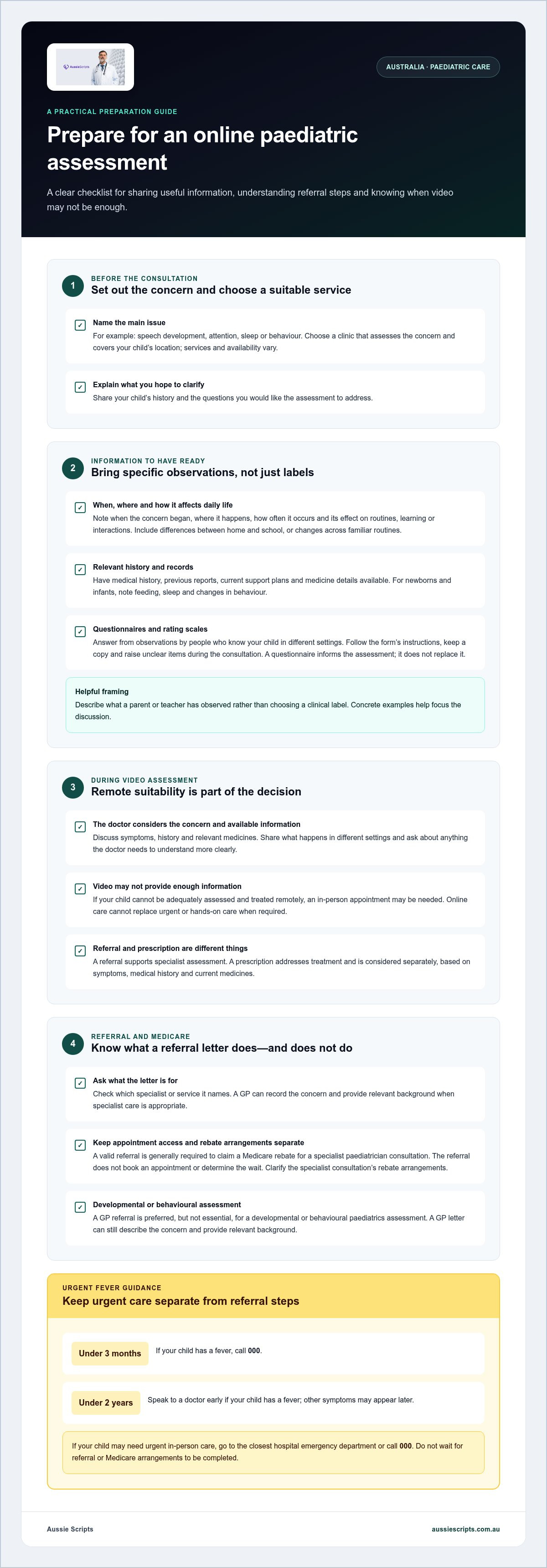
At the GP appointment, explain the concern and when it began. Share relevant medical history and specific examples, such as recurring symptoms, changes in sleep or communication difficulties. Ask what the referral is for and which specialist or service it names. The referral and Medicare claim are separate, so clarify the rebate arrangements for the specialist consultation.
Children may need care at different stages, from newborn and infant concerns to developmental or behavioural questions later in childhood. A GP referral is preferred, but not essential, for a developmental or behavioural paediatrics assessment. A GP letter can still describe the concern and give the specialist relevant background.
For newborns and infants, note feeding, sleep and changes in behaviour before a consultation. For older children, record when a concern occurs and how it affects routines, learning or interactions. Early intervention improves long-term functional outcomes in the vast majority of paediatric conditions. Specific examples help practitioners understand why you are seeking care.
Fever needs prompt attention in some circumstances. Speak to a doctor early if a child under two years old has a fever, because other symptoms may appear later. If a child under three months old has a fever, call 000. If a child may need urgent in-person care, go to the closest hospital emergency department or call 000.
In a video consultation, a doctor can discuss symptoms and consider whether remote assessment is suitable. If your child cannot be adequately assessed and treated by video, they may need an in-person appointment. The doctor may need information that cannot be gathered remotely. An online paediatrician referral in Australia can support the next step when specialist assessment is appropriate, but it cannot replace care requiring an in-person assessment.
Medication can also be discussed during telehealth. Before deciding whether prescribing is appropriate, the doctor considers your child’s symptoms, medical history and current medicines. A referral supports specialist assessment, while a prescription addresses treatment. Have a current medication list ready, including medicine names and how your child takes them.
Keep urgent decisions separate from referral and rebate arrangements. The advice is to call 000 if a child under 3 months old has a fever. A referral letter concerns access to specialist assessment, while a video consultation is suitable only when the doctor can adequately assess and treat the child remotely. If the doctor cannot do so, an in-person appointment may be needed. These are separate considerations: the response to a fever does not depend on completing referral steps or clarifying a Medicare claim, and specialist care does not replace urgent attention when it is needed.
Online doctor assessment and referral suitability
An online paediatrician referral in Australia can start with an assessment by a doctor through a telehealth clinic. Clinics offering online paediatrician consultations differ in the children they see and concerns they assess. Before booking, identify the main issue, such as speech development, attention, sleep or behaviour, and choose a service suited to that concern.
A child can have a developmental or behavioural paediatrics assessment without a GP referral, although a referral is preferred. Explain your child’s history and what you hope the assessment will clarify. A referral may help organise relevant records and describe why specialist input is being sought.
During a video consultation, the doctor may ask when the concern began, where it occurs and how it affects daily life. Describe differences between home and school, or changes across familiar routines. Have previous reports, current support plans and relevant medicine details available. Specific examples help focus the assessment.
Questionnaires and rating scales can organise observations about a child’s behaviour or development. Describe what happens, how often and in which setting. If a form asks about attention, report what a parent or teacher has observed rather than choosing a clinical label. A questionnaire provides information but does not replace the doctor’s assessment.
Complete forms using observations from people who know your child in different settings. Follow each rating scale’s instructions and answer consistently. Keep a copy of your responses and raise unclear items during the consultation. This gives the doctor information to consider alongside your child’s history and your family’s concerns.
Online paediatrician referrals in Australia are available through services that cover the child’s location. Availability across states and territories depends on the clinic. The doctor also considers whether video provides enough information for the assessment. A child who cannot be adequately assessed and treated by video may need an in-person appointment.
A video consultation cannot provide every part of an in-person assessment. If the doctor cannot assess the child adequately or determine an appropriate next step remotely, in-person care may be needed. An online paediatrician referral in Australia can help organise specialist care when remote assessment is suitable, but it cannot replace urgent or hands-on care where required. For a digital referral document after an assessment, an online Specialist Referral may support the next step.
A paediatric specialist may provide a prescription or refer your child for pathology or radiology tests after a consultation. These are possible follow-up steps, not guaranteed outcomes. Explain why you are seeking specialist input and ask whether either option is appropriate for your child. If the specialist recommends one, ask what the prescription or test referral is intended to address and what happens next. The consultation may lead to a prescription, a pathology or radiology test referral, or neither.
Referral requirements and GP referral forms
To request a paediatrician referral in Australia, book a GP appointment and explain the concern, such as delayed speech, learning difficulties or recurring symptoms. The GP can assess your child and prepare a referral letter when specialist input is appropriate. For developmental or behavioural paediatrics, a GP referral is preferred but not essential for an assessment.
Referral paperwork varies between practices and specialist clinics. A letter usually identifies the child, explains the reason for referral and includes relevant medical history. Ask the receiving clinic how it accepts referral documents, then follow its instructions. A referral helps the specialist understand the request, but does not book an appointment or guarantee a Medicare rebate.
For an online appointment, a parent or guardian usually provides the child’s details and explains the reason for seeking care during booking. The clinic then outlines the consultation process. Read the appointment instructions, including how to join the video consultation and submit documents. Keep the referral letter handy to provide or discuss if requested.
Prepare records that explain your child’s situation. A short timeline can make changes easier to describe. Include relevant medical history and previous assessment reports. For developmental concerns, examples from home, childcare or school can show how the issue affects daily activities and learning. If someone else has observed the concern, note what they saw and when.
- Have the child’s identifying details and current medicines ready.
- Keep referral letters, test results and previous reports accessible.
- Write down the main concern and examples you want to discuss.
- Have questions about the referral or rebate ready for the GP or clinic.
Use a phone, tablet or computer with a working camera, microphone and internet connection. Test the sound and video before the appointment, and choose a quiet space where your child can be seen and heard. If the connection drops, follow the clinic’s instructions to reconnect or continue the consultation.
Protect your child’s privacy by joining from a private room and limiting who can hear the discussion. Send medical documents only through the clinic’s stated process, rather than leaving them visible on a shared device. Keep your child’s records secure after the session, especially when using a family computer or tablet.
A video appointment can support discussion and referral planning, but it cannot provide every element of an in-person assessment. If the child cannot be adequately assessed by video, the doctor may need to arrange in-person care. A child who may need urgent care should be taken to the closest hospital emergency department or have a parent call 000.
Practitioner referrals and support
A referral process can involve a GP, a paediatrician and the family, each contributing different information. The GP explains why specialist care is being sought, while parents describe how the concern affects daily life. For example, a referral about attention may include observations from home and school. Clear details help the specialist understand the family’s question.
Before the referral is sent, ask the GP to explain its purpose and destination. Check that the letter names the relevant concern and includes useful background, such as previous assessments or current treatment. Keep a copy for your records. If the specialist clinic requests additional documents, having the referral and reports together makes it easier to respond.
After submitting the referral, contact the receiving clinic to confirm it arrived and ask how appointment requests are handled. A referral does not set an appointment date. Find out what information the clinic needs next and how it will contact you. Keep your contact details current so messages about scheduling or documents reach you.
Medicare rebates are separate from referral coordination. A referral may support access to specialist care, but it is not the rebate claim. Ask the practice how the consultation will be billed and what documentation it provides. Keep the referral, appointment details and payment records together to follow the relevant Medicare process accurately.
Practitioners can help families plan next steps after an assessment. A paediatrician’s letter may outline recommendations for the GP to consider, such as follow-up discussions or further evaluation. Ask how the specialist’s findings will be shared with the referring practitioner. This keeps relevant clinicians informed without expecting one appointment to address every concern.
If your child feels anxious about an appointment, explain the process in simple terms beforehand. For example, tell them they will speak with a doctor on screen and can have a parent beside them. Choose a quiet place, check the internet connection and prepare the child’s questions. If your child cannot attend or participate, tell the clinic and ask how to rearrange the consultation.
During the appointment, one parent can describe the main concern while another records the recommendations. Ask the practitioner to explain unfamiliar terms and identify the next action, such as providing a report or booking follow-up. Write down who will take each step. A short written plan helps prevent confusion when several family members or practitioners are involved.
Keep copies of referral documents, note clinic instructions and record follow-up actions. If a specialist recommends sharing information with your child’s GP, ask how that will happen. These steps help you track the referral pathway and carry useful advice into the next appointment.
Referral letter delivery and validity
A referral letter links the reason for your child’s care with the specialist appointment being requested. Check that it identifies your child, explains the concerns and names the intended specialist or service. For example, a referral about speech development should describe the specific communication concern, not simply say that an assessment is needed.
How the referral is delivered depends on the GP practice and receiving clinic. The practice may send the letter or give it to you to forward. Follow the clinic’s instructions for its preferred method, such as uploading a document or using an accepted digital channel. Keep a copy and note when it was sent.
For an online booking, enter your child’s details accurately and use the same name as on the referral. If the telehealth service asks for documents before the appointment, submit the referral and relevant reports through its stated process. Keep the confirmation message so you can find the booking details and see which documents were received.
A referral is most useful when it describes the current reason for specialist care. If your child’s concerns have changed since the GP wrote it, such as new speech difficulties or another developmental concern, tell the clinic and referring GP. Updated information can help the specialist understand the current request rather than relying on an earlier description.
There is no single validity period that applies to every referral in every situation. The receiving clinic’s requirements and the referral’s relevance to the appointment both matter. Ask the practice handling the booking what it needs for the specialist consultation. If updated information is required, the GP can revise the letter to reflect your child’s current concerns.
Keep the referral with supporting records, such as previous assessments, school observations or a list of current medicines. Send only documents relevant to the appointment. Use the clinic’s secure submission method, and avoid sharing your child’s medical information through an unrelated platform or shared account.
Before the appointment, confirm the booking details, check that the referral has reached the intended clinic and keep the letter accessible during the video consultation. If the appointment changes or your child’s needs shift, update the clinic with relevant information. These steps help keep the referral aligned with the care being sought.
If you need a digital referral document for specialist care, request a Specialist Referral.
Aussie Scripts: Standard Script
Aussie Scripts offers Standard Script and Specialist Referral options for people seeking digital healthcare support. If your child needs a referral letter after an online assessment, a Specialist Referral may help with that next step. A referral supports access to specialist care, but does not replace the paediatrician’s assessment or guarantee an appointment or Medicare rebate.
Standard Script is a separate option for prescription needs. It is not a substitute for urgent assessment or specialist paediatric care. Choose the service that matches your immediate need, and have relevant medical details ready for the consultation.
For information about these digital services, visit aussiescripts.com.au.
Make your child’s next appointment more focused
Before arranging an online paediatrician referral in Australia, write down the main question you want the specialist to address. A concise note about what has changed, what support your child already receives and what you hope to understand can help focus the next discussion. Where appropriate, involve your child in preparing, so they know what to expect and can share their concerns in their own words.
Use the next step that fits the care needed. If you’re seeking help with a digital referral, contact Aussie Scripts for support. For urgent symptoms, seek urgent medical care rather than waiting for a routine online appointment. Keeping the purpose of the referral clear can help you make practical decisions as your child’s care progresses.
Contact Aussie Scripts for support with your next step. A clear question is a useful place to begin.
Frequently Asked Questions
What is the cost?
The cost of paediatric care varies by provider and appointment type, and depends on whether a Medicare rebate applies. A rebate may reduce the out-of-pocket cost of an eligible specialist consultation, but may not cover the full fee. Keep the specialist’s fee and any rebate information separate from costs for related services, such as tests or follow-up appointments. Aussie Scripts’ service fees are separate from a paediatrician’s consultation costs.
When is a GP referral required for a paediatrician in Australia, including for Medicare rebates?
A valid referral is generally needed to claim a Medicare rebate for a specialist paediatrician consultation. A GP can assess your child and provide a referral letter explaining the reason for specialist care. For developmental or behavioural paediatrics assessments, a GP referral is preferred but not essential to arrange an assessment. Referral requirements and rebate eligibility are separate considerations, so be clear whether you are seeking specialist care or a particular Medicare benefit.
Disclaimer
The information provided by AussieScripts is for general informational purposes only and does not constitute medical advice, diagnosis, or treatment. For advice tailored to your specific symptoms or health concerns, please consult one of our doctors or your regular GP.
