Post-bariatric surgery medical support online and costs
Post-bariatric surgery medical support online can help you discuss hydration, protein, food progression and costs, and choose follow-up suited to your recovery.

What happens when recovery questions concern your next sip, meal or source of protein? Post-bariatric surgery medical support online can help you discuss food progression, hydration and protein needs with a health professional, while keeping advice relevant to your stage of recovery.
It’s reasonable to want clear guidance after surgery, particularly when eating and drinking change as recovery progresses. The initial post-operative nutrition care period is 1-8 weeks, and needs can differ across recovery stages. Online consultations can provide a way to discuss concerns and understand what professional follow-up may be appropriate, but they don’t replace urgent medical assessment when symptoms need immediate attention.
This article explains what online support can cover, from nutrition questions to professional consultations, and how needs may change over time. It also outlines what affects costs, so you can distinguish a general online consultation from ongoing, specialised bariatric care.
Key Takeaways
- Learn what to discuss with a health professional about hydration, protein intake and food progression during recovery.
- Understand how dietitians, therapists and surgical teams can contribute different kinds of follow-up support.
- See how support needs may shift with recovery stage, personal circumstances and treatment goals.
- Identify factors that can affect potential costs, including the type of care and any additional consultations.
- Explore when a Medical Certificate, Standard Script, Express Script or Specialist Referral may be relevant to your next step.
Table of Contents
- Post-operative hydration, protein and food progression
- Professional support from therapists, dietitians, and surgical teams
- How professionals tailor support to needs and recovery stage
- Potential additional costs
- Surgeon, Bariatric GP and Nurse Practitioner consultations
- Aussie Scripts: Medical Certificate
Post-operative hydration, protein and food progression
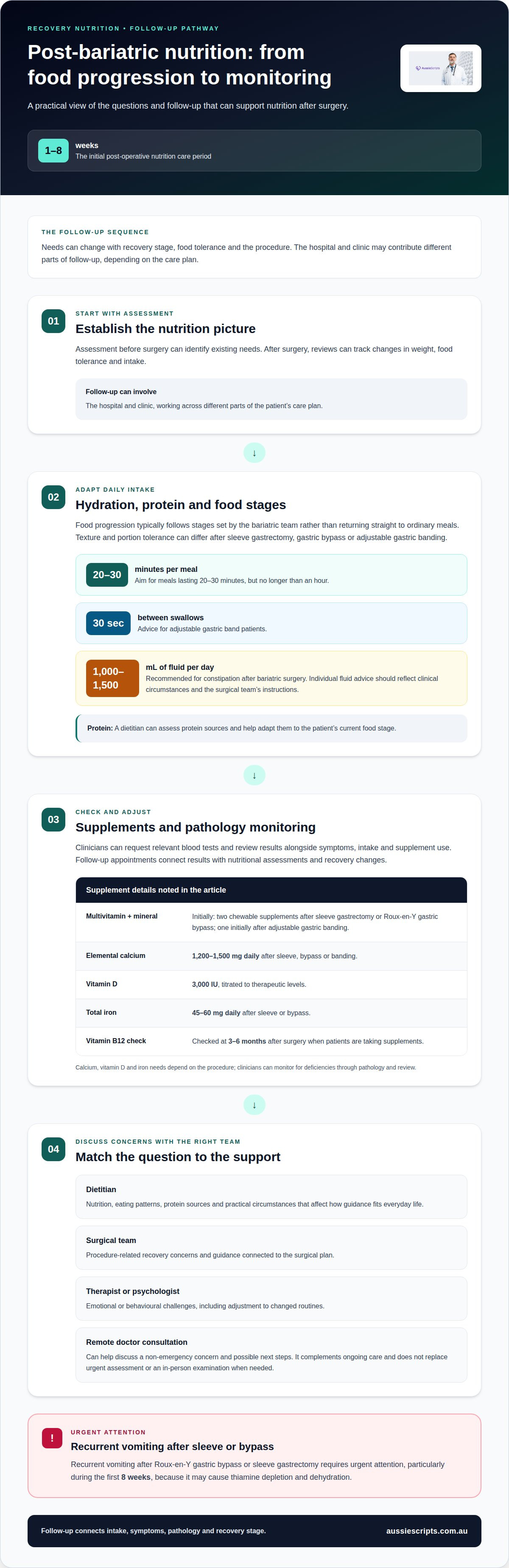
The initial post-operative nutrition care period after bariatric surgery is 1-8 weeks. Nutritional assessment before the operation helps identify existing needs, while post-operative reviews can track changes in weight, food tolerance and intake. The hospital and clinic may contribute different parts of this follow-up, depending on the care plan.
Hydration and protein intake need attention as eating patterns change. A dietitian can assess protein sources and help adapt them to the patient’s current food stage. For constipation after bariatric surgery, the recommended fluid intake is 1000-1500 mL/day. Individual fluid advice should take account of the patient’s clinical circumstances and surgical team’s instructions.
Food progression typically moves through stages set by the bariatric team, rather than returning straight to ordinary meals. Texture and portion tolerance can vary after a sleeve gastrectomy, gastric bypass or adjustable gastric band. Patients are advised to aim for meals lasting 20-30 minutes, but no longer than an hour. Adjustable gastric band patients are advised to wait at least 30 seconds between swallows.
Australian clinicians can arrange pathology tests by issuing requests for relevant blood tests, then review results alongside symptoms, intake and supplement use. Follow-up appointments help connect results with nutritional assessments and changes in recovery.
Vitamin and mineral supplements may be required after surgery. After sleeve gastrectomy or Roux-en-Y gastric bypass, recommendations include two chewable multivitamin and mineral supplements initially; adjustable gastric banding recommendations list one initially. Calcium, vitamin D and iron needs also depend on the procedure. Suggested daily amounts include 1 200-1 500 mg of elemental calcium after sleeve, bypass or banding, and 3 000 IU of vitamin D, titrated to therapeutic levels. Total iron intake of 45-60 mg daily is recommended after sleeve or bypass. Clinicians can monitor for deficiencies through pathology and review; vitamin B12 is checked at 3-6 months after surgery when patients are taking supplements.
Post-operative appointments also provide a point to discuss nausea, vomiting, constipation or difficulty tolerating food. Recurrent vomiting after Roux-en-Y gastric bypass or sleeve gastrectomy requires urgent attention, particularly during the first 8 weeks, because it may cause thiamine depletion and dehydration. Follow-up helps determine whether nutritional advice or further assessment is needed.
Preparation and peer support can also shape nutrition care around surgery. Most bariatric surgery patients are advised to follow a very low energy diet for 2-4 weeks immediately before surgery. A study reported that 84 percent of bariatric patients followed support groups on Facebook. Eligible Australian patients may apply to access part of their superannuation for clinically necessary medical treatment through the Early Release of Superannuation program.
Professional support from therapists, dietitians, and surgical teams
After bariatric surgery, recovery questions can involve nutrition, emotional wellbeing and clinical concerns. Dietitians, therapists and surgical teams contribute different expertise, helping patients connect practical guidance with their recovery plan. Post-bariatric surgery medical support online can complement this care by providing a remote setting to discuss relevant concerns with a doctor.
Dietitian Assessment and Psychosocial Factors
A dietitian assessment considers nutrition, eating patterns and practical circumstances. Work schedules, family responsibilities, mood and access to suitable foods can all affect how well guidance fits everyday life. For example, someone working shifts may need advice that accounts for irregular meal breaks. Discussing emotional and social factors also helps a dietitian understand barriers and tailor recommendations.
Guidance and Recovery Support
Dietitians provide nutrition guidance, while surgical teams address procedure-related recovery concerns. Therapists or psychologists can help with emotional or behavioural challenges, such as adjusting to changed routines. Ongoing follow-up with a surgeon, dietitian and psychologist is recommended, with each professional setting appointment frequency individually.
These roles complement one another rather than replace one another. A nutrition question may call for dietitian input, while a new surgical concern belongs with the treating team. Psychosocial support addresses different needs, such as distress affecting daily routines. Coordinating these perspectives helps keep advice relevant to your circumstances and recovery.
Telehealth Support Services
Australian telehealth services offer remote consultations with Australian-registered doctors. Post-bariatric surgery medical support online can help you discuss a non-emergency concern and understand possible next steps. It complements, but does not replace, continuing care from a bariatric surgeon, dietitian or psychologist.
For example, you can use a remote consultation to explain a concern between planned appointments. A doctor can consider your reported symptoms and relevant health history during the discussion. If the issue needs assessment beyond telehealth, a remote consultation may not be suitable. It cannot replace urgent medical assessment or an in-person examination when one is needed.
Peer support can complement clinical care. The American Society of Metabolic and Bariatric Surgery recommends postoperative support group attendance for bariatric patients. A group can offer a place to discuss practical adjustments with others, while clinical questions remain with the relevant health professional. For instance, a dietitian can assess individual nutrition needs that a peer discussion cannot.
How professionals tailor support to needs and recovery stage
Support plans change as you move through recovery and longer-term weight management. Professionals consider the procedure, current concerns, practical circumstances and personal goals. Post-bariatric surgery medical support online can complement scheduled follow-up by helping you discuss a non-emergency concern between appointments. It does not replace ongoing care from your treating professionals.
Early post-surgery covers the first 0-6 months after bariatric surgery. During this stage, the care team can focus on immediate recovery needs and help patients adjust to changes in daily routines. Active weight loss is categorised as 6-18 months after surgery, when support may address evolving goals and changing circumstances. Maintenance begins 18+ months after surgery, with attention shifting towards sustaining routines and addressing ongoing concerns.
These stages provide context, not a fixed timetable for every patient. A surgeon, dietitian and psychologist may each play a different role in comprehensive care. For example, surgical concerns, nutrition questions and emotional adjustment may require input from separate professionals. Each health professional determines follow-up frequency individually, according to your needs and progress.
When choosing services in Australia, you can consider whether a bariatric centre is accredited by the Metabolic and Bariatric Surgery Accreditation and Quality Improvement Program. Accredited centres must offer professionally supervised support groups. You can also consider whether follow-up includes relevant surgical, dietetic and psychological input, rather than relying on one professional for every concern.
Personal circumstances shape which support is useful. Someone returning to work may need a plan that fits their schedule, while a person experiencing emotional difficulty may need psychological input. A dietitian can adapt nutrition guidance to practical routines, and the surgical team can address procedure-related concerns. These examples show how professionals can align care with your current situation.
Post-bariatric surgery medical support online offers a remote way to discuss questions between planned reviews. A doctor can consider your reported concern and relevant history, then discuss an appropriate next step. Remote support works alongside your established recovery plan, while your surgeon and other treating professionals continue their follow-up. If a concern needs urgent attention, an online consultation is not a substitute for urgent assessment.
Potential additional costs
Online follow-up may involve separate consultations or assessments beyond a bariatric operation. Costs depend on the professional, the consultation’s scope and any additional services required. A dietitian review, surgical appointment and psychological consultation address different needs, so they should not be treated as one bundled cost. For a clear estimate, consider the appointment type, its purpose and whether further care is arranged.
What does online bariatric follow-up cost in Australia, and is it covered by Medicare or private health insurance? Fees depend on the professional and service. Medicare rebates for bariatric surgeons’ and anaesthetists’ fees are partial and do not cover hospital or theatre costs. Private Gold or Silver Plus hospital policies commonly cover bariatric surgery, but that does not establish cover for online follow-up.
Separate surgery-related expenses from ongoing support costs. This figure relates to surgery, not a telehealth appointment or dietitian review. Sleeve gastrectomy patients may also need follow-up care after their operation, with appointment type and frequency shaped by recovery needs.
Some patients seek support with emotional adjustment, changing routines or concerns about weight loss. These needs may involve consultations with different professionals, each addressing a distinct part of recovery. A dietitian may focus on nutrition, while a psychologist can address psychosocial concerns. Costs therefore reflect the type of support involved, not the patient’s goals alone.
Goals may include improving eating routines, managing recovery concerns or maintaining progress after surgery. A clinician’s assessment helps identify the relevant appointment type and whether further follow-up forms part of the care plan. This distinction can prevent surgery, hospital and ongoing consultation costs from being confused in a personal budget.
If you are comparing potential expenses, separate the procedure, hospital and theatre costs from post-operative professional appointments. Medicare rebates for surgeons’ and anaesthetists’ fees are partial, while those rebates do not cover hospital and theatre costs. Private hospital cover applies to bariatric surgery under relevant policies; online follow-up is a separate service with its own fee structure.
Surgeon, Bariatric GP and Nurse Practitioner consultations
Australians can access virtual consultations with Australian-registered doctors. Telehealth can support follow-up discussions, while the bariatric surgeon and other treating professionals remain central to ongoing post-operative care.
A surgeon’s consultation focuses on the operation, surgical recovery and procedure-related concerns. For example, someone who has had sleeve gastrectomy, gastric bypass or adjustable gastric banding may discuss recovery changes with their surgical team. Ongoing follow-up with a surgeon is recommended, with that professional determining appointment frequency individually.
A Bariatric GP can provide medical review alongside the surgical team. A consultation may consider your health history, current concerns and progress after weight loss surgery. The GP can also help coordinate general medical care with your existing post-operative plan. This role differs from the surgeon’s procedure-specific follow-up and does not replace it.
Nurse Practitioners can contribute clinical assessment and recovery support within their professional scope. For instance, before a remote appointment, describe any change in symptoms, its effect on daily activities and relevant surgical details. The clinician can use this information to guide the consultation and identify whether another member of your care team should be involved.
A multidisciplinary approach brings these roles together with dietetic and psychological support. Follow-up with a surgeon, dietitian and psychologist is recommended, with each professional setting appointment frequency individually. A dietitian may address nutrition questions, while psychological input can support psychosocial needs. The surgical team can focus on procedure-related concerns and recovery.
For an online appointment, useful context includes the type of bariatric procedure, when it took place, your current concerns and existing follow-up arrangements. These details help an Australian-registered doctor understand your question. A remote consultation is suited to discussion and clinical review, but it does not provide an in-person physical examination or emergency care.
Clear roles matter after gastric and other bariatric procedures. A surgeon handles surgical follow-up, a Bariatric GP supports broader medical review, and a Nurse Practitioner contributes care within their scope. For example, you can discuss a general health concern with a doctor, while procedure-related recovery remains connected to your surgical team. Online care can complement coordinated follow-up.
Telehealth consultations with Australian-registered doctors can support follow-up alongside a bariatric surgeon, Bariatric GP or Nurse Practitioner. These clinicians provide surgical follow-up, broader medical review and recovery support within their respective roles.
Aussie Scripts: Medical Certificate
Aussie Scripts offers online medical consultations with Australian-registered doctors for health concerns affecting work or daily responsibilities. A Medical Certificate may document a health-related absence if a doctor assesses your circumstances and considers a certificate appropriate. It does not replace bariatric follow-up with your surgeon, dietitian or other treating professionals.
For example, recovery symptoms or another health issue may make it difficult to work or meet usual commitments. During a virtual consultation, an Australian-registered doctor considers the information you provide and determines whether a Medical Certificate is appropriate. A certificate is not automatic and does not provide surgical assessment or ongoing bariatric treatment.
Other offerings may be relevant to separate needs:
- Standard Script: an online prescription option when a doctor determines a prescription is appropriate.
- Express Script: another prescription option, subject to clinical assessment.
- Specialist Referral: may support access to specialist care when the doctor considers a referral appropriate.
These options serve different purposes. A Medical Certificate provides documentation following a consultation, a script relates to prescribed treatment, and a Specialist Referral concerns further specialist care. None replaces the post-operative plan created by your bariatric team. For procedure-related symptoms or recovery questions, your treating team remains central to your care.
Before a virtual appointment, explain your concern, its effect on everyday activities and any relevant medical context. For instance, describe whether the issue relates to a current health concern or a request for documentation. The doctor can assess the matter during the consultation and determine an appropriate outcome. Any certificate, prescription or referral depends on that clinical assessment.
A Medical Certificate may be relevant when a health concern affects work or other responsibilities and you need documentation. A Standard Script or Express Script may suit a separate prescription request, while a Specialist Referral may be considered for specialist care. These are distinct services, not a comprehensive bariatric program. Continue planned surgical and dietetic follow-up for recovery-related care.
Frequently Asked Questions
Still Have Questions?
Online medical support can help clarify a non-emergency concern and identify an appropriate next step. For example, if you are unsure whether a new issue relates to recovery, discuss its timing, impact and relevant procedure with a doctor. Keep your bariatric care team involved in ongoing treatment. For urgent symptoms, an online consultation is not a substitute for prompt medical assessment.
When Is Professional Support Necessary?
Professional support is useful when recovery raises a medical, nutritional or emotional concern that needs assessment. This may include difficulty following the care plan, uncertainty about changing symptoms or challenges adjusting to new routines. A surgeon can address procedure-related questions, while a dietitian or psychologist focuses on their respective areas. Recurrent vomiting after certain bariatric procedures requires urgent attention.
What medical follow-up is recommended after bariatric surgery in Australia?
Ongoing follow-up with a surgeon, dietitian and psychologist is recommended after bariatric surgery. Each professional sets appointment frequency individually, based on their role and your needs. For instance, discuss a surgical concern with your surgeon and nutrition questions with a dietitian. Coordinated care helps keep each consultation focused on the appropriate aspect of recovery.
How often should patients see a bariatric surgeon or GP after weight-loss surgery?
There is no single appointment frequency for every patient in the available guidance. The surgeon determines follow-up frequency individually, considering recovery needs and your care plan. A GP can also contribute to broader medical care, particularly when a concern extends beyond the operation itself. If symptoms change between planned reviews, seek advice rather than waiting for the next routine appointment.
What dietitian and mental health support is recommended after bariatric surgery?
Dietitian support can address nutrition needs and practical challenges with eating after surgery. Psychological support can help with emotional or behavioural concerns linked to changing routines and adjustment. Ongoing follow-up with a dietitian and psychologist is recommended, with each professional deciding appointment frequency individually. For example, if lifestyle changes are difficult, discuss both nutrition and emotional wellbeing with the relevant professionals.
What symptoms after bariatric surgery require urgent medical attention in Australia?
Recurrent vomiting after Roux-en-Y gastric bypass or sleeve gastrectomy requires urgent attention, particularly during the first 8 weeks after surgery. Vomiting can contribute to thiamine depletion and dehydration. Don’t rely on an online consultation to manage an urgent concern. Seek prompt medical assessment; if it is an emergency, call 000 in Australia.
Disclaimer
The information provided by AussieScripts is for general informational purposes only and does not constitute medical advice, diagnosis, or treatment. For advice tailored to your specific symptoms or health concerns, please consult one of our doctors or your regular GP.